
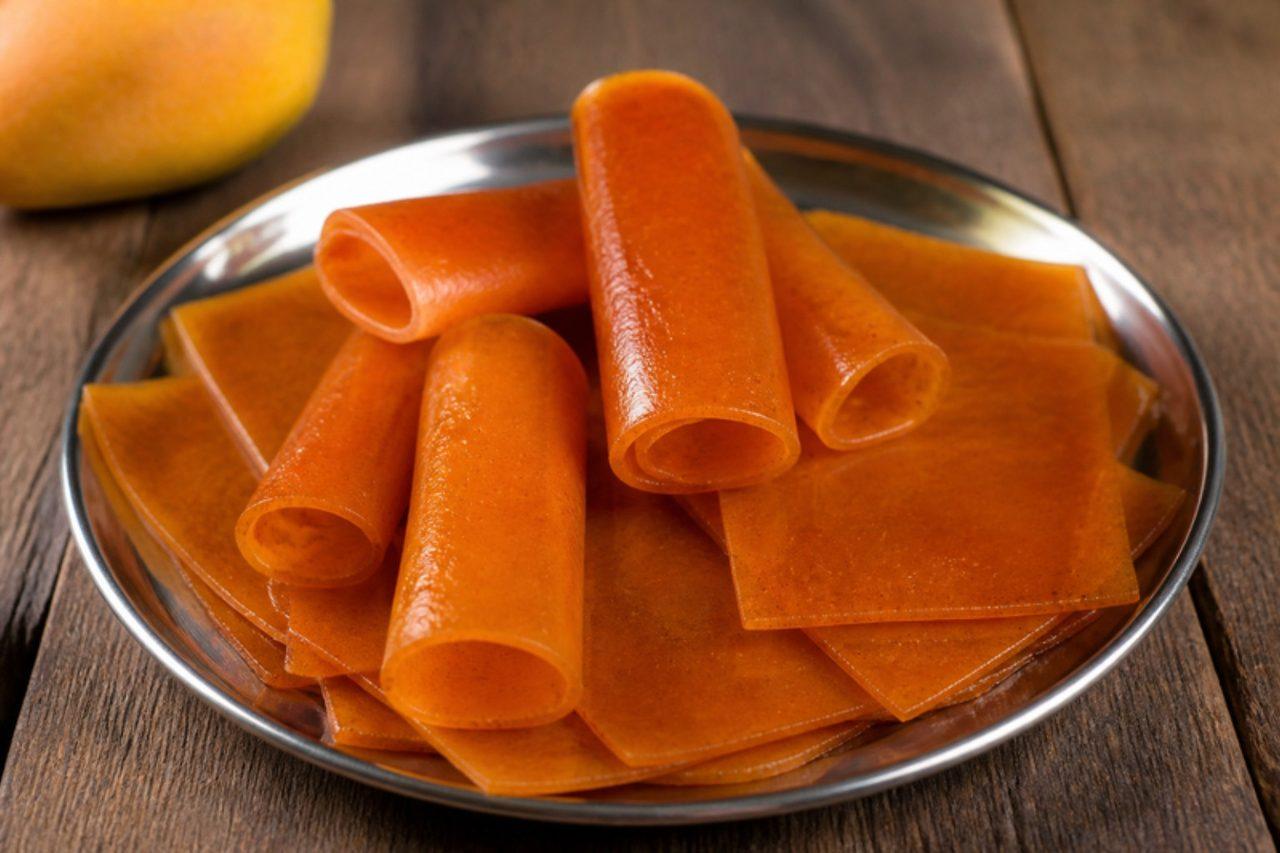
AI-generated image
Aam papad
Mango fruit leather
आम पापड़: chewy, sweet-tart mango leather dried in thin layers on steel thalis through the peak of summer (plus 2–4 days in the sun)



Children in Lucknow, Varanasi and across Uttar Pradesh grew up tearing strips off aam papad from the corner shop, but the homemade kind, made when Dussehri and Langra mangoes are cheap and overripe in June, is in another league: thick, glossy, chewy, deep orange and properly mango-tasting, with a sour edge. Ripe pulp is cooked down with a little sugar and lemon until thick, then spread thinly on greased thalis and left on the terrace. Many families add a new layer every day for a week to build up a thick slab. Eat it as a sweet snack, cut into squares or rolls, or tuck it into a lunchbox. Common mistake: spreading the pulp in one thick layer to save time; the outside dries while the centre stays sticky and can turn mouldy. Chef's tip: no sun? Spread it on a lined tray and dry it in the oven at 60–70 °C, door slightly ajar, for 6–8 hours.
- Total time
- 55 min
- Difficulty
- medium
- Serves
- 16
Ingredients
- 2 ¼ lb ripe mango pulpfrom about 5 sweet, fibre-free mangoes such as Dussehri, Kesar or Alphonso
- 5 ½ oz sugarmore or less, depending on the mangoes
- 1 tbsp lemon juice
- ¼ tsp ground green cardamom (optional)
- 1 pinch black salt (kala namak) (optional)
- 1 tsp neutral oilfor greasing the plates
Shop this recipe on Amazon
What you'll need
Spices & pantry
Fresh ingredients (2)
Links open Amazon in a new tab. As an Amazon Associate, WhatToEat.Today earns from qualifying purchases.
Method
0/6 doneStep 1: Blend 2 ¼ lb ripe mango pulp until completely smooth, then press it through a sieve if the mangoes are at all stringy.
5 minStep 2: Cook the pulp in a wide, heavy pan over a medium heat with 5 ½ oz sugar, stirring often, until the sugar dissolves and the pulp darkens slightly.
5 minStep 3: Lower the heat and keep cooking for 20–25 minutes, stirring and scraping the bottom constantly as it splutters, until thick enough that a line drawn through it with the spoon holds for a few seconds. Stir in 1 tbsp lemon juice, ¼ tsp ground green cardamom and 1 pinch black salt (kala namak).
25 minStep 4: Grease 3–4 large steel plates or trays with 1 tsp neutral oil and spread the pulp in a thin, even layer, about 3 mm thick. Use the back of a spoon to smooth it.
5 minStep 5: Cover loosely with fine muslin to keep off insects and dry in full sun for 2–4 days, bringing it indoors at night. It is done when the top is no longer sticky and the sheet peels off the plate in one piece.
Step 6: Peel the sheet, turn it over and give the underside a few more hours in the sun. Cut into squares or roll it up, wrap in baking paper and store in an airtight jar for up to 6 months; discard any pieces with mould.
5 min
Nutrition per serving
- Calories
- 80 kcal
- Protein
- 1 g
- Carbs
- 20 g
- Fat
- 0 g
- Fibre
- 1 g
Nutrition values are estimates.
KrazyBadal
Good to know
- How long does aam papad take?
- About 55 minutes in total: 20 minutes to prepare and 35 minutes to cook.
- How many people does it serve?
- 16 as written. Change the servings above the ingredients and every amount scales to match.
- Is it vegan?
- Yes. It has no meat, fish, dairy or eggs.
- Is it gluten free?
- Yes, as written. Check the labels on stock, sauces and spice mixes, which sometimes contain gluten.
- Can I make it ahead?
- Yes. It keeps well, so you can cook it earlier in the day or the day before and reheat it.
- What can I use instead of sugar?
- Caster sugar, same amount.
- What can I use instead of lemon juice?
- Lime juice, same amount.
Reviews
No reviews yet. Be the first to cook it.
Rate this recipe
Sign in to rate and review this recipe.
You might also like

Sabudana khichdiSago with peanuts and potato
Sabudana khichdi is the dish that sees Maharashtra through every vrat (fast), from Navratri to Ekadashi, but it's so good that people eat it any day of the week. Soaked sago pearls are tossed in a pan with crushed roasted peanuts, cubes of potato, cumin and green chilli until each pearl turns glassy and separate, then finished with lemon and coriander. It's soft, chewy, nutty and gently hot. Fasting rules vary from family to family, so check yours; this version uses rock salt and no asafoetida, onion or garlic. Traditionally it's cooked in ghee; use ghee instead of oil if you aren't keeping it vegan. Chef's tip: soak the sago in just enough water to cover by the height of the pearls themselves, no more; too much water is the reason khichdi turns into one sticky lump.


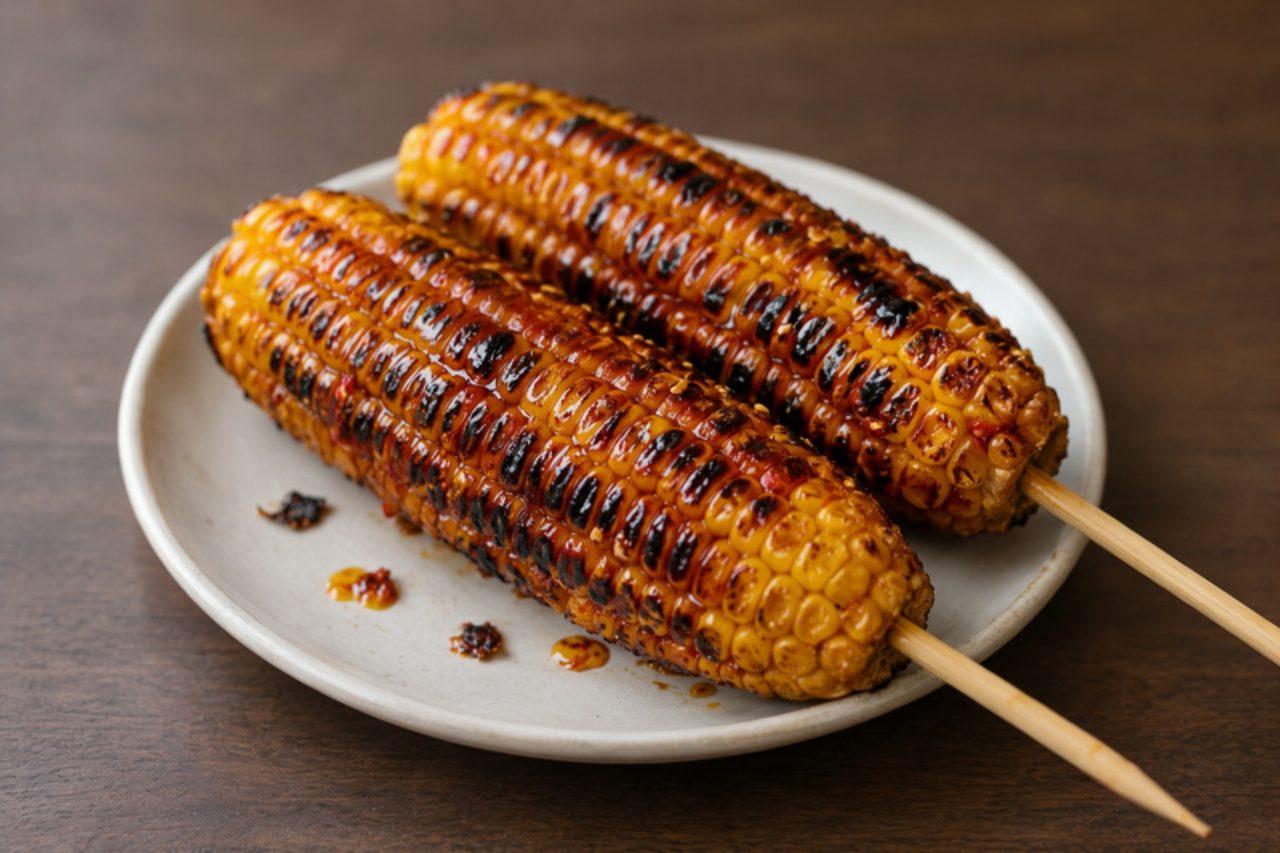
Taiwanese grilled corn
At Raohe and Shilin night markets the grilled-corn stalls are easy to find: look for the queue and the smoky, sweet smell. Cobs are par-cooked, then turned slowly over charcoal while the cook brushes them with a dark glaze of sacha sauce, thick soy paste, garlic and chilli, layer after layer, until the kernels are sticky, slightly charred and deeply savoury. It is eaten hot from a paper sleeve while walking the market. Sacha (shacha) sauce, a Taiwanese barbecue paste, usually contains dried fish and shrimp; vegetarian sacha is sold in Asian shops. Contains soy, wheat and fish. Chef's tip: brush thin coats and turn often; one thick coat burns before the corn chars.
 Taiwanese

Bagara bainganBaby aubergines in peanut sesame sauce
Bagara baingan is a Hyderabadi wedding dish of small aubergines cooked whole in a dark, tangy gravy of roasted peanuts, sesame, dried coconut and tamarind. Unlike a Gujarati stuffed brinjal, the aubergines here are only quartered at the base and fried until silky, then left to soak up a thin-but-rich sauce that is finished with a tempering, the 'baghar' that gives the dish its name. It's sour, nutty and gently spiced, and is served with biryani, bagara rice or plain rice. Chef's tip: choose small, glossy purple aubergines that feel heavy for their size; soft, light ones are full of seeds and turn mushy before the gravy has a chance to cling.