
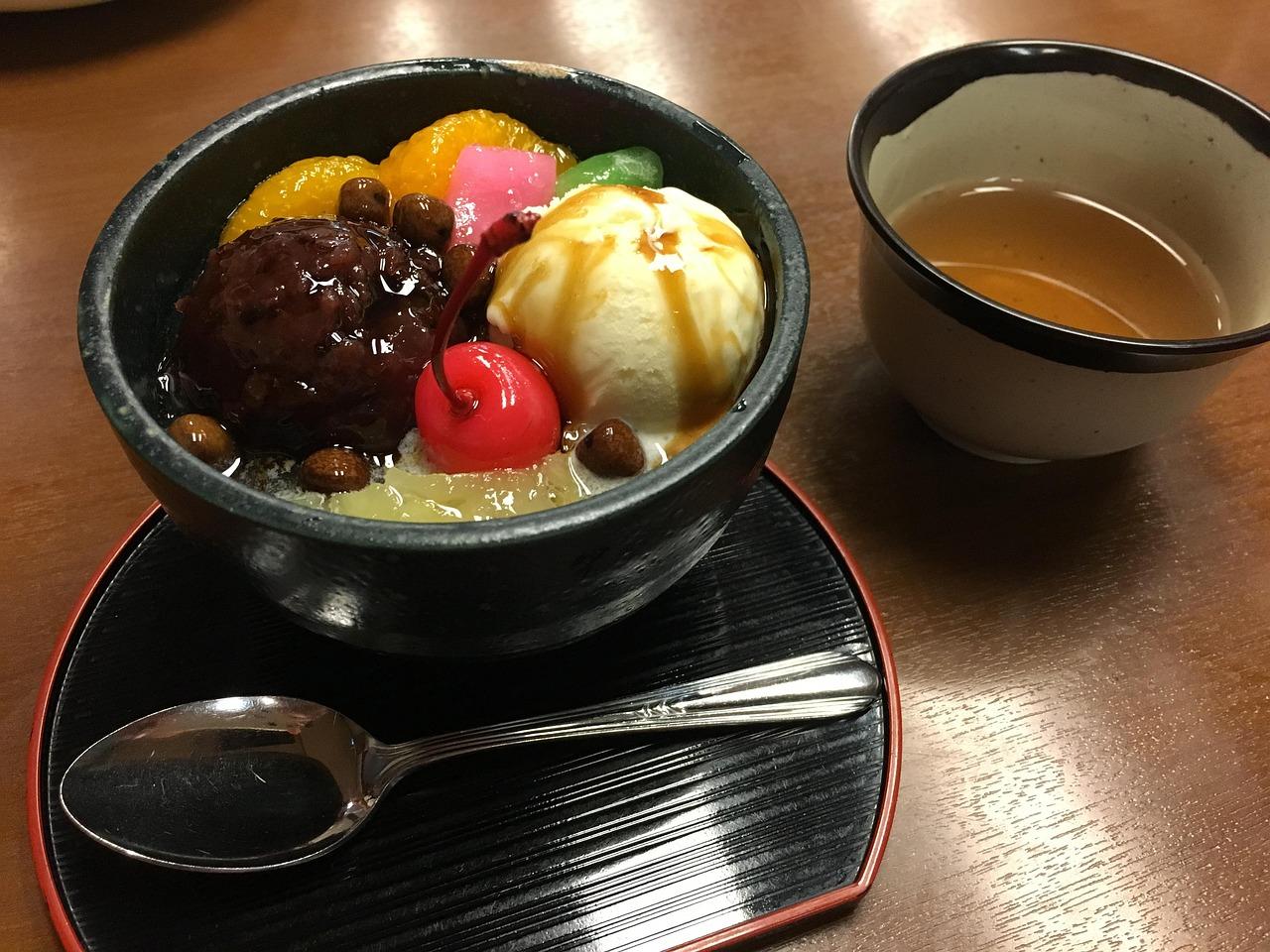
Anmitsu
Agar jelly with red bean
Anmitsu (あんみつ): agar jelly cubes with fruit, red bean paste and black sugar syrup



Anmitsu became a craze in Tokyo's Ginza and Asakusa tea rooms in the 1930s and is still the classic summer order in kanmidokoro, the sweet cafés of old Tokyo. Clear, firm cubes of agar jelly are piled into a bowl with seasonal fruit, a scoop of sweet bean paste and boiled red peas, then drenched in dark, smoky kuromitsu syrup. The common mistake is using gelatin, which melts; agar jelly stays firm and refreshing at room temperature. Chef's tip: make the kuromitsu with Okinawan kokuto black sugar if you can; it gives a deep, almost liquorice-like flavour that muscovado only gets close to.
- Total time
- 30 min
- Difficulty
- easy
- Serves
- 4
Ingredients
For the agar jelly
- ⅛ oz agar powder
- 2 cups water
- 1 tbsp sugar
For the black sugar syrup
- ¼ cup water
To serve
- 4 oz sweet red bean paste
- 10 ½ oz mixed fruitsuch as mandarin segments, strawberries and kiwi
- 4 tbsp boiled red peas (aka endo) or sweet azuki (optional)
Shop this recipe on Amazon
Spices & pantry
Fresh ingredients (1)
Links open Amazon in a new tab. As an Amazon Associate, WhatToEat.Today earns from qualifying purchases.
Method
0/5 doneStep 1: Whisk ⅛ oz agar powder into 2 cups water in a pan with 1 tbsp sugar, bring to the boil and boil for 2 minutes, stirring.
5 minStep 2: Pour into a wet 15 cm square dish and leave to set at room temperature, about 40 minutes, then chill.
40 minStep 3: For the syrup, simmer 2 ⅞ oz Okinawan black sugar or dark muscovado and ¼ cup water for 3–4 minutes, until it coats a spoon. Cool; it thickens as it cools.
4 minStep 4: Cut the jelly into 1.5 cm cubes and divide between 4 bowls.
Step 5: Arrange 10 ½ oz mixed fruit, 4 tbsp boiled red peas (aka endo) or sweet azuki and a scoop of 4 oz sweet red bean paste on top. Pour over the black sugar syrup just before eating.
Nutrition per serving
- Calories
- 200 kcal
- Protein
- 3 g
- Carbs
- 48 g
- Fat
- 0 g
- Fibre
- 4 g
Nutrition values are estimates.
KrazyBadal
Good to know
- How long does anmitsu take?
- About 30 minutes in total: 15 minutes to prepare and 15 minutes to cook.
- How many people does it serve?
- 4 as written. Change the servings above the ingredients and every amount scales to match.
- Is it vegan?
- Yes. It has no meat, fish, dairy or eggs.
- Is it gluten free?
- Yes, as written. Check the labels on stock, sauces and spice mixes, which sometimes contain gluten.
- What can I use instead of sugar?
- Caster sugar, same amount.
Reviews
No reviews yet. Be the first to cook it.
Rate this recipe
Sign in to rate and review this recipe.
You might also like
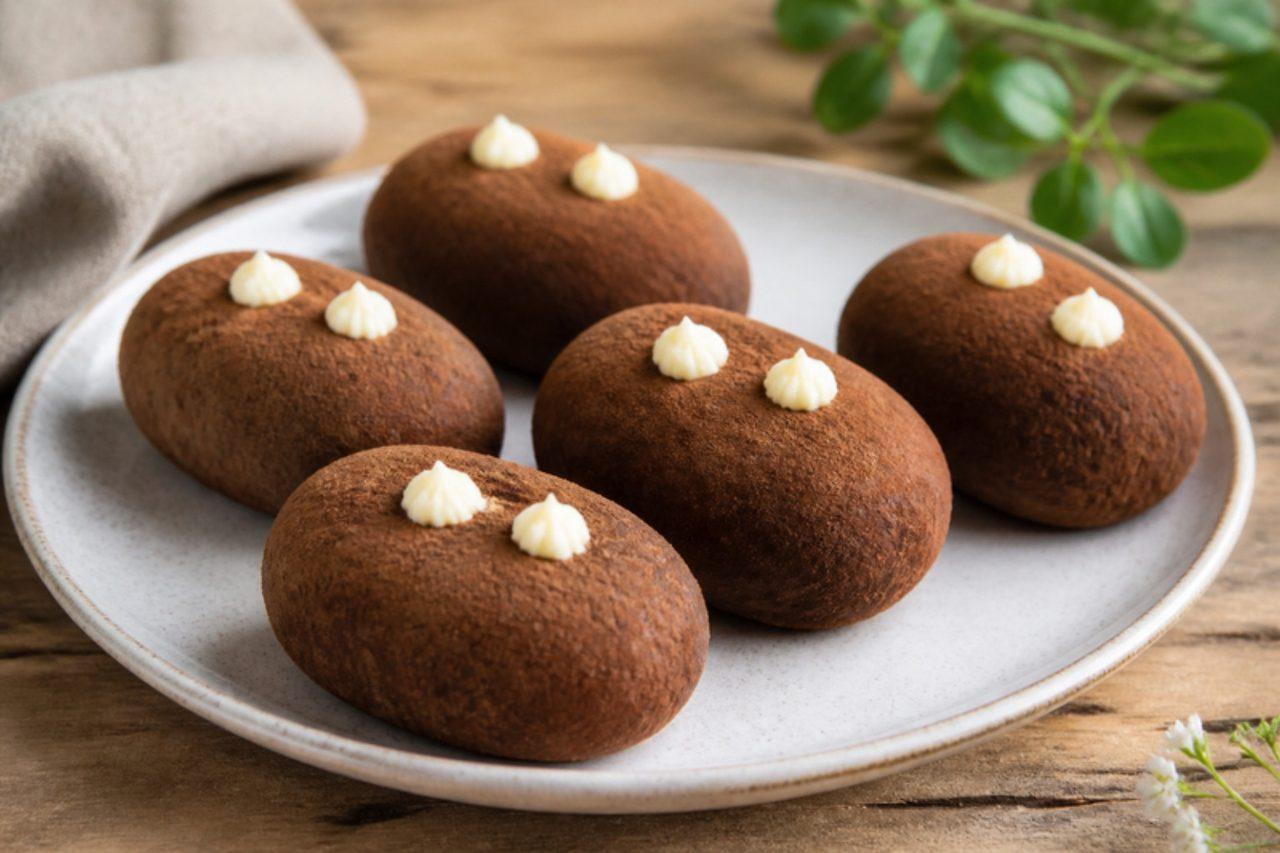
Kartoshka cakeCocoa and cake crumb truffles
Soviet cafés and school canteens sold these knobbly brown 'potatoes' for a few kopecks, and they began as a thrifty way to use up sponge and biscuit trimmings at the bakery. Crumbs are bound with butter and sweetened condensed milk, flavoured with cocoa and vanilla, shaped into little potatoes, rolled in cocoa and finished with two dabs of pale butter cream for the sprouts. They are fudgy and dense like a brownie truffle, need no oven, and children love making them. Traditional bakers added a spoonful of rum, an optional extra for adult batches only; this version is alcohol-free with vanilla. The usual slip is coarse crumbs, which make the potatoes crack, so blitz them as fine as sand. Chef's tip: chill the shaped potatoes for at least 20 minutes so they hold their shape and slice cleanly.
 Russian

Yaki onigiriGrilled rice balls
Yaki onigiri (焼きおにぎり) are rice balls grilled until they form a crisp, toasty crust, then brushed with soy sauce glaze. They are eaten all over Japan, at izakaya, at barbecues and from the freezer section, as a snack or with miso soup. The inside stays soft and steamy while the outside crackles. Best eaten hot, straight from the pan. Chef's tip: let the shaped rice balls dry for 10 minutes before they go in the pan. A drier surface forms a better crust and won't stick, and the glaze goes on only at the end so it doesn't burn.


Undu walaluFried urad dal rings in treacle
Walalu means bangles, and these dark, sticky rings of fried urad dal soaked in kithul treacle are a sweet that Sinhala families bring out for Avurudu and for special almsgivings, often made in large batches by an aunt known for her steady hand. A thick, fluffy paste of ground black gram is piped into loops and fried until crisp, then plunged straight into warm treacle, so the rings stay crunchy on the outside while drinking up the syrup. They taste a little like a darker, smokier jalebi, with a toffee finish from the palm treacle. Watery batter is what ruins them; it spreads into flat blobs, so grind the soaked dal with as little water as possible and beat it until light. This recipe uses no asafoetida, so it is naturally gluten free. Chef's tip: pipe the rings onto small squares of baking paper and lower them into the oil paper and all; the paper peels away in seconds.
 Sri Lankan

Perfect for:Summer coolers