
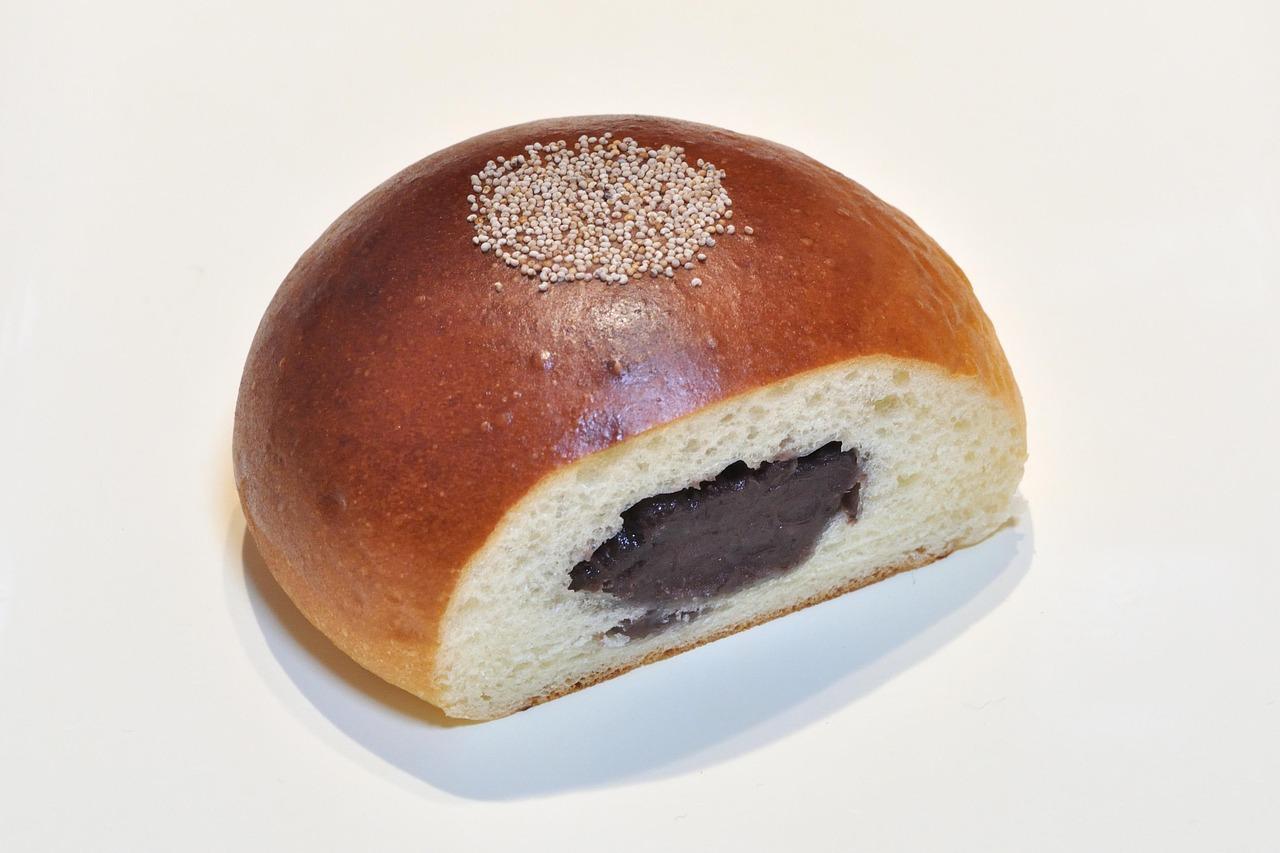
Anpan
Japanese sweet buns filled with red bean paste

Tokyo's Ginza district gave Japan its first sweet bun in 1874, when a bakery there wrapped Western-style bread dough around azuki bean paste, the filling of traditional wagashi; a version topped with a salted cherry blossom was presented to the Emperor Meiji the following year. Anpan (あんパン) is still sold in every Japanese bakery and convenience store, eaten with green tea or milk as an afternoon snack and packed in school bags. The bread is soft, faintly sweet and shiny brown, wrapped round a thick layer of smooth, earthy-sweet red bean paste, with sesame seeds or a pink blossom pressed into a dimple on top. A paste that is too soft is the usual cause of trouble: it oozes out of the seam and leaves a hollow bun, so use a stiff koshian you can roll into balls. Chef's tip: roll the filling into balls and freeze them for 15 minutes before wrapping; firm balls are far easier to enclose neatly and keep the dough an even thickness all round.
- Total time
- 164 min
- Difficulty
- medium
- Serves
- 8
Ingredients
For the dough
- 1 oz caster sugar
- ½ tsp salt
- ⅛ oz instant dried yeast
- 1 eggbeaten
- ½ cup whole milklukewarm
- ⅞ oz unsalted buttersoft
For the filling
- 11 ½ oz smooth red bean paste (koshian)firm enough to roll
To finish
- 1 egg yolkbeaten with 1 tsp milk; for no egg wash, brush with 2 tbsp milk
- 8 salted cherry blossoms (optional)soaked in water for 10 minutes and patted dry
Shop this recipe on Amazon
What you'll need
Spices & pantry
Fresh ingredients (4)
Links open Amazon in a new tab. As an Amazon Associate, WhatToEat.Today earns from qualifying purchases.
Method
0/11 doneStep 1: Mix 9 oz strong white bread flour, 1 oz caster sugar, ½ tsp salt and ⅛ oz instant dried yeast in a bowl. Add 1 egg and ½ cup whole milk and bring together into a soft, sticky dough.
Step 2: Knead for 5 minutes, then work in ⅞ oz unsalted butter and knead for 8–10 minutes more, until smooth, glossy and stretchy enough to pull into a thin sheet.
15 minStep 3: Cover and leave in a warm place for about 1 hour, until doubled.
60 minStep 4: Meanwhile divide 11 ½ oz smooth red bean paste (koshian) into 8 balls of 40 g. Set them on a plate and freeze for 15 minutes to firm up.
15 minStep 5: Knock back the dough, divide it into 8 pieces of about 55 g and roll each into a ball. Cover and rest for 10 minutes.
10 minStep 6: Flatten a dough ball into a 10 cm disc, slightly thicker in the middle. Set a bean ball in the centre, gather the edges up over it and pinch them firmly together. Place seam side down on a lined tray and flatten slightly with your palm. Repeat.
Step 7: Cover and prove for 35–45 minutes in a warm place, until puffy and nearly doubled.
40 minStep 8: Meanwhile heat the oven to 375°F (350°F fan). Brush the buns with 1 egg yolk. Dip the end of a small rolling pin or a bottle cap in flour and press a dimple into the centre of each bun, almost to the filling.
Step 9: Sprinkle a pinch of 1 tsp black or white sesame seeds into each dimple, or press in a cherry blossom 8 salted cherry blossoms.
Step 10: Bake for 12–14 minutes, until deep, shiny golden-brown, the bases sound hollow and the bread reads about 88–194°F.
13 minStep 11: Cool on a rack for 15 minutes before eating. They keep for 2 days in an airtight box, and freeze well.
Nutrition per serving
- Calories
- 250 kcal
- Protein
- 7 g
- Carbs
- 45 g
- Fat
- 5 g
- Fibre
- 3 g
Nutrition values are estimates.
KrazyBadal
Good to know
- How long does anpan take?
- About 164 minutes in total: 150 minutes to prepare and 14 minutes to cook.
- How many people does it serve?
- 8 as written. Change the servings above the ingredients and every amount scales to match.
- Is it vegetarian?
- Yes. It has no meat or fish.
- What can I use instead of strong white bread flour?
- Plain flour, same amount (the dough will be softer and rise a little less).
- What can I use instead of caster sugar?
- Caster sugar, same amount.
Reviews
No reviews yet. Be the first to cook it.
Rate this recipe
Sign in to rate and review this recipe.
You might also like

Miso soup
Miso soup (味噌汁) is drunk every day in homes all over Japan, at breakfast as well as dinner, beside a bowl of rice. The base is dashi; this vegan version uses kombu and dried shiitake instead of bonito, which gives it a deep, rounded flavour. Silken tofu and wakame seaweed are the classic fillings. It takes ten minutes; just remember not to boil the miso. Chef's tip: add the miso at the very end and never let it boil. Boiling kills the miso's fresh, fermented aroma; Japanese cooks say the soup should only 'smile', with the surface barely trembling.


Yaki onigiriGrilled rice balls
Yaki onigiri (焼きおにぎり) are rice balls grilled until they form a crisp, toasty crust, then brushed with soy sauce glaze. They are eaten all over Japan, at izakaya, at barbecues and from the freezer section, as a snack or with miso soup. The inside stays soft and steamy while the outside crackles. Best eaten hot, straight from the pan. Chef's tip: let the shaped rice balls dry for 10 minutes before they go in the pan. A drier surface forms a better crust and won't stick, and the glaze goes on only at the end so it doesn't burn.

ChipaCheese bread rings
In Paraguay you hear 'chipa, chipa!' called by vendors with big baskets on buses and street corners, and every family bakes it for Holy Week, when chipa is the food of Good Friday. Cassava starch, a little cornmeal, butter, eggs and a lot of hard cheese are kneaded into a dough scented with aniseed, shaped into rings or small rolls and baked in a hot oven, traditionally a domed clay tatakua. It's chewy, crisp outside and best warm with cocido (toasted yerba tea). Chef's tip: the dough should feel soft and slightly greasy; add milk a spoon at a time, as too much makes the chipa spread flat.
 Paraguayan
