
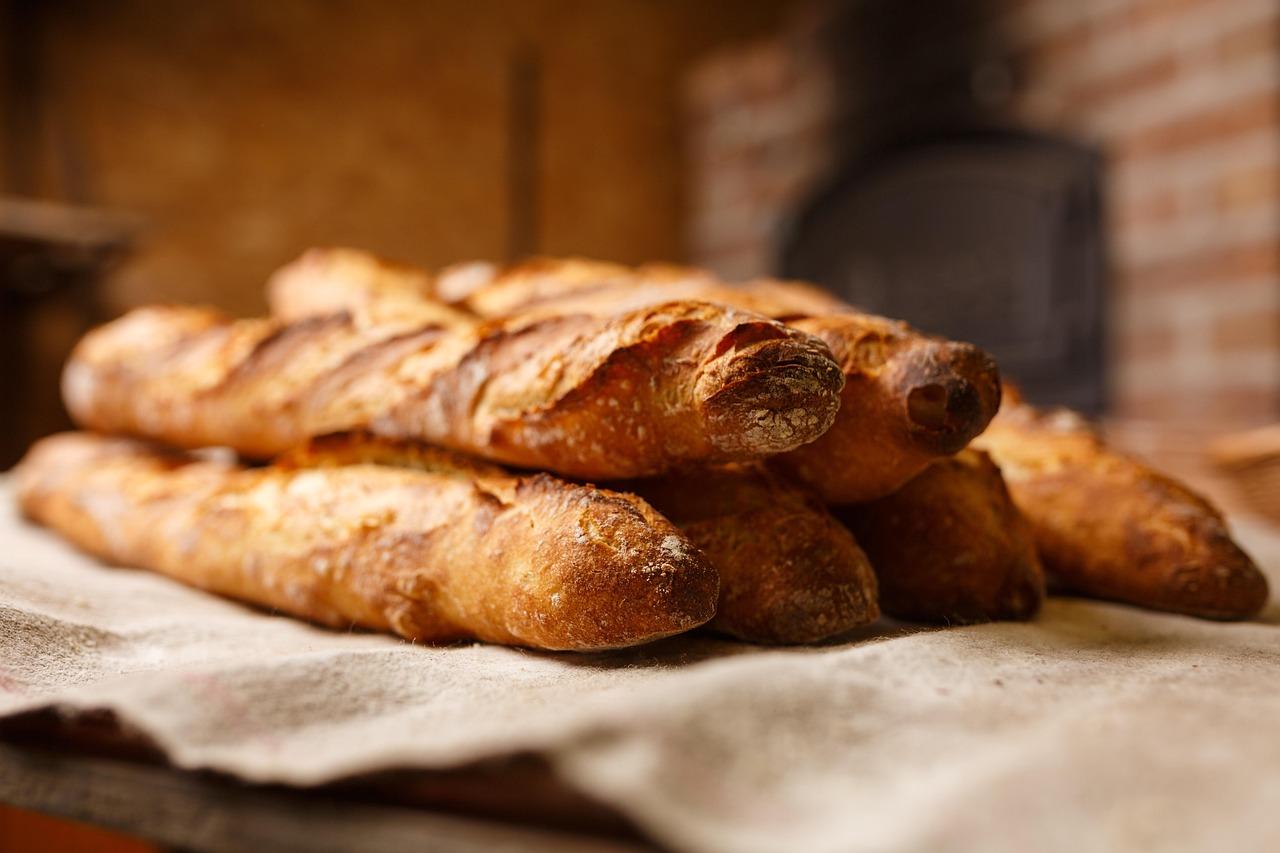
Baguette
The French baguette de tradition: flour, water, salt and yeast


Four ingredients and nothing else: since a 1993 decree, a loaf sold in France as a baguette de tradition may contain only flour, water, salt and leavening. Parisians buy one or two a day, warm from the boulangerie, and the end of the loaf rarely makes it home uneaten. A good one has a thin, shattering, deep golden crust, an open, creamy crumb and a faint nutty sweetness from a long, slow rise. Tear it for butter and jam at breakfast, split it for a jambon-beurre or a cheese sandwich, or put it on the table with soup, salad and a cheese board. Shaping is where most home bakers go wrong: pressing all the air out while rolling the dough long gives a tight, cottony crumb, so handle it lightly and let the bench rest do the work. Chef's tip: cut the slashes almost lengthways, at a shallow angle with the blade nearly flat, and overlap each one by a third; straight-down, crosswise cuts just open into flat scars instead of the raised 'ears' you want.
- Total time
- 445 min
- Difficulty
- hard
- Serves
- 6
Ingredients
For the dough
- 1 ½ cups watercool, about 22°C
- ⅛ oz instant dried yeast1 tsp
- ⅓ oz fine sea salt
For baking
- 2 tbsp plain flouror rice flour, for the cloth
- 1 cup waterboiling, for steam
Shop this recipe on Amazon
What you'll need
Spices & pantry
Links open Amazon in a new tab. As an Amazon Associate, WhatToEat.Today earns from qualifying purchases.
Method
0/12 doneStep 1: Mix 1 ⅛ lb French T65 flour or strong white bread flour with all but 2 tbsp of 1 ½ cups water until no dry flour is left. Cover and leave for 30 minutes; this rest (autolyse) makes the dough smoother and stretchier.
30 minStep 2: Sprinkle ⅛ oz instant dried yeast and ⅓ oz fine sea salt over the dough with the reserved water. Squeeze and fold it in with a wet hand for 3–4 minutes until fully absorbed.
4 minStep 3: Knead on an unfloured surface by slapping and folding for 5 minutes, until the dough is smooth and pulls cleanly off the worktop. Put it in a lightly oiled tub and cover.
5 minStep 4: Leave it for 3 hours at warm room temperature. In the first 1½ hours, give it a set of folds every 30 minutes: lift one side, fold it over, turn the tub and repeat four times. By the end it should be airy, domed and about 50% bigger.
180 minStep 5: Tip the dough onto a lightly floured surface and divide into 3 equal pieces. Fold each loosely into a short log, seam down, cover and rest for 30 minutes.
30 minStep 6: Shape each baguette: pat into a rectangle, fold the top third down and seal with the heel of your hand, then fold in half again and seal the seam. Roll gently from the centre out to about 38 cm long (or the length of your baking tray), tapering the ends.
Step 7: Dust a linen cloth or tea towel with 2 tbsp plain flour, pleat it between the loaves to hold their shape, and lay them seam up. Cover and prove for 45–60 minutes, until puffy and a floured finger leaves a dent that springs back slowly.
50 minStep 8: Meanwhile heat the oven to 475°F (450°F fan) with a baking stone or upturned heavy tray in the middle and an empty roasting tin on the bottom shelf.
40 minStep 9: Roll the loaves seam down onto a sheet of baking paper. Make 3 long, overlapping slashes on each with a razor blade held at a shallow angle.
Step 10: Slide them onto the hot stone, pour 1 cup water into the roasting tin and shut the door quickly. Bake for 12 minutes.
12 minStep 11: Carefully remove the steam tin and bake for 10–14 minutes more, until the crust is deep golden-brown, the cuts have opened, the base sounds hollow and the centre reads about 205°F.
12 minStep 12: Cool on a rack for at least 20 minutes; you will hear the crust crackle. Eat the same day, or freeze and refresh in a hot oven for 5 minutes.
Nutrition per serving
- Calories
- 300 kcal
- Protein
- 10 g
- Carbs
- 63 g
- Fat
- 1 g
- Fibre
- 3 g
Nutrition values are estimates.
KrazyBadal
Good to know
- How long does baguette take?
- About 445 minutes in total: 420 minutes to prepare and 25 minutes to cook.
- How many people does it serve?
- 6 as written. Change the servings above the ingredients and every amount scales to match.
- Is it vegan?
- Yes. It has no meat, fish, dairy or eggs.
- What can I use instead of french t65 flour or strong white bread flour?
- Plain flour, same amount (the dough will be softer and rise a little less).
- What can I use instead of plain flour?
- Self-raising flour, same amount (then leave out the baking powder).
Reviews
No reviews yet. Be the first to cook it.
Rate this recipe
Sign in to rate and review this recipe.
You might also like
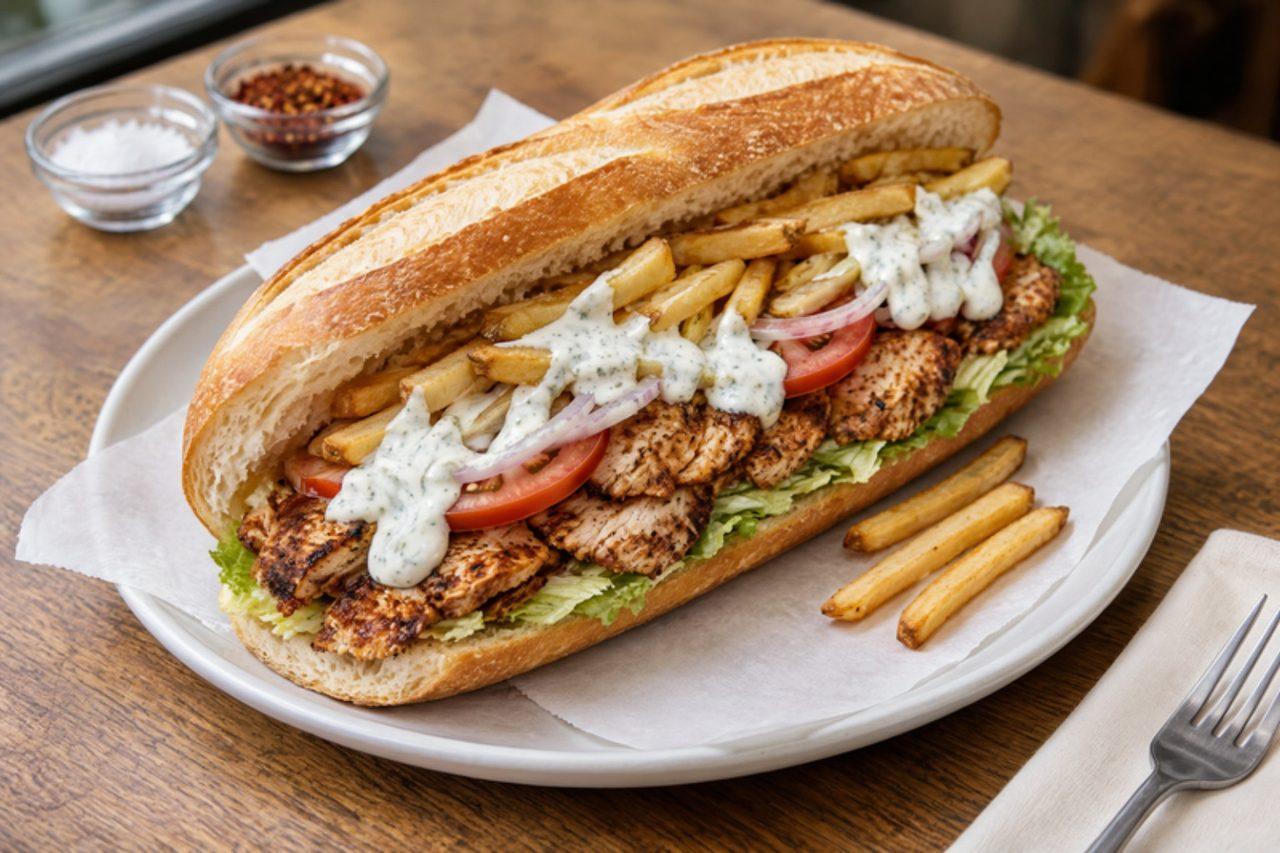
Sandwich grecKebab baguette
In Paris, a "grec" is the late-night kebab sandwich named after the Greek-run shops that first sold it in the Latin Quarter. On rue de la Huchette and rue Saint-André-des-Arts near Saint-Michel, students queue after a night out for crusty bread or pitta stuffed with meat shaved from a turning spit, lettuce, tomato and onion, a garlicky white sauce, and, the Paris touch, a handful of fries pushed right inside. This home version marinates chicken thighs in spiced yoghurt, sears them hard and slices them thin, with oven fries. It contains milk, egg (in the mayonnaise) and wheat. Chef's tip: slice the meat thinly across the grain after resting; thick chunks don't feel like a grec.

ChipaCheese bread rings
In Paraguay you hear 'chipa, chipa!' called by vendors with big baskets on buses and street corners, and every family bakes it for Holy Week, when chipa is the food of Good Friday. Cassava starch, a little cornmeal, butter, eggs and a lot of hard cheese are kneaded into a dough scented with aniseed, shaped into rings or small rolls and baked in a hot oven, traditionally a domed clay tatakua. It's chewy, crisp outside and best warm with cocido (toasted yerba tea). Chef's tip: the dough should feel soft and slightly greasy; add milk a spoon at a time, as too much makes the chipa spread flat.
 Paraguayan

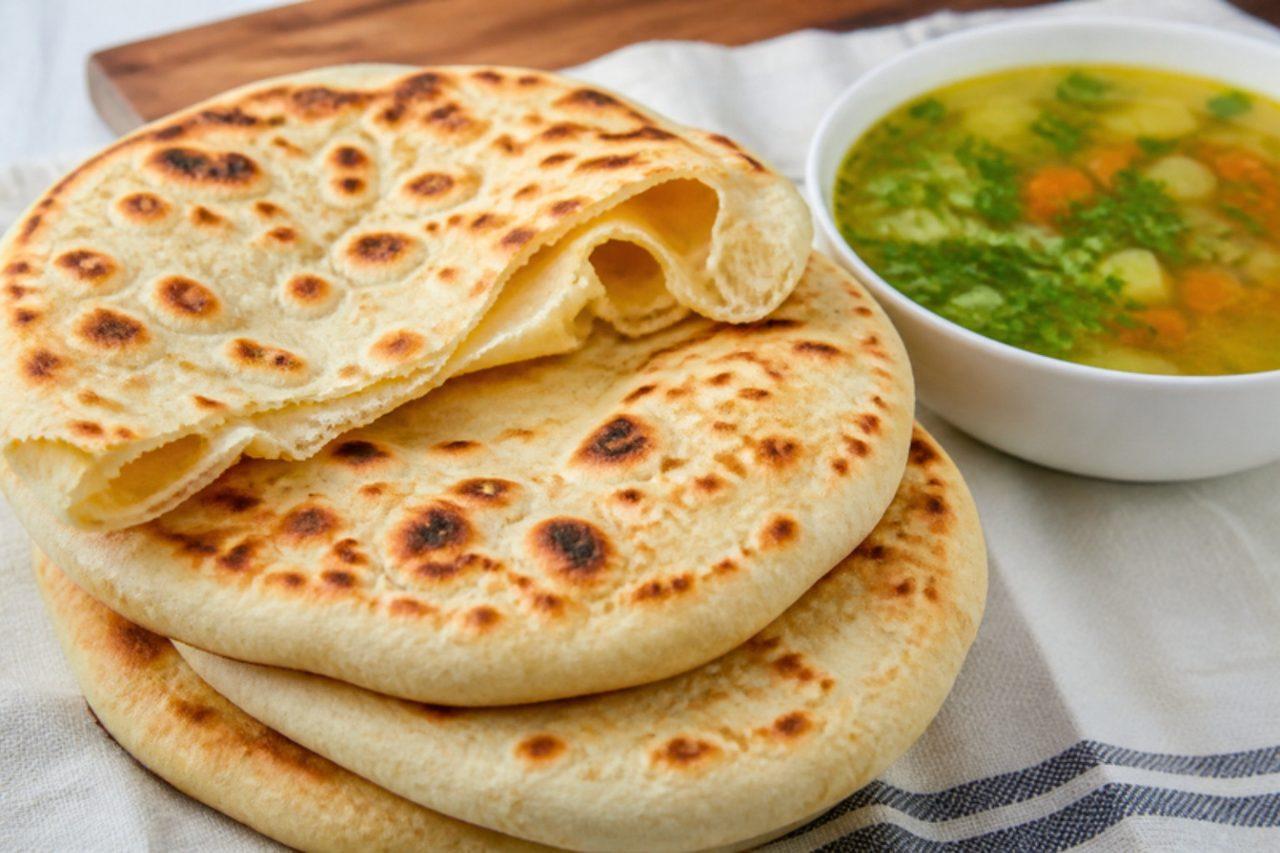
SalufPuffy flatbread
Saluf is the everyday bread of Yemenite Israelis, slapped onto a hot pan or taboon in Rosh HaAyin and Sha'arayim in Rehovot and eaten with marak temani, hilbe and zhug. It is soft and blistered, thicker than pita and with no pocket, made to tear and dunk. Home cooks often roll it too thin, which gives a cracker; it should be about 1 cm thick so it stays pillowy. Chef's tip: cook it under a lid on a very hot dry pan for the first minute, which traps steam and puffs it the way a taboon does.
 Israeli
