
AI-generated image
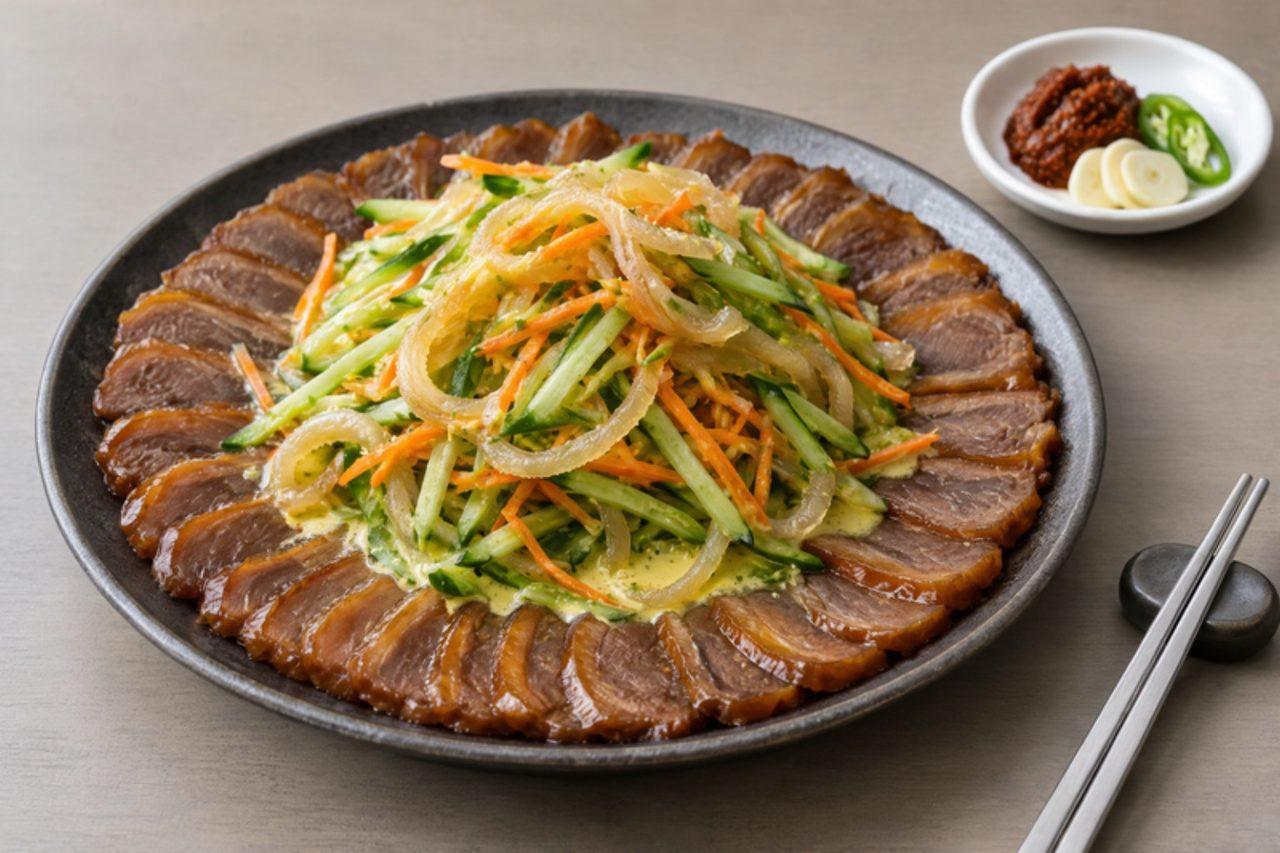
Naengchae jokbal
냉채족발: Busan's cold sliced braised pork trotter with cucumber, jellyfish and a sharp mustard-garlic dressing

Busan's Jokbal Alley in Bupyeong-dong, beside Kkangtong Market, is where braised pork trotter was first served cold as a salad, a summer trick that spread across Korea. The pork trotters are simmered for hours in soy, ginger and spices until the skin turns sticky and tender, chilled, sliced thin and tossed with cucumber, shredded jellyfish and a nose-tingling dressing of Korean mustard, vinegar and garlic. It is evening food, shared from a big platter. Chef's tip: slice the meat only once it is fully cold; warm trotter meat tears instead of cutting into clean slices.
- Total time
- 190 min
- Difficulty
- hard
- Serves
- 6
Ingredients
For the braised trotters
- 3 ⅓ lb pork trotterssplit and cleaned by the butcher
- ½ cup soy sauce
- 8 ¼ cups water
- 1 onionhalved
- 1 oz fresh gingersliced
- 1 tsp black peppercorns
- 3 tbsp sugar
- 1 tsp instant coffee (optional)for the traditional dark colour
For the salad
- 5 ½ oz salted shredded jellyfishready-prepared, from Asian grocers
- 1 cucumber
- 1 carrotsmall
For the mustard dressing
- 4 tbsp rice vinegar
- 2 tbsp sugar
- 2 garlic clovesgrated
- 1 tsp soy sauce
- ½ tsp salt
- 2 tbsp cold water
To serve
- 1 tbsp pine nuts (optional)
Shop this recipe on Amazon
Spices & pantry
Fresh ingredients (6)
Links open Amazon in a new tab. As an Amazon Associate, WhatToEat.Today earns from qualifying purchases.
Method
0/8 doneStep 1: Soak 3 ⅓ lb pork trotters in cold water for 30 minutes, then put them in a large pot of fresh water, bring to the boil and boil for 10 minutes. Drain and rinse well.
40 minStep 2: Return to the clean pot with ½ cup soy sauce, 8 ¼ cups water, 1 onion, 8 garlic cloves, 1 oz fresh ginger, 3 spring onions, 1 cinnamon stick, 2 star anise, 1 tsp black peppercorns, 3 tbsp sugar and 1 tsp instant coffee if using. Bring to the boil, cover and simmer gently for 2 hours, until the skin is soft and sticky and a chopstick slides into the meat. It will be far above the 160°F pork needs.
120 minStep 3: Leave the trotters to cool in the liquid for 20 minutes, then lift out, cover and chill until completely cold and firm.
20 minStep 4: Meanwhile, rinse 5 ½ oz salted shredded jellyfish and soak it in cold water for 30 minutes, changing the water twice. Taste a strand; it should be only lightly salty. Common mistake: skipping the soak; the jellyfish makes the whole salad far too salty.
30 minStep 5: Pour hot water from the kettle (about 176°F, not boiling) over the jellyfish for 5 seconds, until it curls, then plunge into iced water. Drain and squeeze dry.
2 minStep 6: Cut 1 cucumber, 1 carrot and ½ Korean pear or nashi into thin matchsticks.
8 minStep 7: Whisk 1 tbsp Korean mustard (yeon-gyeoja) or hot English mustard, 4 tbsp rice vinegar, 2 tbsp sugar, 2 garlic cloves, 1 tsp soy sauce, ½ tsp salt and 2 tbsp cold water until smooth.
2 minStep 8: Take the cold meat and skin off the bones and slice thinly. Toss with the jellyfish, vegetables, pear and the dressing just before serving, and scatter with 1 tbsp pine nuts if using. Keep leftovers in the fridge and eat within 2 days.
10 min
Nutrition per serving
- Calories
- 420 kcal
- Protein
- 38 g
- Carbs
- 14 g
- Fat
- 23 g
- Fibre
- 2 g
Nutrition values are estimates.
KrazyBadal
Good to know
- How long does naengchae jokbal take?
- About 190 minutes in total: 40 minutes to prepare and 150 minutes to cook.
- How many people does it serve?
- 6 as written. Change the servings above the ingredients and every amount scales to match.
- Can I make it ahead?
- Yes. It keeps well, so you can cook it earlier in the day or the day before and reheat it.
- What can I use instead of soy sauce?
- Tamari, same amount (gluten free).
- What can I use instead of onion?
- 2 shallots per onion.
Reviews
No reviews yet. Be the first to cook it.
Rate this recipe
Sign in to rate and review this recipe.
You might also like

Pork souvlaki
This is a pork recipe. Walk through any Greek town after dark, from Athens to Thessaloniki, and the smell of souvlaki stands drifts down the street; cubes of pork shoulder grilled on thin skewers are the country's favourite cheap supper, eaten standing up or at a plastic-table taverna. At home you marinate the meat in lemon, olive oil, garlic and dried oregano, grill it hard and fast, and pile it on warm pitta with tzatziki, tomato and red onion. Chef's tip: cut the pork into even 2.5 cm cubes and leave a little fat on; lean loin dries out, shoulder stays juicy over high heat.
 Greek
Tteokbokki
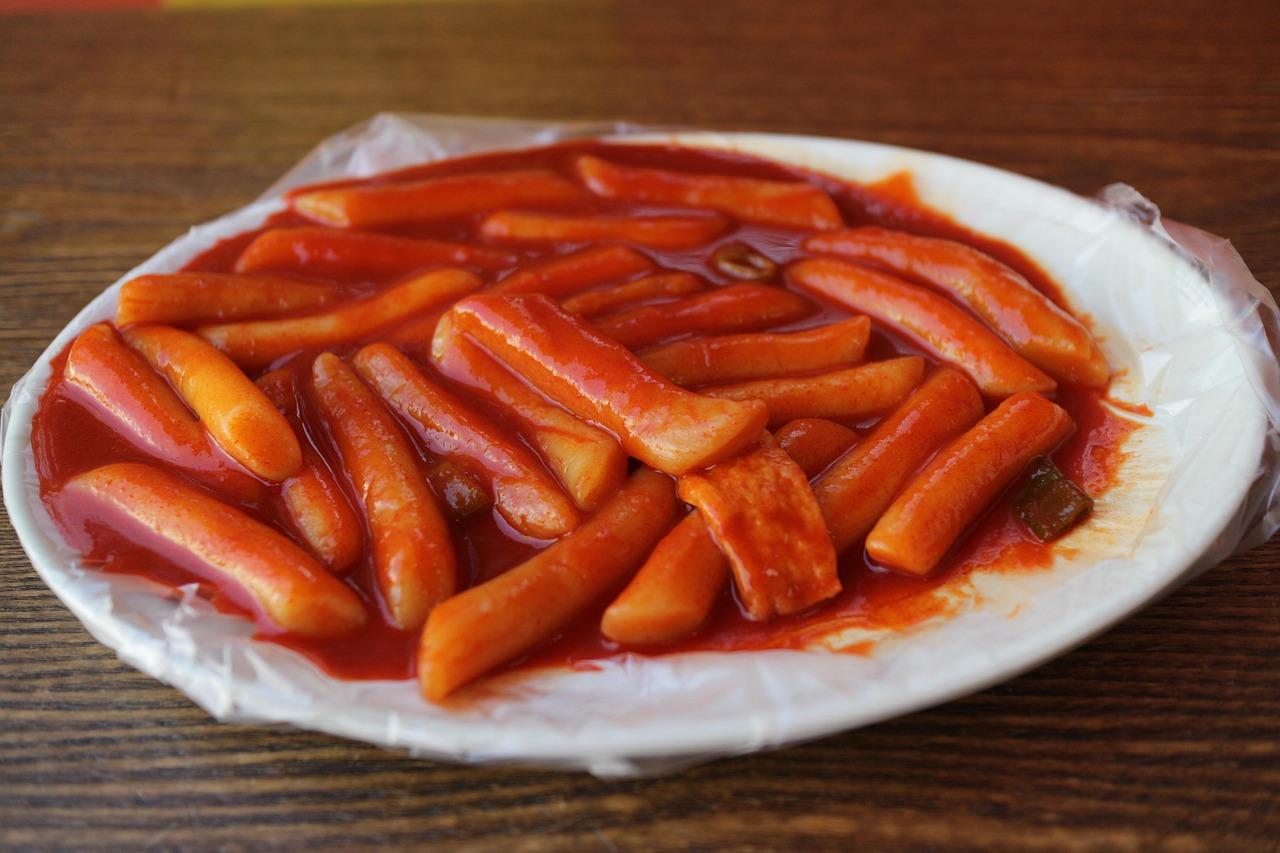
Tteokbokki (떡볶이) is Korea's best-loved street snack: chewy cylinders of rice cake simmered in a thick, glossy, sweet and spicy red sauce. It became a classic in Seoul, where it is sold from street stalls and snack bars in every neighbourhood. Street versions use anchovy stock and fish cakes; this vegan version uses a quick kelp and shiitake stock with cabbage and spring onions, and has all the same punch. Eat it hot, while the rice cakes are soft and stretchy. Chef's tip: keep stirring and scrape the bottom; the rice cakes release starch that thickens the sauce but also catches. The sauce is right when it clings to the spoon in a glossy coat.



Tteokgalbi
Tteokgalbi is rib meat chopped finely, pressed back into neat slabs and grilled, so it's soft enough to eat without struggling with a bone. Two places in South Jeolla claim it: Damyang, the bamboo county, where all-beef patties come with rice steamed in bamboo tubes, and Gwangju's Songjeong district, whose restaurant street near the railway station mixes beef with pork. This home version uses minced beef and pork, seasoned with soy, garlic and pear, then brushed with a soy and honey glaze as it cooks. Serve with rice, lettuce and a few banchan; leftovers are good cold in a lunchbox. Chef's tip: slap the mince against the bowl for a few minutes; it turns sticky and the patties hold together on the grill without any breadcrumbs.