
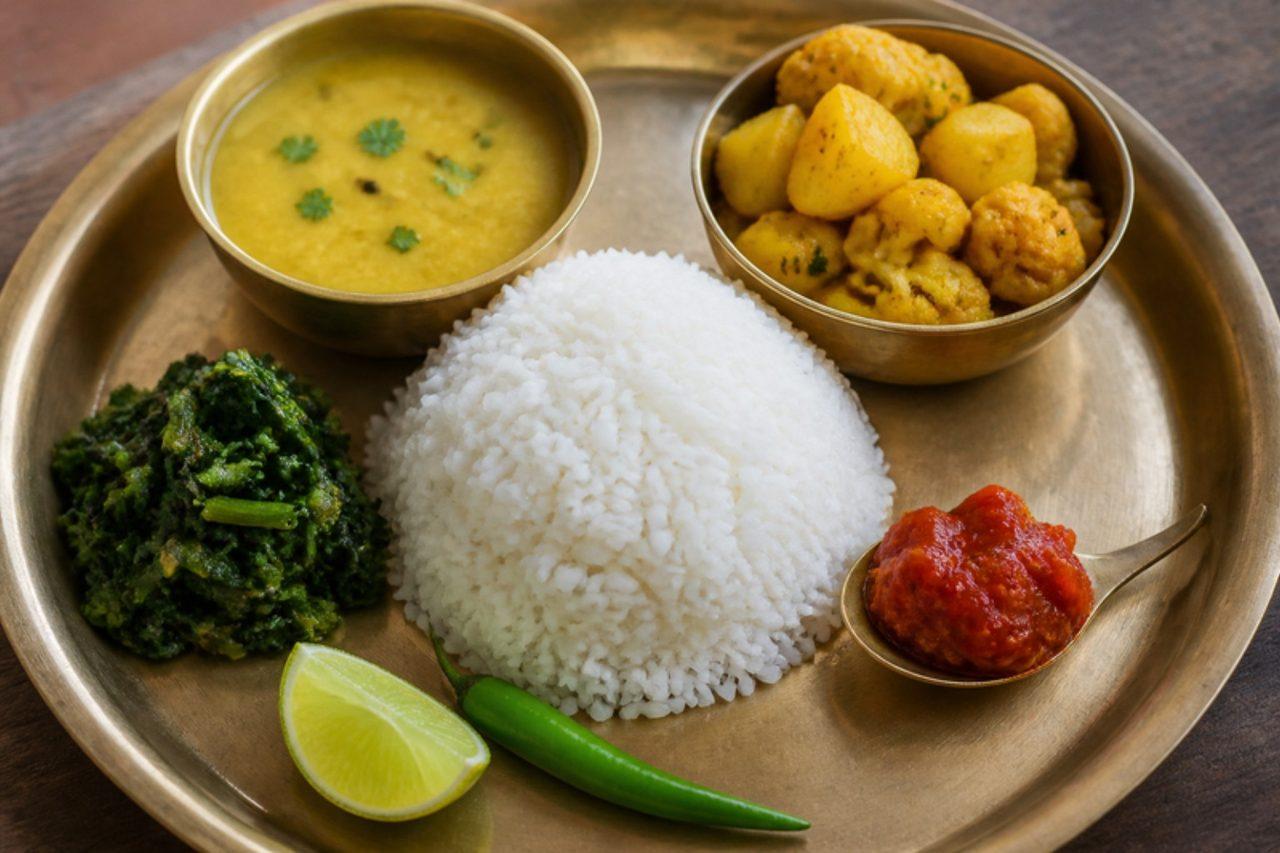
AI-generated image
Dal bhat
Lentils, rice and vegetables
Dal bhat tarkari: Nepal's everyday plate of jimbu-tempered lentils, rice, potato-cauliflower curry and tomato achar


Across Nepal, from Terai farmhouses to trekking lodges below Everest, dal bhat is not a dish so much as the meal itself, eaten twice a day, late morning and early evening, often with the words "dal bhat power, 24 hour". The plate is always the same idea: a mound of plain rice (bhat), a thin, soupy lentil dal scented with jimbu (a dried Himalayan allium) fried in ghee, a dry vegetable tarkari, a little stir-fried greens when there are some, and a sharp spoonful of achar. You pour the dal over the rice and mix it by hand, a little at a time, with bites of curry and pickle. Most newcomers make the dal too thick; Nepali dal should run off the spoon like a light soup so it soaks the rice. Chef's tip: fry the jimbu in the hot ghee only until it darkens a shade and smells of garlicky onion, about 10 seconds, then pour it straight into the dal and cover the pan to trap the aroma.
- Total time
- 60 min
- Difficulty
- easy
- Serves
- 4
Ingredients
For the dal
- 7 oz split red lentils (musuro dal)rinsed until the water runs clear
- 5 cups water
- ½ tsp ground turmeric
- 1 tsp salt
- 2 tbsp ghee
- 1 tsp jimbu (dried Himalayan allium)or 2 thinly sliced garlic cloves if you can't find it
- ⅓ oz fresh gingergrated
For the rice
- 10 ½ oz long-grain ricerinsed three times
- 2 ½ cups water
For the potato and cauliflower tarkari
- 3 tbsp mustard oil
- 1 tsp cumin seeds
- 1 onionthinly sliced
- 3 garlic clovescrushed
- 14 oz potatoespeeled and cut into 2 cm cubes
- 14 oz cauliflowercut into small florets
- ½ tsp ground turmeric
- 1 tsp ground cumin
- ½ tsp chilli powder
- 1 tomatochopped
- 1 tsp salt
- ⅓ oz fresh corianderchopped
To serve
- 4 tbsp golbheda ko achar (Nepali tomato achar)see the separate recipe, or any lime pickle
- 4 tbsp stir-fried mustard greens (saag) (optional)see the separate recipe
- 4 lime wedges (optional)
Shop this recipe on Amazon
Spices & pantry
Fresh ingredients (7)
Links open Amazon in a new tab. As an Amazon Associate, WhatToEat.Today earns from qualifying purchases.
Method
0/9 doneStep 1: Put 7 oz split red lentils (musuro dal), 5 cups water, ½ tsp ground turmeric and ⅓ oz fresh ginger in a large pan and bring to the boil over a high heat. Skim off the grey foam with a spoon as it rises.
8 minStep 2: Turn the heat to medium-low, half-cover and simmer for 25 minutes, stirring now and then, until the lentils have collapsed completely. Whisk hard for 30 seconds so the dal turns smooth, add 1 tsp salt, and check the texture: it should be thin and pourable, like a light soup. Add hot water if it is any thicker.
25 minStep 3: Meanwhile put 10 ½ oz long-grain rice and 2 ½ cups water in a heavy pan with a tight lid. Bring to the boil over a high heat, then cover, turn the heat to the lowest setting and cook for 12 minutes. Turn off the heat and leave it covered for 10 minutes; the grains should be separate and the surface pitted with small steam holes.
22 minStep 4: For the tarkari, heat 3 tbsp mustard oil in a wide frying pan over a medium-high heat until it just starts to smoke, so the raw, sharp edge cooks out. Take the pan off the heat for a few seconds, then add 1 tsp cumin seeds; they should sizzle and darken within 10 seconds.
3 minStep 5: Return to a medium heat, add 1 onion and 3 garlic cloves and fry for 4 minutes, until the onion is soft and pale gold.
4 minStep 6: Add 14 oz potatoes, ½ tsp ground turmeric, 1 tsp ground cumin, ½ tsp chilli powder and 1 tsp salt and toss for 3 minutes, until every cube is yellow and the spices smell toasty, not raw.
3 minStep 7: Add 14 oz cauliflower and 1 tomato, stir, cover and cook over a medium-low heat for 12–15 minutes, stirring every few minutes, until a knife slides easily into the potato and the cauliflower edges are lightly browned. The tarkari should be dry, with no sauce pooling in the pan. Stir in ⅓ oz fresh coriander.
15 minStep 8: Just before serving, heat 2 tbsp ghee in a small pan over a medium-high heat. Add 1 dried red chilli and let it puff and darken for a few seconds, then add 1 tsp jimbu (dried Himalayan allium) and fry for about 10 seconds, until it turns a shade darker and smells strongly of garlic and onion. Pour it straight into the dal (it will hiss), stir once and cover the pan.
1 minStep 9: Serve on large plates or a steel thali: a mound of rice in the middle, dal in a bowl to pour over, the tarkari, 4 tbsp stir-fried mustard greens (saag) and a spoonful of 4 tbsp golbheda ko achar (Nepali tomato achar) around the edge, with 4 lime wedges to squeeze. Refill the dal and rice as people eat; that is the Nepali way.
Nutrition per serving
- Calories
- 540 kcal
- Protein
- 20 g
- Carbs
- 88 g
- Fat
- 13 g
- Fibre
- 12 g
Nutrition values are estimates.
KrazyBadal
Good to know
- How long does dal bhat take?
- About 60 minutes in total: 15 minutes to prepare and 45 minutes to cook.
- How many people does it serve?
- 4 as written. Change the servings above the ingredients and every amount scales to match.
- Is it vegetarian?
- Yes. It has no meat or fish.
- Is it gluten free?
- Yes, as written. Check the labels on stock, sauces and spice mixes, which sometimes contain gluten.
- What can I use instead of split red lentils (musuro dal)?
- Yellow split peas (soak 2 hours and cook longer).
- What can I use instead of ground turmeric?
- Leave it out (it mostly adds colour).
Reviews
No reviews yet. Be the first to cook it.
Rate this recipe
Sign in to rate and review this recipe.
You might also like

Sayur lodehVegetables in coconut milk
Sayur lodeh is everyday cooking in Central Java, made in big pots in Solo and Semarang kitchens and ladled over rice, with lontong rice cakes at Lebaran, or alongside opor and sambal goreng on festive tables. It's soupy rather than thick: a fragrant broth of coconut milk, galangal, lemongrass and lime leaf that carries chunks of aubergine, long beans, chayote and sweetcorn, plus tempeh and tofu to make it a meal. The flavour is mellow and slightly sweet, so the heat comes from sambal on the side. Chef's tip: keep the pot at a gentle simmer once the coconut milk goes in and stir now and then — a rolling boil splits the coconut milk into oily curds.
 Indonesian


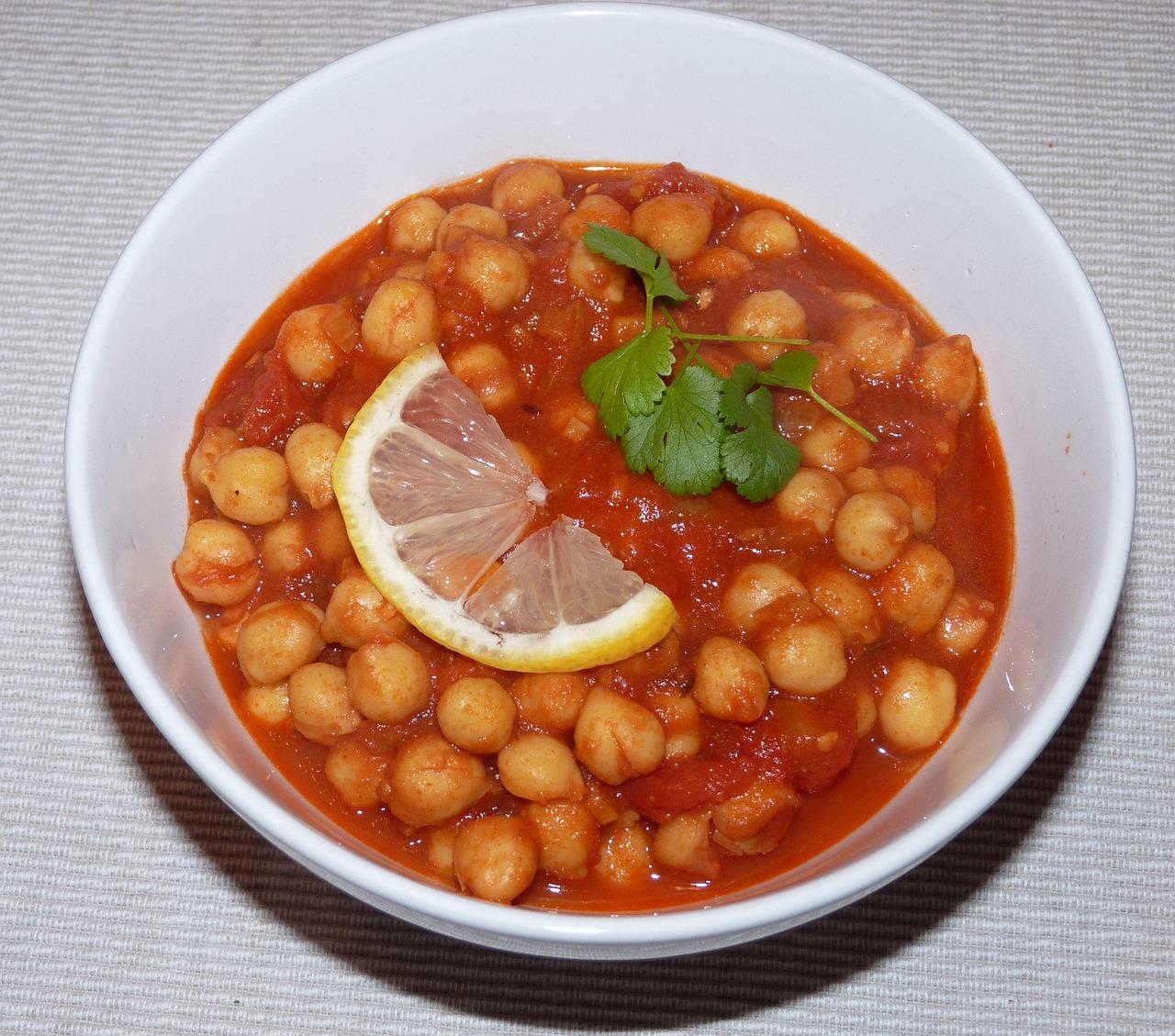
Chana masala
A North Indian staple that comes together from the store cupboard. Toasted cumin, slow-softened onion and a good spoonful of garam masala give tinned chickpeas real depth. Serve with rice, naan or a stack of warm rotis.
 Indian

Bagara bainganBaby aubergines in peanut sesame sauce
Bagara baingan is a Hyderabadi wedding dish of small aubergines cooked whole in a dark, tangy gravy of roasted peanuts, sesame, dried coconut and tamarind. Unlike a Gujarati stuffed brinjal, the aubergines here are only quartered at the base and fried until silky, then left to soak up a thin-but-rich sauce that is finished with a tempering, the 'baghar' that gives the dish its name. It's sour, nutty and gently spiced, and is served with biryani, bagara rice or plain rice. Chef's tip: choose small, glossy purple aubergines that feel heavy for their size; soft, light ones are full of seeds and turn mushy before the gravy has a chance to cling.