
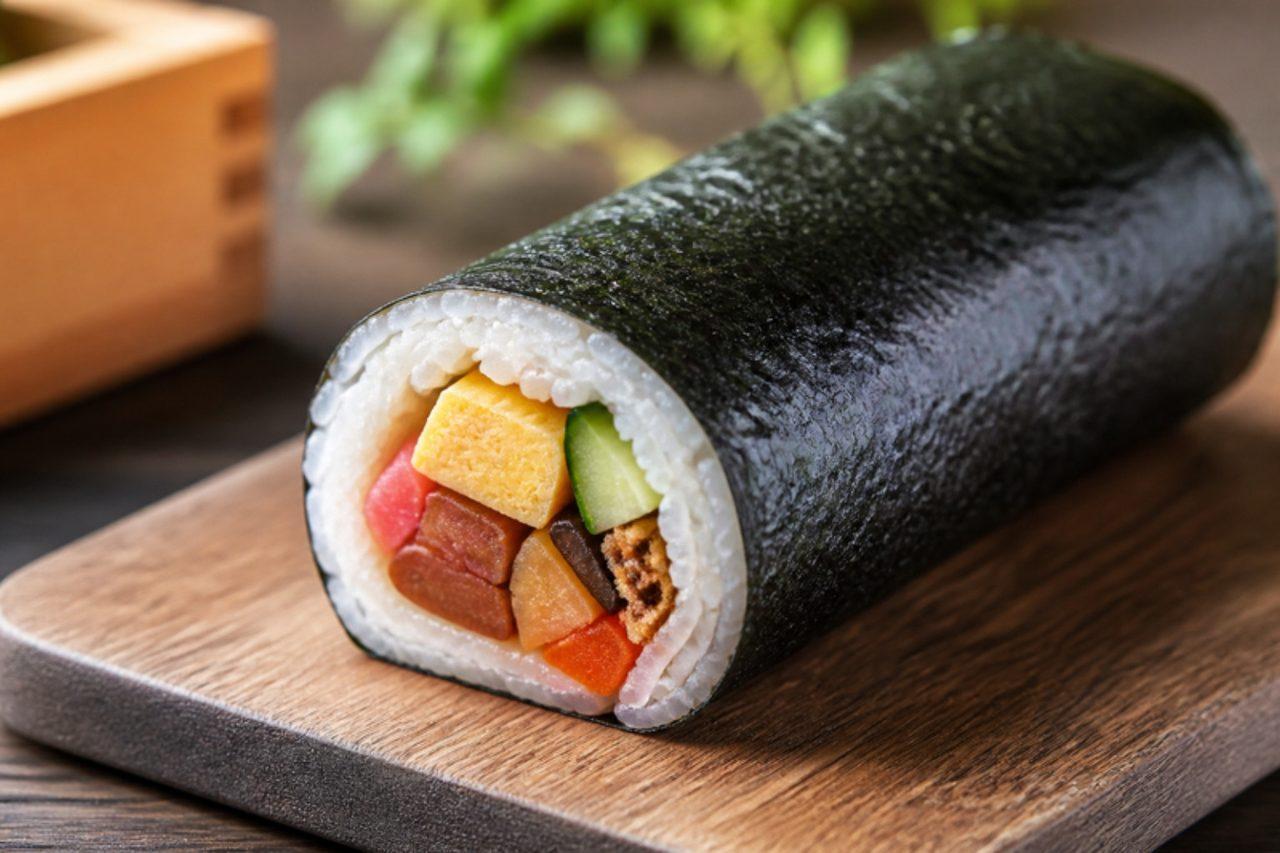
AI-generated image
Ehomaki (lucky direction sushi roll)
A thick, uncut futomaki of seven cooked fillings, eaten whole on Setsubun
 Japanese
Ehomaki began as a merchants' custom in Osaka and has spread across Japan: on the night of Setsubun each person eats a whole, uncut thick sushi roll while facing the year's lucky direction (eho), in silence, making a wish. Leaving it uncut means not cutting your good fortune, and the seven fillings are linked to the Seven Lucky Gods. This version uses cooked fillings only: sweet rolled omelette, cucumber, soy-simmered shiitake and kanpyō gourd ribbon, cooked prawns, crab sticks and spinach, with grilled eel as an optional luxury. The result is soft, sweet-savoury and crunchy at once; serve with clear soup and pickled ginger. The shiitake are simmered in soy and sugar without mirin, so the roll has no alcohol. Chef's tip: lay the fillings slightly overlapping in one tight line on the lower third of the rice, which keeps every bite balanced and the roll round.
- Total time
- 65 min
- Difficulty
- medium
- Serves
- 4
Ingredients
For the sushi rice
- 12 ½ oz Japanese short-grain ricerinsed until the water runs almost clear
- 1 ¾ cups water
- ¼ cup rice vinegar
- 2 tbsp sugar
- 1 tsp salt
For the simmered shiitake and kanpyō
For the omelette
- 3 eggs
- 2 tsp sugar
- 1 pinch salt
- 1 tsp neutral oil
For the fillings and rolling
- 1 cucumbercut lengthways into long batons, seeds removed
- 8 cooked peeled king prawnshalved lengthways
- 4 crab sticks (kanikama)halved lengthways
- 3 ½ oz spinach
- 3 ½ oz cooked grilled eel (kabayaki) (optional)warmed as the pack says, cut into strips
- 4 nori sheetsfull size
Shop this recipe on Amazon
What you'll need
Spices & pantry
Fresh ingredients (4)
Links open Amazon in a new tab. As an Amazon Associate, WhatToEat.Today earns from qualifying purchases.
Method
0/12 doneStep 1: Put 4 dried shiitake mushrooms in 1 cup warm water with a small plate on top to keep them under, and leave for 30 minutes while you start the rice.
2 minStep 2: Drain 12 ½ oz Japanese short-grain rice for 10 minutes, then put it in a heavy pan with 1 ¾ cups water. Bring to the boil over a high heat, cover tightly, turn to the lowest heat and cook for 13 minutes; turn off and leave covered for 10 minutes more without lifting the lid.
25 minStep 3: Meanwhile, wet ½ oz kanpyō (dried gourd ribbon), rub it with 1 tsp salt until it softens, rinse, then boil it for 5 minutes until translucent and soft enough to pinch through with a fingernail.
7 minStep 4: Squeeze the shiitake, keeping 150 ml of their soaking liquid, discard the stems and slice the caps. Simmer the shiitake and kanpyō in that liquid with 2 tbsp soy sauce and 2 tbsp sugar over a low heat for 12–15 minutes, until the liquid has almost gone and both are glossy and dark. Cool.
15 minStep 5: Stir ¼ cup rice vinegar, 2 tbsp sugar and 1 tsp salt together until the sugar dissolves.
2 minStep 6: Tip the hot rice into a wide bowl, pour over the vinegar mixture and cut and fold it in with a damp spatula while fanning, until each grain is glossy and the rice has cooled to body temperature. Common mistake: stirring and pressing the rice. It breaks the grains and turns it into a gummy paste. Cover with a damp cloth.
6 minStep 7: Beat 3 eggs with 2 tsp sugar and 1 pinch salt. Cook in a lightly oiled pan with 1 tsp neutral oil over a medium-low heat, folding it over on itself, for about 4 minutes, until set right through but not browned. Cool and cut into 1 cm strips.
6 minStep 8: Blanch 3 ½ oz spinach in boiling water for 30 seconds, cool in cold water and squeeze it into a firm rope. Have ready 1 cucumber, 8 cooked peeled king prawns and 4 crab sticks (kanikama), plus 3 ½ oz cooked grilled eel (kabayaki) if using. If you are cooking raw prawns, simmer them for 2–3 minutes until pink and opaque all the way through.
5 minStep 9: Lay a sheet of 4 nori sheets, shiny side down, on a bamboo mat. With wet hands, spread a quarter of the rice over it in an even layer, leaving a 3 cm strip bare along the far edge.
2 minStep 10: Arrange a quarter of each filling in a tight line across the rice about a third of the way up from you.
2 minStep 11: Lift the near edge of the mat and roll it over the fillings to meet the rice on the far side, squeezing firmly, then roll on to seal. Rest seam side down for 2 minutes and repeat with the rest.
6 minStep 12: Leave the rolls whole. Keep them covered at cool room temperature and eat the same day, within a few hours; keep the fillings in the fridge until you roll. To follow the custom, face the year's lucky direction and eat your roll without speaking.
1 min
Nutrition per serving
- Calories
- 560 kcal
- Protein
- 24 g
- Carbs
- 95 g
- Fat
- 7 g
- Fibre
- 4 g
Nutrition values are estimates.
KrazyBadal
Good to know
- How long does ehomaki (lucky direction sushi roll) take?
- About 65 minutes in total: 40 minutes to prepare and 25 minutes to cook.
- How many people does it serve?
- 4 as written. Change the servings above the ingredients and every amount scales to match.
- What can I use instead of japanese short-grain rice?
- Any long-grain rice, same amount.
- What can I use instead of rice vinegar?
- Cider vinegar with a pinch of sugar, same amount.
Reviews
No reviews yet. Be the first to cook it.
Rate this recipe
Sign in to rate and review this recipe.
You might also like

Yaki onigiriGrilled rice balls
Yaki onigiri (焼きおにぎり) are rice balls grilled until they form a crisp, toasty crust, then brushed with soy sauce glaze. They are eaten all over Japan, at izakaya, at barbecues and from the freezer section, as a snack or with miso soup. The inside stays soft and steamy while the outside crackles. Best eaten hot, straight from the pan. Chef's tip: let the shaped rice balls dry for 10 minutes before they go in the pan. A drier surface forms a better crust and won't stick, and the glaze goes on only at the end so it doesn't burn.


Miso soup
Miso soup (味噌汁) is drunk every day in homes all over Japan, at breakfast as well as dinner, beside a bowl of rice. The base is dashi; this vegan version uses kombu and dried shiitake instead of bonito, which gives it a deep, rounded flavour. Silken tofu and wakame seaweed are the classic fillings. It takes ten minutes; just remember not to boil the miso. Chef's tip: add the miso at the very end and never let it boil. Boiling kills the miso's fresh, fermented aroma; Japanese cooks say the soup should only 'smile', with the surface barely trembling.
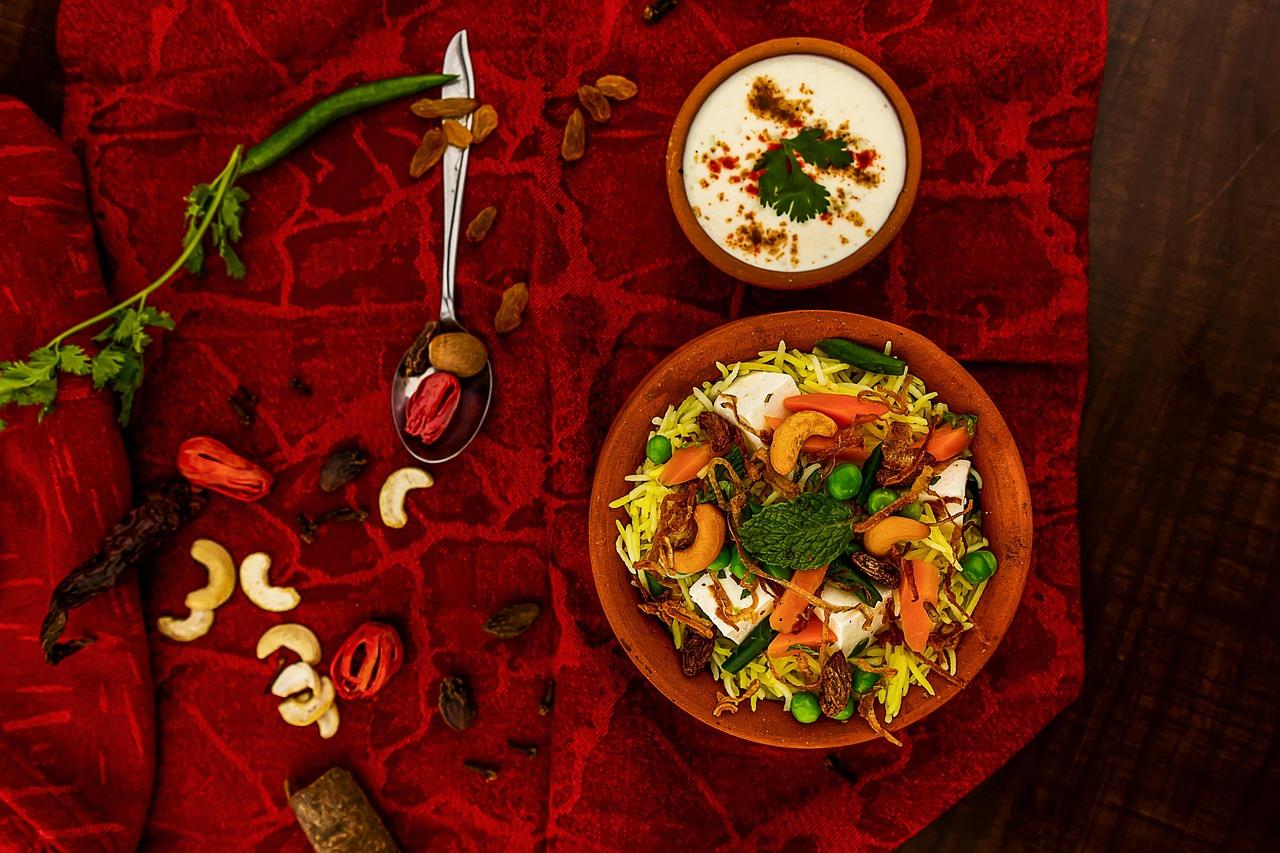
Paneer biryaniRice and moong dal in coconut milk
A mild, creamy biryani: rice and husked green gram roasted in ghee, then cooked in coconut milk with peas, carrots, potatoes, peanuts and cashews, and finished with soft fried paneer and a fresh coriander yogurt. Serve hot, garnished with more fried cashews and paneer.
 Indian
