
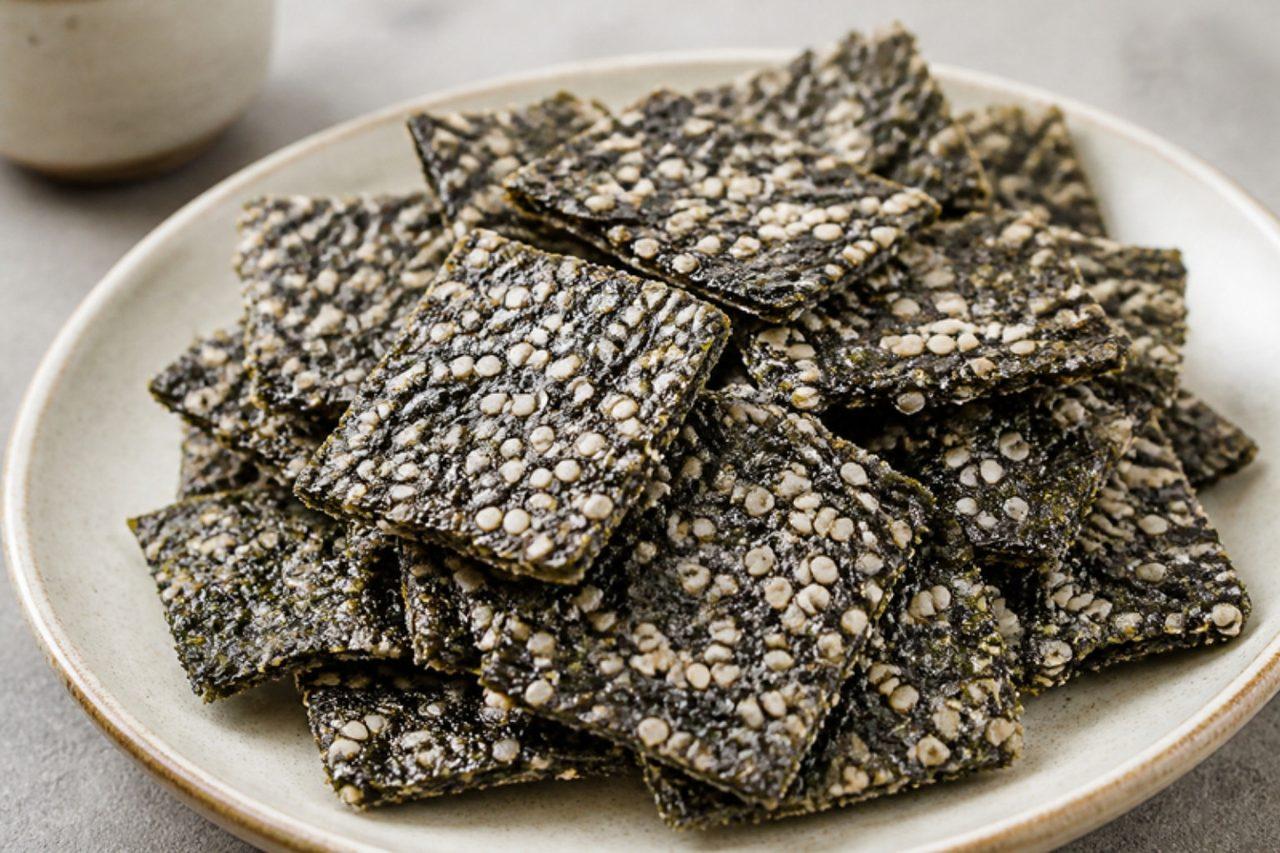
AI-generated image
Gim bugak
Crisp fried seaweed
Gim bugak (김부각): crisp fried laver with sticky rice paste


Gim bugak is a temple snack that Buddhist nuns and village cooks in South Jeolla, especially around Damyang and Namwon, still make in large batches in autumn: sheets of laver are painted with glutinous rice porridge, scattered with sesame, dried in the sun and fried until they puff into crackling, savoury chips. It is eaten as a banchan with rice or as a snack with tea. The common mistake is frying it before it is completely dry; any damp patches stay chewy and spit in the oil. Chef's tip: cut the dried sheets with scissors before frying; once fried they shatter if you try to cut them.
- Total time
- 180 min
- Difficulty
- hard
- Serves
- 6
Ingredients
- 10 laver (gim) sheetsunseasoned
- 4 tbsp glutinous rice flour
- 1 ¼ cups water
- 1 tsp soy sauce
- ¼ tsp salt
- 3 tbsp toasted sesame seeds
- 2 cups neutral oilfor frying
- 1 tsp sugar (optional)
Shop this recipe on Amazon
Links open Amazon in a new tab. As an Amazon Associate, WhatToEat.Today earns from qualifying purchases.
Method
0/8 doneStep 1: Whisk 4 tbsp glutinous rice flour into 1 ¼ cups water in a small pan until smooth. Cook over a medium-low heat, stirring constantly, until it thickens into a glossy, translucent porridge.
5 minStep 3: Lay a sheet of 10 laver (gim) sheets rough side up on a tray lined with baking paper. Brush half of it thinly with porridge, fold the other half over and brush the top.
Step 4: Scatter 3 tbsp toasted sesame seeds over the top and repeat with the rest of the sheets.
Step 5: Dry the sheets until completely crisp and brittle: either outdoors in the sun and breeze for a day, or in the oven at its lowest setting (60–158°F) with the door slightly open, turning once.
150 minStep 6: Snip the dry sheets with scissors into 5 cm squares.
Step 7: Heat 2 cups neutral oil in a deep pan to 350°F. Fry a few pieces at a time for 3–5 seconds, until they puff and turn white-speckled; they burn quickly, so lift them out almost at once.
5 minStep 8: Drain on kitchen paper, sprinkle with 1 tsp sugar, if you like, and cool. Keep airtight for up to a week.
Nutrition per serving
- Calories
- 110 kcal
- Protein
- 2 g
- Carbs
- 9 g
- Fat
- 7 g
- Fibre
- 1 g
Nutrition values are estimates.
KrazyBadal
Good to know
- How long does gim bugak take?
- About 180 minutes in total: 30 minutes to prepare and 150 minutes to cook.
- How many people does it serve?
- 6 as written. Change the servings above the ingredients and every amount scales to match.
- Is it vegan?
- Yes. It has no meat, fish, dairy or eggs.
- What can I use instead of soy sauce?
- Tamari, same amount (gluten free).
- What can I use instead of toasted sesame seeds?
- Poppy seeds or finely chopped pumpkin seeds, same amount.
Reviews
No reviews yet. Be the first to cook it.
Rate this recipe
Sign in to rate and review this recipe.
You might also like

SakarpadaSweet fried dough diamonds
Sakarpada (shakarpara) are little sweet diamonds of a rich dough made with ghee, milk and sugar, fried until golden and crunchy. They are a Diwali favourite with tea, and the cubes go into bhusu too. They keep for weeks in an air-tight tin.
 Indian

Yaki onigiriGrilled rice balls
Yaki onigiri (焼きおにぎり) are rice balls grilled until they form a crisp, toasty crust, then brushed with soy sauce glaze. They are eaten all over Japan, at izakaya, at barbecues and from the freezer section, as a snack or with miso soup. The inside stays soft and steamy while the outside crackles. Best eaten hot, straight from the pan. Chef's tip: let the shaped rice balls dry for 10 minutes before they go in the pan. A drier surface forms a better crust and won't stick, and the glaze goes on only at the end so it doesn't burn.
 Japanese

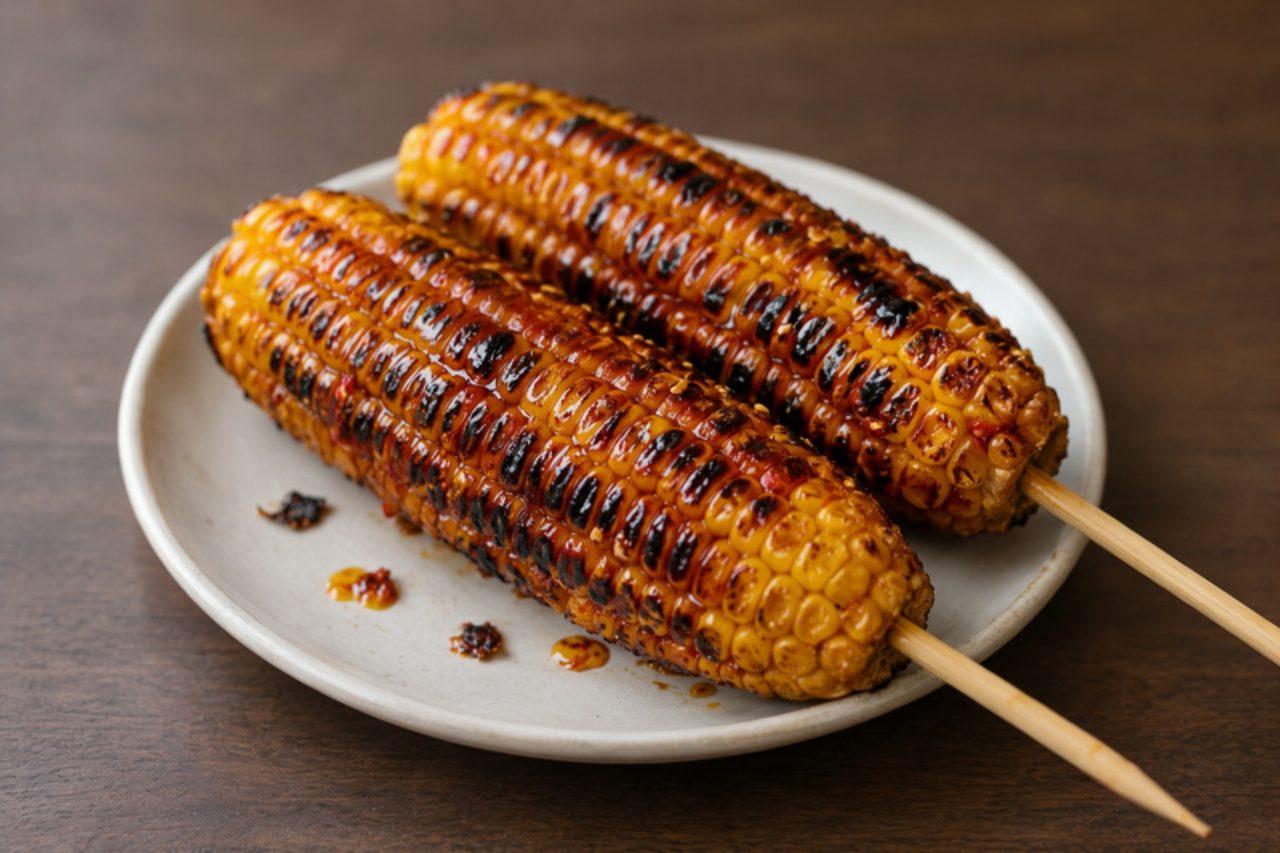
Taiwanese grilled corn
At Raohe and Shilin night markets the grilled-corn stalls are easy to find: look for the queue and the smoky, sweet smell. Cobs are par-cooked, then turned slowly over charcoal while the cook brushes them with a dark glaze of sacha sauce, thick soy paste, garlic and chilli, layer after layer, until the kernels are sticky, slightly charred and deeply savoury. It is eaten hot from a paper sleeve while walking the market. Sacha (shacha) sauce, a Taiwanese barbecue paste, usually contains dried fish and shrimp; vegetarian sacha is sold in Asian shops. Contains soy, wheat and fish. Chef's tip: brush thin coats and turn often; one thick coat burns before the corn chars.
 Taiwanese