
AI-generated image
Kare pan
Curry beef buns
Japanese curry buns with a beef mince filling, baked or fried

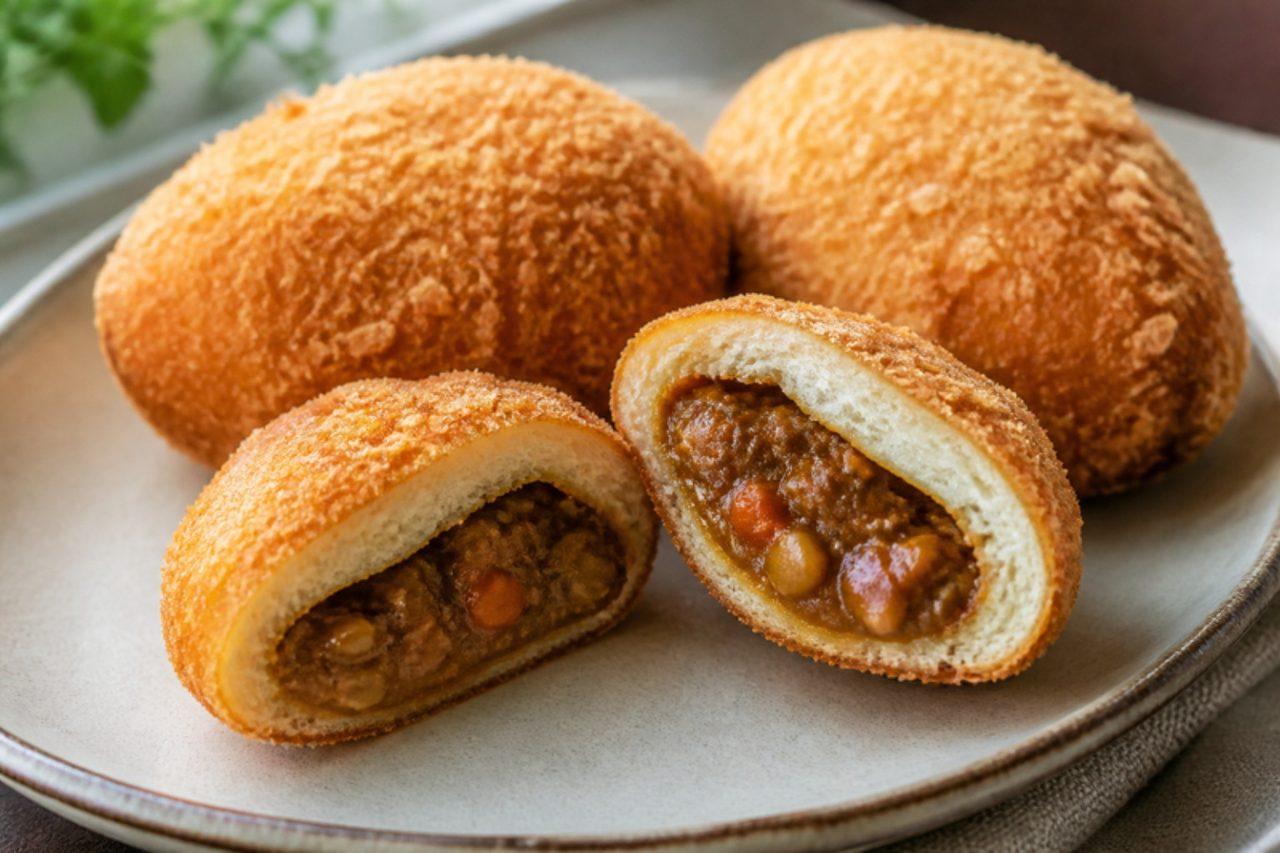
Kare pan (カレーパン) is the best-selling savoury bun in Japanese bakeries and convenience stores: a soft, slightly sweet bread dough wrapped around thick, mild Japanese curry made with beef mince (pork mince works too), coated in panko and fried or baked until crunchy. Office workers in Tokyo eat one hot for lunch, and children love them after school. The outside is crisp, the bread soft and the curry rich and gently spiced. For a vegetarian version, fill them with diced potato, carrot and mushroom cooked in the same homemade roux; ready-made curry blocks often contain animal fat, so check the label. Runny filling is the usual mistake, because it bursts the seam, so cook it thick and chill it. Chef's tip: dampen the dough edges and pinch the seam twice, then place the buns seam-side down to rest.
- Total time
- 125 min
- Difficulty
- medium
- Serves
- 8
Ingredients
For the dough
- 10 ½ oz strong white bread flour
- ⅔ oz sugar
- 1 tsp salt
- ¾ cup warm milk
- ⅔ oz buttersoft
For the curry filling
- 1 tbsp vegetable oil
- 1 onionfinely chopped
- 1 carrotsmall, finely diced
- 9 oz beef minceor pork mince
- ⅔ oz butter
- ⅔ oz plain flour
- 1 ½ tbsp curry powdermild Japanese-style or any mild curry powder
- ½ tsp garam masala
- ¾ cup water or stock
- ½ applegrated
- 1 tbsp soy sauce
- 1 tbsp tomato ketchup
- 1 tsp honey
For the coating (baked)
- 1 eggbeaten; or milk for an egg-free coating
- 2 ⅛ oz panko breadcrumbs
- 2 tbsp vegetable oil
To fry instead (optional)
- 1 litre vegetable oil (optional)for deep-frying
Shop this recipe on Amazon
What you'll need
Spices & pantry
Links open Amazon in a new tab. As an Amazon Associate, WhatToEat.Today earns from qualifying purchases.
Method
0/11 doneStep 1: Mix 10 ½ oz strong white bread flour, ⅔ oz sugar, 1 tsp salt and ⅛ oz fast-action dried yeast. Add ¾ cup warm milk and knead for 5 minutes, then knead in ⅔ oz butter for 5 minutes more, until smooth and stretchy. Cover and leave for 1 hour, until doubled.
60 minStep 2: Meanwhile, heat 1 tbsp vegetable oil in a frying pan over medium heat and cook 1 onion and 1 carrot for 8 minutes, until soft and lightly golden.
8 minStep 3: Add 9 oz beef mince and cook over medium-high heat, breaking it up, for 6–8 minutes, until browned all through; it should reach 160°F on a probe thermometer.
8 minStep 4: Push the mince to one side, melt ⅔ oz butter in the space, stir in ⅔ oz plain flour, 1 ½ tbsp curry powder and ½ tsp garam masala and cook for 1 minute. Stir in ¾ cup water or stock, ½ apple, 1 tbsp soy sauce, 1 tbsp tomato ketchup and 1 tsp honey.
2 minStep 5: Simmer, stirring, for 8–10 minutes, until very thick and a spoon drawn through leaves a clear trail. Spread on a plate, cool, then chill for 30 minutes until firm.
10 minStep 6: Divide the dough into 8 pieces and roll into balls. Flatten each into a 12 cm round, thinner at the edges.
Step 7: Put a heaped tablespoon of cold filling in the middle, fold the dough over into a half-moon and pinch the edge firmly to seal, then pinch it again.
Step 8: Brush each bun with 1 egg, then roll it in 2 ⅛ oz panko breadcrumbs mixed with 2 tbsp vegetable oil, pressing the crumbs on. Place seam-side down on a lined tray and leave for 30 minutes, until puffy.
30 minStep 9: To bake: heat the oven to 400°F (350°F fan) and bake for 15–18 minutes, until the crumbs are deep golden and the buns sound hollow when tapped underneath.
17 minStep 10: To fry instead: coat with egg and plain panko (skip the oil in the crumbs), heat 1 litre vegetable oil to 350°F and fry two or three at a time for 3–4 minutes, turning, until deep golden. Drain on a rack.
Step 11: Cool for 5 minutes before eating; the curry inside stays very hot. They reheat well in a 350°F (325°F fan) oven for 8 minutes.
Nutrition per serving
- Calories
- 330 kcal
- Protein
- 13 g
- Carbs
- 40 g
- Fat
- 13 g
- Fibre
- 2 g
Nutrition values are estimates.
KrazyBadal
Good to know
- How long does kare pan take?
- About 125 minutes in total: 95 minutes to prepare and 30 minutes to cook.
- How many people does it serve?
- 8 as written. Change the servings above the ingredients and every amount scales to match.
- Can I make it ahead?
- Yes. It keeps well, so you can cook it earlier in the day or the day before and reheat it.
- What can I use instead of strong white bread flour?
- Plain flour, same amount (the dough will be softer and rise a little less).
- What can I use instead of sugar?
- Caster sugar, same amount.
Reviews
No reviews yet. Be the first to cook it.
Rate this recipe
Sign in to rate and review this recipe.
You might also like

Miso soup
Miso soup (味噌汁) is drunk every day in homes all over Japan, at breakfast as well as dinner, beside a bowl of rice. The base is dashi; this vegan version uses kombu and dried shiitake instead of bonito, which gives it a deep, rounded flavour. Silken tofu and wakame seaweed are the classic fillings. It takes ten minutes; just remember not to boil the miso. Chef's tip: add the miso at the very end and never let it boil. Boiling kills the miso's fresh, fermented aroma; Japanese cooks say the soup should only 'smile', with the surface barely trembling.


Yaki onigiriGrilled rice balls
Yaki onigiri (焼きおにぎり) are rice balls grilled until they form a crisp, toasty crust, then brushed with soy sauce glaze. They are eaten all over Japan, at izakaya, at barbecues and from the freezer section, as a snack or with miso soup. The inside stays soft and steamy while the outside crackles. Best eaten hot, straight from the pan. Chef's tip: let the shaped rice balls dry for 10 minutes before they go in the pan. A drier surface forms a better crust and won't stick, and the glaze goes on only at the end so it doesn't burn.

ChipaCheese bread rings
In Paraguay you hear 'chipa, chipa!' called by vendors with big baskets on buses and street corners, and every family bakes it for Holy Week, when chipa is the food of Good Friday. Cassava starch, a little cornmeal, butter, eggs and a lot of hard cheese are kneaded into a dough scented with aniseed, shaped into rings or small rolls and baked in a hot oven, traditionally a domed clay tatakua. It's chewy, crisp outside and best warm with cocido (toasted yerba tea). Chef's tip: the dough should feel soft and slightly greasy; add milk a spoon at a time, as too much makes the chipa spread flat.
 Paraguayan
