
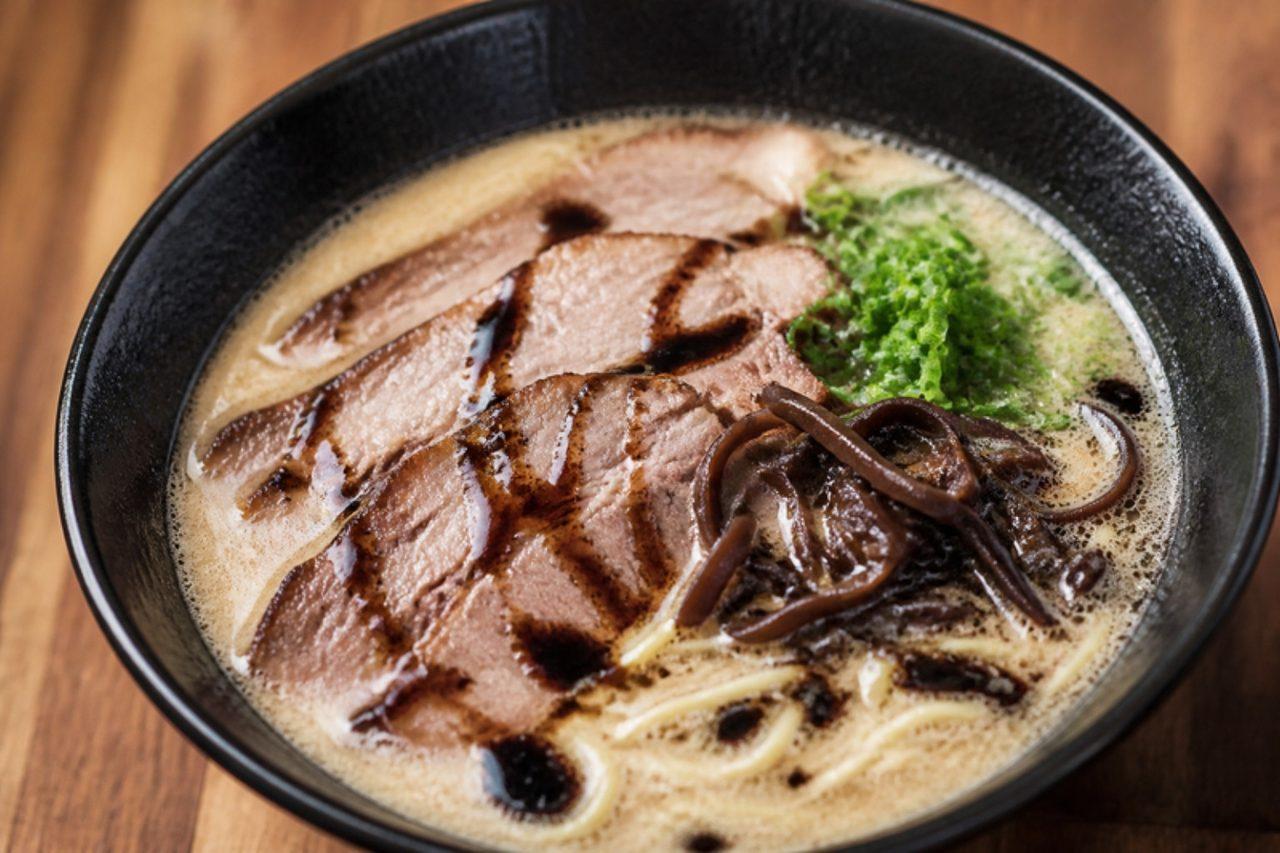
AI-generated image
Kumamoto ramen
熊本ラーメン: pork-and-chicken broth, firm thick noodles, chashu and black burnt-garlic oil

Kumamoto's ramen grew from the same Kyushu pork-bone tradition as Hakata's, but it took its own road. The broth blends pork bones with chicken for a rounder, milder soup, the noodles are thicker and firmer, and every bowl is finished with mayu, a black oil made by slowly burning garlic, plus a handful of crisp fried garlic chips. Ramen shops around Kumamoto city and its castle serve it with chashu, wood ear mushroom and a seasoned egg. This version is a long weekend project, but the mayu and the chashu can be made a day ahead. Chef's tip: make the mayu over low heat and keep stirring; the garlic must go slowly from gold to brown to black, which takes about 15 minutes.
- Total time
- 120 min
- Difficulty
- hard
- Serves
- 4
Ingredients
For the broth
- 2 ¼ lb pork bones (trotters, split, and neck bones)ask the butcher to cut them
- 1 ⅛ lb chicken wings or carcass
- 12 ½ cups waterplus extra for topping up
- 1 onionhalved
- 1 oz gingersliced
- 1 head garlichalved across
For the chashu
- 1 ⅛ lb boneless pork shoulder or bellyrolled and tied with string
- ¼ cup soy sauce
- 3 tbsp mirincontains alcohol; see step 7
- 1 tbsp sugar
For the mayu and garlic chips
- 8 cloves garlicfinely grated
- 4 cloves garlicthinly sliced
- 6 tbsp vegetable oil
- 2 tbsp toasted sesame oil
For the tare and bowls
- 2 tsp salt
- 3 tbsp light soy sauce (usukuchi)
- 4 eggs
- ⅛ oz dried wood ear mushroomssoaked and sliced
- 4 spring onionsfinely sliced
- 1 sheet noricut into quarters
Shop this recipe on Amazon
What you'll need
Spices & pantry
Fresh ingredients (9)
Links open Amazon in a new tab. As an Amazon Associate, WhatToEat.Today earns from qualifying purchases.
Method
0/17 doneStep 1: Put 2 ¼ lb pork bones (trotters, split, and neck bones) and 1 ⅛ lb chicken wings or carcass in your largest pot, cover with cold water and bring to the boil over high heat. Boil for 10 minutes; a thick grey scum will rise.
15 minStep 2: Drain into a colander and rinse every bone under cold water, scrubbing off the dark scum and any blood. Wash out the pot.
5 minStep 3: Return the bones to the clean pot with 12 ½ cups water. Bring to a rolling boil over high heat and keep it boiling hard, lid off, topping up with boiling water to keep the bones covered. Common mistake: letting the pot only simmer; the rolling boil is what breaks down the fat and collagen and turns the broth cloudy and rich.
10 minStep 4: Tie 1 ⅛ lb boneless pork shoulder or belly in a tight roll if the butcher has not, and lower it into the boiling broth. Turn the heat down to a steady boil.
2 minStep 5: After 60 minutes, lift out the pork. It should be tender when pierced with a skewer and at least 145°F/145 °F in the centre. Put it in a small container or zip bag.
60 minStep 6: Add 1 onion, 1 oz ginger, 1 head garlic and 2 leek or spring onion green tops to the broth and keep boiling for 30 minutes more.
30 minStep 7: Meanwhile, heat ¼ cup soy sauce, 3 tbsp mirin and 1 tbsp sugar in a small pan just until the sugar dissolves. Pour it over the warm pork and leave to marinate, turning now and then, while the broth finishes. Mirin contains a little alcohol; for an alcohol-free marinade use 1 tbsp more sugar and 2 tbsp water instead.
3 minStep 8: Bring a pan of water to the boil, lower in 4 eggs and boil for 6 and a half minutes for jammy yolks. Cool in iced water, peel and put them in with the pork and its marinade.
10 minStep 9: For the garlic chips, put 4 cloves garlic and 3 tbsp of the 6 tbsp vegetable oil in a small cold frying pan. Heat over medium-low, stirring, until the slices are pale gold, then lift them onto kitchen paper; they crisp as they cool. Keep the oil.
6 minStep 10: For the mayu, add 8 cloves garlic and the rest of the vegetable oil to the garlic-chip oil. Cook over low heat, stirring all the time, as it turns gold, then brown, then black, about 15 minutes.
15 minStep 11: Take the mayu off the heat, stir in 2 tbsp toasted sesame oil and leave to cool. It should smell deeply roasted and bittersweet, not sharp and acrid; if it smells like burnt toast, start again. Blend or crush to a smooth black oil.
5 minStep 12: Strain the broth through a fine sieve and skim off some of the surface fat, leaving a thin layer. You should have about 1.6 litres; top up with water or boil down to get there. Keep it hot.
5 minStep 13: Slice the chashu thinly. Put ½ tsp 2 tsp salt and 2 tsp 3 tbsp light soy sauce (usukuchi) in each of 4 warmed bowls.
3 minStep 14: Cook 1 ⅛ lb fresh medium-thick straight ramen noodles in plenty of boiling water for the time on the pack, keeping them firm. Drain well.
3 minStep 15: Pour 400 ml hot broth into each bowl and stir to dissolve the tare. Add the noodles, then top with chashu, a halved egg, ⅛ oz dried wood ear mushrooms, 4 spring onions and 1 sheet nori.
3 minStep 16: Spoon 1 to 2 tsp mayu over each bowl and scatter with garlic chips. Serve straight away.
1 minStep 17: To make ahead, cool leftover broth quickly in a sink of cold water, refrigerate within 2 hours and use within 3 days, or freeze for up to 3 months. Mayu keeps in a jar in the fridge for 2 weeks.
Nutrition per serving
- Calories
- 830 kcal
- Protein
- 47 g
- Carbs
- 72 g
- Fat
- 39 g
- Fibre
- 4 g
Nutrition values are estimates.
KrazyBadal
Good to know
- How long does kumamoto ramen take?
- About 120 minutes in total: 20 minutes to prepare and 100 minutes to cook.
- How many people does it serve?
- 4 as written. Change the servings above the ingredients and every amount scales to match.
- Can I make it ahead?
- Yes. It keeps well, so you can cook it earlier in the day or the day before and reheat it.
- What can I use instead of onion?
- 2 shallots per onion.
- What can I use instead of garlic?
- ½ tsp garlic paste or ⅛ tsp garlic powder per clove.
Reviews
No reviews yet. Be the first to cook it.
Rate this recipe
Sign in to rate and review this recipe.
You might also like

Boiled pasta
The basic method for any dried pasta, from penne to spaghetti. A large pan of salted boiling water keeps the pasta from sticking, and you cook it only until just done, with a little bite left. Use it in salads, bakes or with any sauce.
 Italian


Miso soup
Miso soup (味噌汁) is drunk every day in homes all over Japan, at breakfast as well as dinner, beside a bowl of rice. The base is dashi; this vegan version uses kombu and dried shiitake instead of bonito, which gives it a deep, rounded flavour. Silken tofu and wakame seaweed are the classic fillings. It takes ten minutes; just remember not to boil the miso. Chef's tip: add the miso at the very end and never let it boil. Boiling kills the miso's fresh, fermented aroma; Japanese cooks say the soup should only 'smile', with the surface barely trembling.

Yaki onigiriGrilled rice balls
Yaki onigiri (焼きおにぎり) are rice balls grilled until they form a crisp, toasty crust, then brushed with soy sauce glaze. They are eaten all over Japan, at izakaya, at barbecues and from the freezer section, as a snack or with miso soup. The inside stays soft and steamy while the outside crackles. Best eaten hot, straight from the pan. Chef's tip: let the shaped rice balls dry for 10 minutes before they go in the pan. A drier surface forms a better crust and won't stick, and the glaze goes on only at the end so it doesn't burn.