
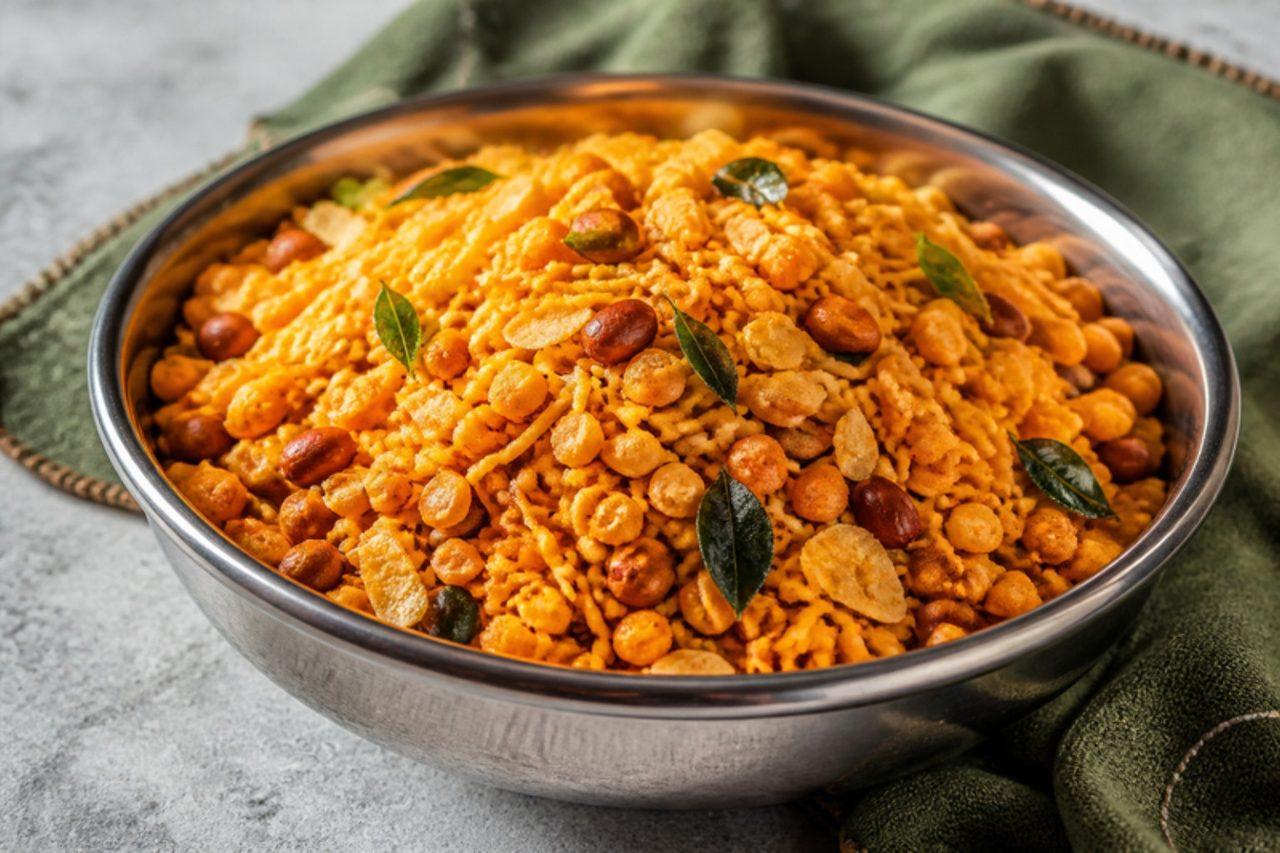
AI-generated image
Madras mixture
Crunchy savoury snack mix
மிக்சர்: Tamil Nadu's crunchy jumble of besan sev and kara boondi with fried peanuts, poha, roasted gram and crisp curry leaves



In Chennai sweet shops the glass jars of mixture sit beside the murukku, and at Deepavali most Tamil families make their own. It is built from separately fried parts: thin besan omapodi-style sev, little spiced kara boondi pearls, thick poha fried to a crunch, fried gram, peanuts and a big handful of curry leaves, all tossed with chilli and asafoetida while warm. The flavour is salty, peppery and savoury, with no sugar and no raisins, which is what sets it apart from Gujarati chevdo. Each part has a different crunch, so every handful is different. Serve it with filter coffee or tea. Use gluten-free asafoetida if you need it gluten-free. Chef's tip: fry everything in the same oil in order, from lightest to heaviest flavour: poha and peanuts first, then boondi, then sev; that keeps the oil clean and every part tastes fresh.
- Total time
- 75 min
- Difficulty
- medium
- Serves
- 12
Ingredients
For the sev
- 5 ½ oz gram flour (besan)
- 2 tbsp rice flour
- 1 tsp red chilli powder
- ¾ tsp salt
- 1 tbsp groundnut or sunflower oilhot
- ¼ cup waterabout
For the kara boondi
- 3 ½ oz gram flour (besan)
- ½ tsp red chilli powder
- ½ tsp salt
- ½ cup waterabout
To mix
- 1 ⅜ oz thick poha (aval)
- 2 ⅝ oz raw peanuts
- 1 ¾ oz roasted gram (pottukadalai)
- 30 curry leaves
- 1 tsp red chilli powder
- ¼ tsp gluten-free asafoetida
- ½ tsp salt
Shop this recipe on Amazon
What you'll need
Spices & pantry
Fresh ingredients (1)
Links open Amazon in a new tab. As an Amazon Associate, WhatToEat.Today earns from qualifying purchases.
Method
0/8 doneStep 1: For the sev, mix 5 ½ oz gram flour (besan), 2 tbsp rice flour, 1 tsp red chilli powder and ¾ tsp salt, rub in 1 tbsp groundnut or sunflower oil and knead with ¼ cup water into a soft, sticky dough. Cover.
Step 2: For the boondi, whisk 3 ½ oz gram flour (besan), ½ tsp red chilli powder, ½ tsp salt and ½ cup water into a smooth batter that coats a spoon and falls in a steady ribbon. Rest for 5 minutes.
5 minStep 3: Heat 4 ¼ cups groundnut or sunflower oil, for deep-frying in a kadhai over a medium heat to about 350°F. Fry 1 ⅜ oz thick poha (aval) in a fine sieve dipped in the oil for 20–30 seconds until it puffs and turns crisp but still pale. Drain in a large bowl lined with kitchen paper.
3 minStep 4: Fry 2 ⅝ oz raw peanuts for 3–4 minutes until they crackle and the skins darken slightly, then 1 ¾ oz roasted gram (pottukadalai) for 30 seconds, and add both to the bowl.
5 minStep 5: Hold a perforated spoon over the oil and pour on a ladle of batter, tapping gently so drops fall in. Fry the boondi for 1–2 minutes until the sizzle quietens and they are crisp. Common mistake: batter too thick; the drops come out with tails instead of round pearls. Add a teaspoon of water if they do.
12 minStep 6: Fill a sev press fitted with the fine-holed plate and press the dough into the oil in circles. Fry for 1–2 minutes, turning once, until crisp and golden. Drain and break into 3–4 cm pieces when cool.
12 minStep 7: Fry 30 curry leaves for 15–20 seconds until they turn translucent and stop sizzling. Stand back; they spit.
Step 8: Add the boondi, sev and curry leaves to the bowl. While still warm, sprinkle over 1 tsp red chilli powder, ¼ tsp gluten-free asafoetida and ½ tsp salt and toss gently with your hands. Cool completely and store airtight for up to 3 weeks.
Nutrition per serving
- Calories
- 210 kcal
- Protein
- 6 g
- Carbs
- 16 g
- Fat
- 14 g
- Fibre
- 3 g
Nutrition values are estimates.
KrazyBadal
Good to know
- How long does madras mixture take?
- About 75 minutes in total: 25 minutes to prepare and 50 minutes to cook.
- How many people does it serve?
- 12 as written. Change the servings above the ingredients and every amount scales to match.
- Is it vegan?
- Yes. It has no meat, fish, dairy or eggs.
- Is it gluten free?
- Yes, as written. Check the labels on stock, sauces and spice mixes, which sometimes contain gluten.
- Can I make it ahead?
- Yes. It keeps well, so you can cook it earlier in the day or the day before and reheat it.
- What can I use instead of red chilli powder?
- Cayenne, half the amount (hotter).
- What can I use instead of red chilli powder?
- Cayenne, half the amount (hotter).
Reviews
No reviews yet. Be the first to cook it.
Rate this recipe
Sign in to rate and review this recipe.
You might also like

Yaki onigiriGrilled rice balls
Yaki onigiri (焼きおにぎり) are rice balls grilled until they form a crisp, toasty crust, then brushed with soy sauce glaze. They are eaten all over Japan, at izakaya, at barbecues and from the freezer section, as a snack or with miso soup. The inside stays soft and steamy while the outside crackles. Best eaten hot, straight from the pan. Chef's tip: let the shaped rice balls dry for 10 minutes before they go in the pan. A drier surface forms a better crust and won't stick, and the glaze goes on only at the end so it doesn't burn.
 Japanese

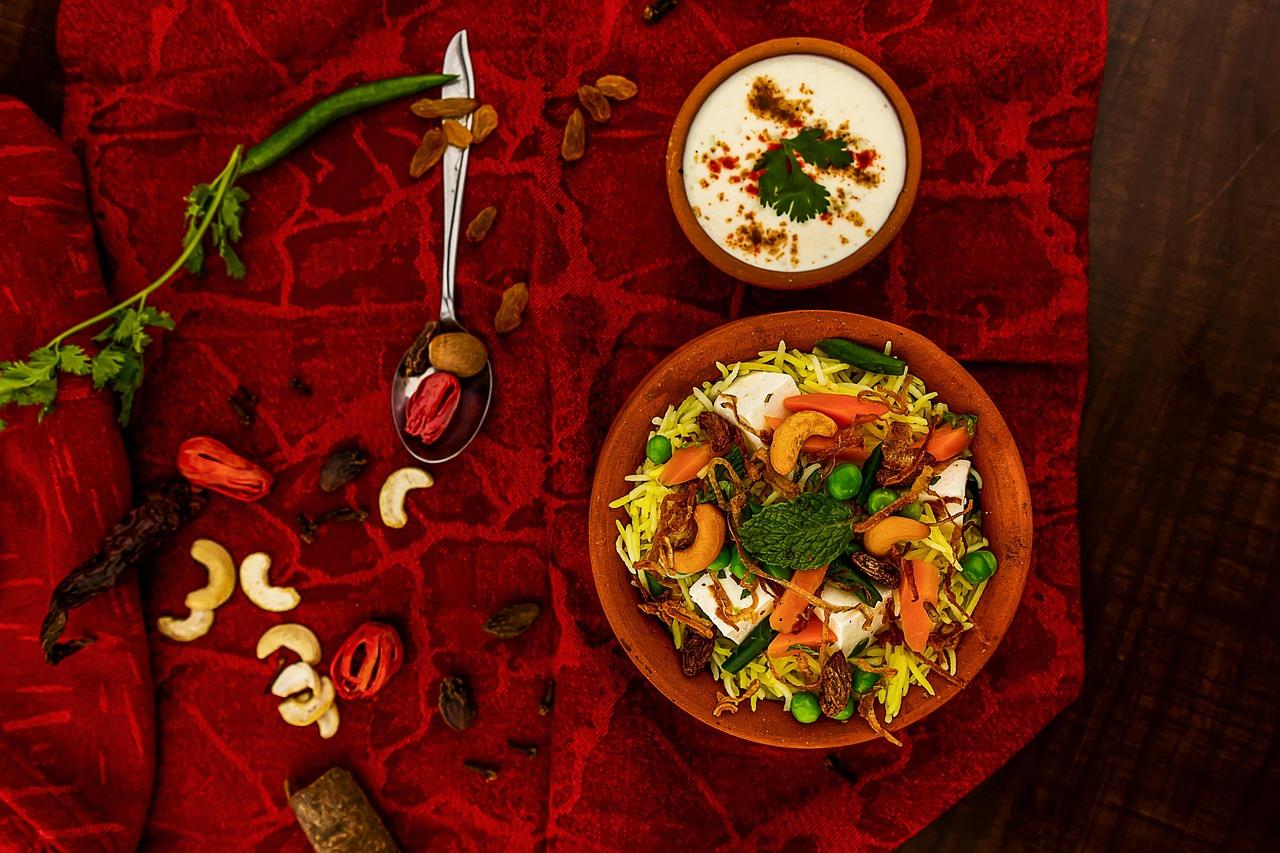
Paneer biryaniRice and moong dal in coconut milk
A mild, creamy biryani: rice and husked green gram roasted in ghee, then cooked in coconut milk with peas, carrots, potatoes, peanuts and cashews, and finished with soft fried paneer and a fresh coriander yogurt. Serve hot, garnished with more fried cashews and paneer.


Sabudana khichdiSago with peanuts and potato
Sabudana khichdi is the dish that sees Maharashtra through every vrat (fast), from Navratri to Ekadashi, but it's so good that people eat it any day of the week. Soaked sago pearls are tossed in a pan with crushed roasted peanuts, cubes of potato, cumin and green chilli until each pearl turns glassy and separate, then finished with lemon and coriander. It's soft, chewy, nutty and gently hot. Fasting rules vary from family to family, so check yours; this version uses rock salt and no asafoetida, onion or garlic. Traditionally it's cooked in ghee; use ghee instead of oil if you aren't keeping it vegan. Chef's tip: soak the sago in just enough water to cover by the height of the pearls themselves, no more; too much water is the reason khichdi turns into one sticky lump.
Perfect for:Diwali