
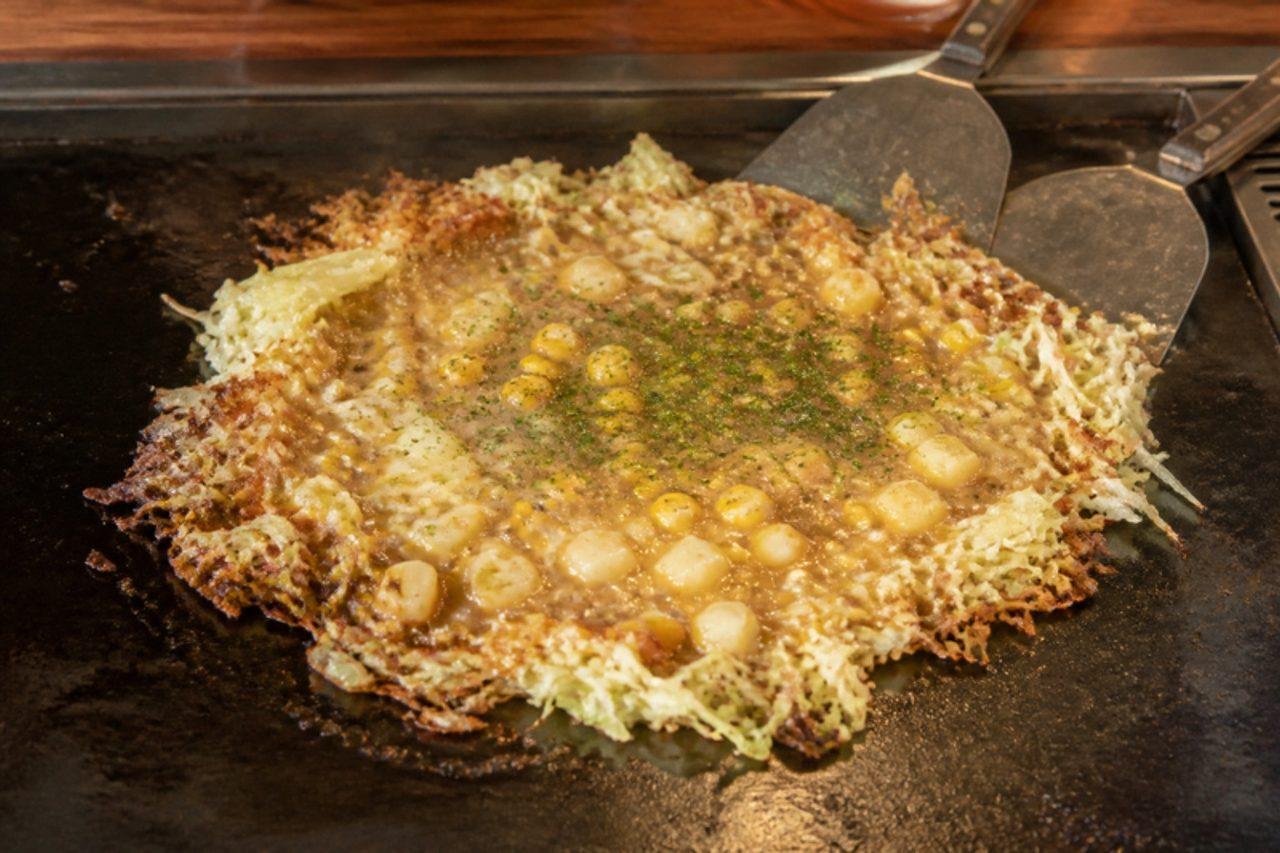
AI-generated image
Monjayaki
Griddled cabbage and batter
もんじゃ焼き (monjayaki): a loose cabbage-and-batter griddle dish from Tsukishima, scraped up straight from the hotplate
 Japanese
Monjayaki comes from Tsukishima, a small island district in Tokyo Bay, where one street holds more than seventy monja restaurants. It began as a cheap after-school snack at sweet shops, with children writing letters in thin batter on a griddle. Today friends gather round a teppan table, build a ring of chopped cabbage, pour the runny batter into the middle and eat it with tiny spatulas while it is still molten. It never sets into a pancake like okonomiyaki: the texture is gooey, with crisp, toasty bits where it sticks to the plate. Our version leaves out the usual dried shrimp and uses mochi and cheese, a favourite Tsukishima combination. Chef's tip: press a little monja against the hot griddle with your spatula and wait until it crackles. That crisp layer, called the okoge, is the best bite.
- Total time
- 27 min
- Difficulty
- easy
- Serves
- 2
Ingredients
For the batter
- ⅔ oz plain flour
- 1 ¼ cups kombu-shiitake dashicold
- 1 tsp soy sauce
For the filling
- 7 oz white cabbagefinely chopped into 5 mm pieces
- 2 spring onionsthinly sliced
- 3 tbsp tenkasu (tempura crumbs)plain kind (check for shrimp or bonito), or crushed plain rice crackers
- 1 ¾ oz sweetcorn kernels
- 1 kirimochi (dried rice cake)cut into 1 cm cubes
- 1 tbsp vegetable oil
To finish
- 1 tsp aonori (green seaweed flakes) (optional)
- 1 tbsp beni shoga (red pickled ginger) (optional)
Shop this recipe on Amazon
Spices & pantry
Fresh ingredients (4)
Links open Amazon in a new tab. As an Amazon Associate, WhatToEat.Today earns from qualifying purchases.
Method
0/7 doneStep 1: Whisk ⅔ oz plain flour into 1 ¼ cups kombu-shiitake dashi until there are no lumps, then stir in 2 tbsp vegetarian Worcestershire sauce and 1 tsp soy sauce. It will look like thin, cloudy soup, which is right.
Step 2: Put 7 oz white cabbage, 2 spring onions, 3 tbsp tenkasu (tempura crumbs), 1 ¾ oz sweetcorn kernels and 1 kirimochi (dried rice cake) in a bowl, then pour the batter over without mixing, so the solids sit on top.
Step 3: Heat an electric griddle or a large frying pan over medium-high heat and add 1 tbsp vegetable oil. Lift the solids out of the batter with a slotted spoon and fry them, chopping with two spatulas, for 3–4 minutes until the cabbage wilts and smells sweet.
4 minStep 4: Push the cabbage into a ring about 20 cm across with a hole in the middle, like a doughnut. Pour half the batter into the hole and let it bubble for 1 minute until it thickens.
1 minStep 5: Common mistake: pouring all the batter at once, so it bursts the ring and floods the pan. Add it in two goes, letting the first half thicken first.
Step 6: Pour in the rest of the batter, then mix everything together with the spatulas, chopping as you go, and spread it out thinly. Scatter 1 ⅜ oz pizza cheese or grated mozzarella over the top.
2 minStep 7: Cook for 2–3 minutes more over medium heat until the edges turn golden and crisp and the cheese melts. Sprinkle with 1 tsp aonori (green seaweed flakes) and 1 tbsp beni shoga (red pickled ginger). Eat straight from the griddle with small spatulas or spoons, pressing each bite against the hot surface until it sizzles.
3 min
Nutrition per serving
- Calories
- 330 kcal
- Protein
- 12 g
- Carbs
- 46 g
- Fat
- 11 g
- Fibre
- 5 g
Nutrition values are estimates.
KrazyBadal
Good to know
- How long does monjayaki take?
- About 27 minutes in total: 15 minutes to prepare and 12 minutes to cook.
- How many people does it serve?
- 2 as written. Change the servings above the ingredients and every amount scales to match.
- Is it vegetarian?
- Yes. It has no meat or fish.
- What can I use instead of plain flour?
- Self-raising flour, same amount (then leave out the baking powder).
- What can I use instead of soy sauce?
- Tamari, same amount (gluten free).
Reviews
No reviews yet. Be the first to cook it.
Rate this recipe
Sign in to rate and review this recipe.
You might also like

SakarpadaSweet fried dough diamonds
Sakarpada (shakarpara) are little sweet diamonds of a rich dough made with ghee, milk and sugar, fried until golden and crunchy. They are a Diwali favourite with tea, and the cubes go into bhusu too. They keep for weeks in an air-tight tin.
 Indian

Yaki onigiriGrilled rice balls
Yaki onigiri (焼きおにぎり) are rice balls grilled until they form a crisp, toasty crust, then brushed with soy sauce glaze. They are eaten all over Japan, at izakaya, at barbecues and from the freezer section, as a snack or with miso soup. The inside stays soft and steamy while the outside crackles. Best eaten hot, straight from the pan. Chef's tip: let the shaped rice balls dry for 10 minutes before they go in the pan. A drier surface forms a better crust and won't stick, and the glaze goes on only at the end so it doesn't burn.


Miso soup
Miso soup (味噌汁) is drunk every day in homes all over Japan, at breakfast as well as dinner, beside a bowl of rice. The base is dashi; this vegan version uses kombu and dried shiitake instead of bonito, which gives it a deep, rounded flavour. Silken tofu and wakame seaweed are the classic fillings. It takes ten minutes; just remember not to boil the miso. Chef's tip: add the miso at the very end and never let it boil. Boiling kills the miso's fresh, fermented aroma; Japanese cooks say the soup should only 'smile', with the surface barely trembling.