
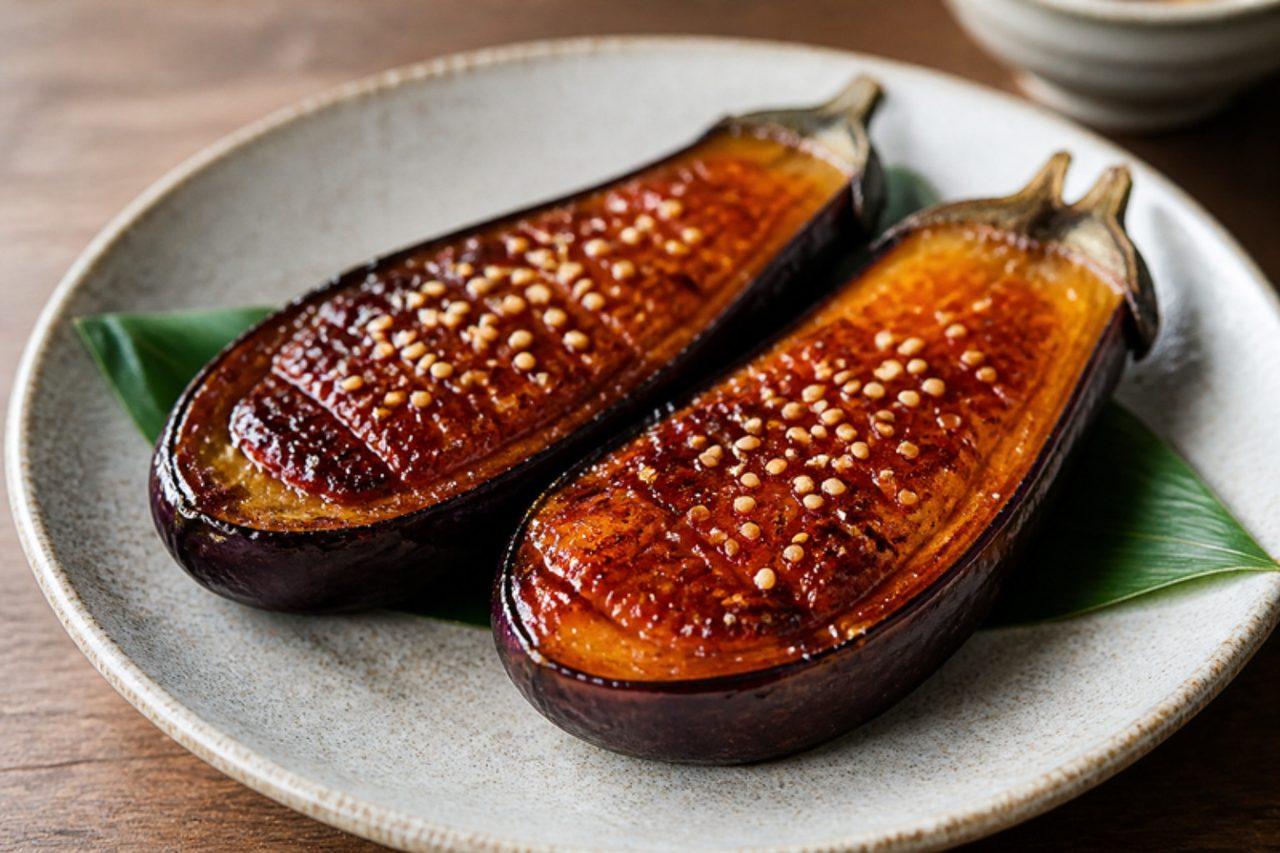
AI-generated image
Nasu dengaku
Miso-glazed aubergine
Nasu dengaku (なす田楽): grilled aubergine with a sweet miso glaze


Dengaku began in Kyoto as tofu on skewers brushed with miso and grilled at temple festivals; today the aubergine version is a favourite izakaya plate across Japan, best in late summer when Japanese aubergines are at their sweetest. The halves are scored, cooked until the flesh is custard-soft, then spread with a glossy sweet miso and grilled until it bubbles and blisters. The mirin and sake contain alcohol but simmer away in the glaze; the notes give alcohol-free swaps. The usual mistake is grilling the miso before the aubergine is fully soft: it burns while the inside stays spongy. Chef's tip: score the cut side in a deep criss-cross, almost to the skin, so the heat and the glaze both get right in.
- Total time
- 32 min
- Difficulty
- easy
- Serves
- 2
Ingredients
- 2 auberginesmedium, about 250 g each, or 4 slim Japanese ones
- 2 tbsp vegetable oil
For the miso glaze
- 3 tbsp white or blended miso
- 2 tbsp mirincontains alcohol; for alcohol-free use 1 tsp sugar per tbsp, dissolved in 1 tbsp water
- 1 tbsp sakecontains alcohol; for alcohol-free use the same amount of water
- 1 tbsp sugar
To finish
- 1 spring onion (optional)thinly sliced
Shop this recipe on Amazon
Fresh ingredients (2)
Links open Amazon in a new tab. As an Amazon Associate, WhatToEat.Today earns from qualifying purchases.
Method
0/5 doneStep 1: Heat the grill to high. Halve 2 aubergines lengthways and score the cut sides deeply in a 1 cm criss-cross, stopping just short of the skin.
5 minStep 2: Heat 2 tbsp vegetable oil in a large frying pan over a medium heat and lay the aubergines cut-side down. Fry for 5 minutes until golden, then turn, cover with a lid and cook for 6–8 minutes more, until the flesh is completely soft when pressed.
13 minStep 3: Meanwhile, stir 3 tbsp white or blended miso, 2 tbsp mirin, 1 tbsp sake and 1 tbsp sugar in a small pan over a low heat for 2–3 minutes, until glossy and as thick as ketchup.
3 minStep 4: Put the aubergines cut-side up on a lined tray, spread the glaze evenly over each one, and grill 10 cm from the heat for 2–3 minutes, until the miso bubbles and catches in dark spots. Watch closely: it burns fast.
3 minStep 5: Sprinkle with 1 tsp toasted white sesame seeds and 1 spring onion and serve hot, scooping the flesh from the skin with a spoon.
Nutrition per serving
- Calories
- 210 kcal
- Protein
- 4 g
- Carbs
- 22 g
- Fat
- 12 g
- Fibre
- 6 g
Nutrition values are estimates.
KrazyBadal
Good to know
- How long does nasu dengaku take?
- About 32 minutes in total: 10 minutes to prepare and 22 minutes to cook.
- How many people does it serve?
- 2 as written. Change the servings above the ingredients and every amount scales to match.
- Is it vegan?
- Yes. It has no meat, fish, dairy or eggs.
- What can I use instead of mirin?
- Rice vinegar with ½ tsp sugar per tbsp.
- What can I use instead of sugar?
- Caster sugar, same amount.
Reviews
No reviews yet. Be the first to cook it.
Rate this recipe
Sign in to rate and review this recipe.
You might also like
Black bean tacos with lime slaw
Proof that a meat-free taco night can be the best one. The beans are mashed with chipotle and cumin so they hold together in the tortilla, and a quick lime slaw adds crunch.
 Mexican


Yaki onigiriGrilled rice balls
Yaki onigiri (焼きおにぎり) are rice balls grilled until they form a crisp, toasty crust, then brushed with soy sauce glaze. They are eaten all over Japan, at izakaya, at barbecues and from the freezer section, as a snack or with miso soup. The inside stays soft and steamy while the outside crackles. Best eaten hot, straight from the pan. Chef's tip: let the shaped rice balls dry for 10 minutes before they go in the pan. A drier surface forms a better crust and won't stick, and the glaze goes on only at the end so it doesn't burn.

Caramelised clay-pot tofu and mushroomsBraised tofu and mushrooms
Kho is the slow braise of the Mekong Delta: food simmered in a little clay pot (nồi đất) with dark caramel and seasoning until the sauce is sticky and the flavours go deep. This vegetarian cousin of cá kho tộ (braised fish) uses golden tofu and meaty mushrooms in place of fish, cooked in coconut water, as cooks do in the south, and finished with plenty of black pepper. Serve it bubbling in its pot with steamed rice and a sour soup or plain boiled vegetables. Chef's tip: take the caramel (nước màu) to a deep mahogany, darker than you think, just before it smokes; pale caramel only tastes sweet, while dark caramel gives the bittersweet, smoky flavour of a real kho.
 Vietnamese