
AI-generated image
Shio pan
Japanese salt butter rolls with a crisp, buttery base
 Japanese
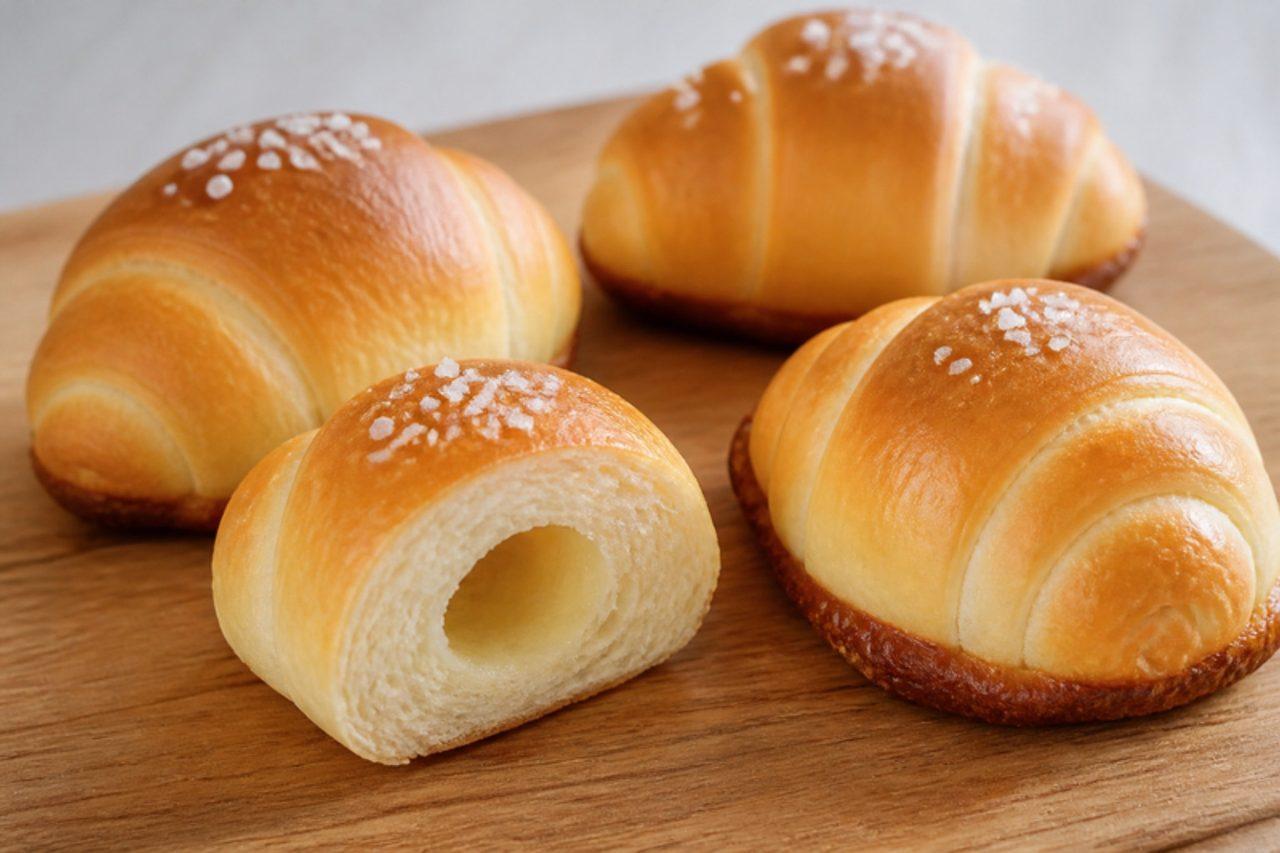
Shio pan (塩パン) began in 2003 at a small bakery in Yawatahama, a port town on the Ehime coast of Shikoku, and spread so fast that most Japanese bakeries now sell their own, as do the 'sogeum-ppang' shops of Seoul. Each roll is wound around a stick of cold butter; in the oven the butter melts out and fries the base, leaving a crisp, salty, golden bottom, a hollow, buttery tunnel inside and soft, chewy bread on top, finished with flaky salt. Eat them warm for breakfast with coffee, or split them for an egg or cucumber sandwich. Proving them somewhere too warm is the classic misstep: above about 28°C the butter leaks out before baking and the rolls lose their crunch. Chef's tip: leave the rolls on the tray for a couple of minutes after baking so they soak the melted butter back up into their bases.
- Total time
- 165 min
- Difficulty
- medium
- Serves
- 8
Ingredients
For the dough
- ½ oz caster sugar
- ⅛ oz salt
- ⅛ oz instant dried yeast1 tsp
- ½ cup whole milklukewarm
- ¼ cup waterlukewarm
- ½ oz unsalted buttersoft
For the filling and topping
- 2 ⅞ oz salted buttercold, cut into 8 sticks of 10 g
- 1 tbsp waterfor brushing
- 1 tsp flaky sea salt
Shop this recipe on Amazon
What you'll need
Fresh ingredients (3)
Links open Amazon in a new tab. As an Amazon Associate, WhatToEat.Today earns from qualifying purchases.
Method
0/10 doneStep 1: Mix 9 oz strong white bread flour, ½ oz caster sugar, ⅛ oz salt and ⅛ oz instant dried yeast. Add ½ cup whole milk and ¼ cup water and bring together into a dough.
Step 2: Knead for 5 minutes, add ½ oz unsalted butter and knead for 6–8 minutes more, until smooth and elastic.
12 minStep 3: Cover and leave in a warm place for 45–60 minutes, until doubled.
50 minStep 4: Divide into 8 pieces of about 55 g. Roll each into a ball, then roll one side under your palm into a teardrop or carrot shape about 12 cm long. Cover and rest for 10 minutes.
10 minStep 5: Roll each teardrop with a rolling pin into a long, thin triangle about 30 cm long and 8 cm wide at the base, holding the narrow tip and stretching gently as you roll.
Step 6: Lay a stick of 2 ⅞ oz salted butter across the wide end and roll the dough up loosely towards the tip, like a croissant. Pinch the end gently and place tip side down on a lined tray, well spaced.
Step 7: Cover and prove at cool room temperature (no warmer than about 82°F) for 40–50 minutes, until puffy.
45 minStep 8: Meanwhile heat the oven to 400°F (375°F fan). Brush or spray the rolls with 1 tbsp water and sprinkle each with a pinch of 1 tsp flaky sea salt.
Step 9: Bake for 13–15 minutes, until deep golden on top and the bases are crisp and browned in a pool of sizzling butter. Pressed lightly, the tops should spring back.
14 minStep 10: Leave on the tray for 2 minutes, then move to a rack. They are best warm, within a few hours; reheat in a hot oven for 3 minutes to recrisp.
2 min
Nutrition per serving
- Calories
- 230 kcal
- Protein
- 5 g
- Carbs
- 27 g
- Fat
- 11 g
- Fibre
- 1 g
Nutrition values are estimates.
KrazyBadal
Good to know
- How long does shio pan take?
- About 165 minutes in total: 150 minutes to prepare and 15 minutes to cook.
- How many people does it serve?
- 8 as written. Change the servings above the ingredients and every amount scales to match.
- Is it vegetarian?
- Yes. It has no meat or fish.
- What can I use instead of strong white bread flour?
- Plain flour, same amount (the dough will be softer and rise a little less).
- What can I use instead of caster sugar?
- Caster sugar, same amount.
Reviews
No reviews yet. Be the first to cook it.
Rate this recipe
Sign in to rate and review this recipe.
You might also like

Miso soup
Miso soup (味噌汁) is drunk every day in homes all over Japan, at breakfast as well as dinner, beside a bowl of rice. The base is dashi; this vegan version uses kombu and dried shiitake instead of bonito, which gives it a deep, rounded flavour. Silken tofu and wakame seaweed are the classic fillings. It takes ten minutes; just remember not to boil the miso. Chef's tip: add the miso at the very end and never let it boil. Boiling kills the miso's fresh, fermented aroma; Japanese cooks say the soup should only 'smile', with the surface barely trembling.


Yaki onigiriGrilled rice balls
Yaki onigiri (焼きおにぎり) are rice balls grilled until they form a crisp, toasty crust, then brushed with soy sauce glaze. They are eaten all over Japan, at izakaya, at barbecues and from the freezer section, as a snack or with miso soup. The inside stays soft and steamy while the outside crackles. Best eaten hot, straight from the pan. Chef's tip: let the shaped rice balls dry for 10 minutes before they go in the pan. A drier surface forms a better crust and won't stick, and the glaze goes on only at the end so it doesn't burn.

ChipaCheese bread rings
In Paraguay you hear 'chipa, chipa!' called by vendors with big baskets on buses and street corners, and every family bakes it for Holy Week, when chipa is the food of Good Friday. Cassava starch, a little cornmeal, butter, eggs and a lot of hard cheese are kneaded into a dough scented with aniseed, shaped into rings or small rolls and baked in a hot oven, traditionally a domed clay tatakua. It's chewy, crisp outside and best warm with cocido (toasted yerba tea). Chef's tip: the dough should feel soft and slightly greasy; add milk a spoon at a time, as too much makes the chipa spread flat.
 Paraguayan
