
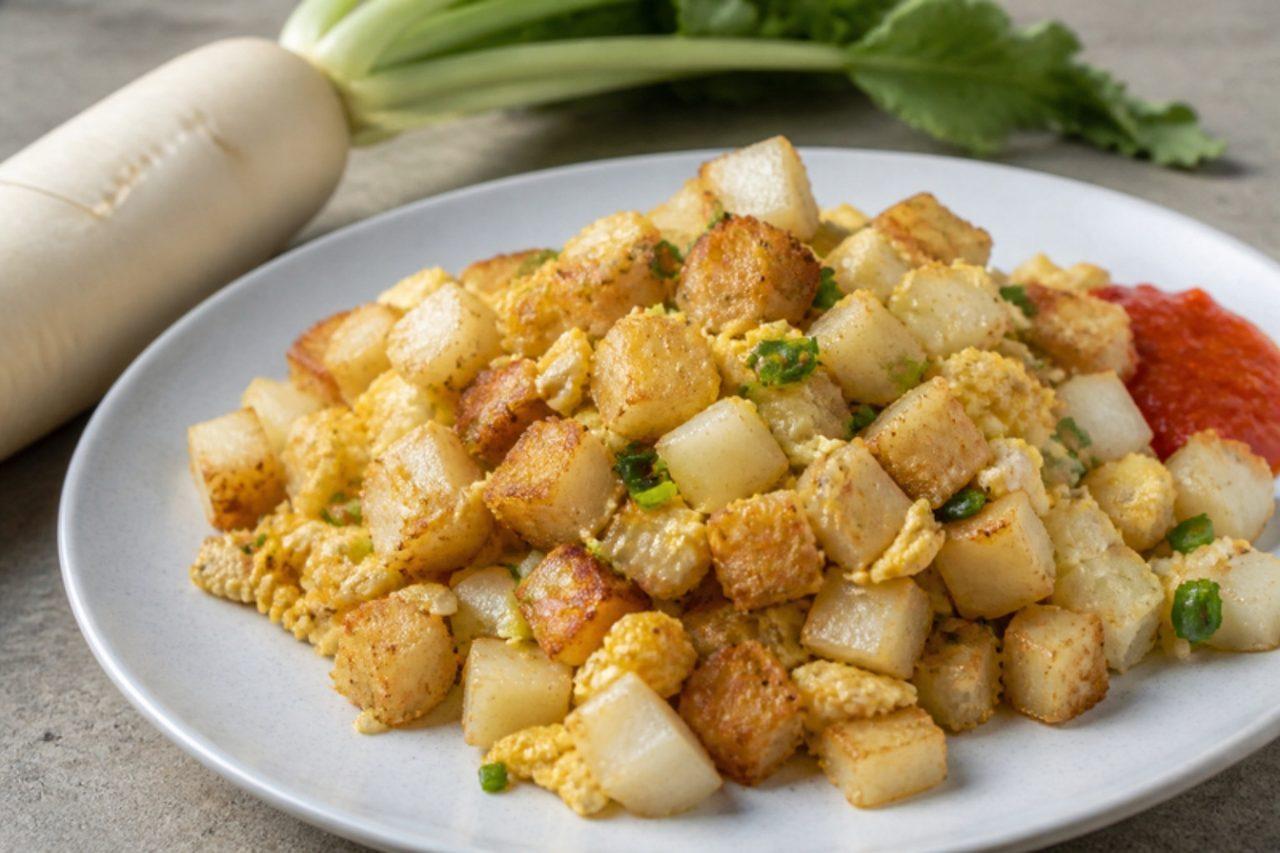
AI-generated image
Singapore carrot cake (chai tow kway)
Fried radish cake with egg
Chai tow kway: fried white radish cake with egg, white or black


Singapore's carrot cake has no carrot in it: "carrot" is the local word for white radish (daikon). A steamed cake of rice flour and grated radish is cut into cubes and fried with egg and garlic until crisp and golden, either "white" (plain and eggy) or "black" (with sweet dark soy). It's a breakfast and supper favourite at hawker centres like Chinatown Complex. Most stalls add chai poh (preserved radish); this version leaves it out because many brands are made with fish sauce, and spring onions bring the savoury lift instead. Chef's tip: steam the cake a day ahead and chill it overnight; cold, firm cake cuts cleanly and crisps instead of falling apart.
- Total time
- 75 min
- Difficulty
- medium
- Serves
- 4
Ingredients
For the radish cake
- 1 ⅛ lb white radish (daikon/mooli)peeled and coarsely grated
- 7 oz rice flour
- 2 tbsp tapioca starch
- 1 ½ cups water
- 1 tsp salt
- ½ tsp ground white pepper
- 1 tbsp vegetable oilplus extra for the tin
To fry
- 4 tbsp vegetable oil
- 4 garlic clovesfinely chopped
- 3 eggsbeaten
- 2 tbsp kecap manis (optional)only for the black version
- 3 spring onionssliced
- 2 tbsp chilli sauce (optional)to serve
Shop this recipe on Amazon
What you'll need
Spices & pantry
Fresh ingredients (3)
Links open Amazon in a new tab. As an Amazon Associate, WhatToEat.Today earns from qualifying purchases.
Method
0/9 doneStep 1: Put 1 ⅛ lb white radish (daikon/mooli) in a pan with 100 ml of the ½ cup water, cover and cook over a medium heat for 8–10 minutes, until soft and translucent. Don't drain it; the radish juice flavours the cake.
10 minStep 2: Whisk 7 oz rice flour, 2 tbsp tapioca starch, 1 tsp salt and ½ tsp ground white pepper with the rest of the 1 cup water until smooth. Add 1 tbsp vegetable oil.
Step 3: Pour the batter into the hot radish and stir over a low heat for 2–3 minutes, until it thickens to a heavy paste that pulls away from the pan.
3 minStep 4: Scrape into an oiled 20 cm square tin and smooth the top. Steam over a high heat for 40 minutes, until a chopstick pushed into the centre comes out clean and the cake looks glossy and semi-translucent. Cool, then chill for at least 4 hours, ideally overnight.
40 minStep 5: Turn out and cut into 2 cm cubes.
Step 6: Heat 4 tbsp vegetable oil in a large non-stick frying pan or wok over a medium-high heat. Fry the cubes in one layer for 6–8 minutes, turning occasionally, until golden and crisp on most sides. A common mistake is moving them too often: let each side sit until it releases on its own.
8 minStep 7: Push the cubes aside, add 4 garlic cloves and fry for 20 seconds until fragrant. Drizzle over 1 tbsp tamari (gluten-free soy sauce) (and 2 tbsp kecap manis for black carrot cake) and toss.
1 minStep 8: Pour 3 eggs over the cubes in a thin layer and leave for a minute, until the egg sets on the bottom. Turn it over in sections and fry until golden on both sides, chopping it up loosely with the spatula.
3 minStep 9: Scatter over 3 spring onions and serve hot with 2 tbsp chilli sauce.
Nutrition per serving
- Calories
- 420 kcal
- Protein
- 10 g
- Carbs
- 55 g
- Fat
- 18 g
- Fibre
- 3 g
Nutrition values are estimates.
KrazyBadal
Good to know
- How long does singapore carrot cake (chai tow kway) take?
- About 75 minutes in total: 20 minutes to prepare and 55 minutes to cook.
- How many people does it serve?
- 4 as written. Change the servings above the ingredients and every amount scales to match.
- Is it vegetarian?
- Yes. It has no meat or fish.
- Is it gluten free?
- Yes, as written. Check the labels on stock, sauces and spice mixes, which sometimes contain gluten.
- What can I use instead of garlic cloves?
- ½ tsp garlic paste or ⅛ tsp garlic powder per clove.
- What can I use instead of eggs?
- 1 tbsp ground flaxseed + 3 tbsp water per egg, left for 5 minutes (baking only; vegan).
Reviews
No reviews yet. Be the first to cook it.
Rate this recipe
Sign in to rate and review this recipe.
You might also like

SakarpadaSweet fried dough diamonds
Sakarpada (shakarpara) are little sweet diamonds of a rich dough made with ghee, milk and sugar, fried until golden and crunchy. They are a Diwali favourite with tea, and the cubes go into bhusu too. They keep for weeks in an air-tight tin.
 Indian

Yaki onigiriGrilled rice balls
Yaki onigiri (焼きおにぎり) are rice balls grilled until they form a crisp, toasty crust, then brushed with soy sauce glaze. They are eaten all over Japan, at izakaya, at barbecues and from the freezer section, as a snack or with miso soup. The inside stays soft and steamy while the outside crackles. Best eaten hot, straight from the pan. Chef's tip: let the shaped rice balls dry for 10 minutes before they go in the pan. A drier surface forms a better crust and won't stick, and the glaze goes on only at the end so it doesn't burn.
 Japanese

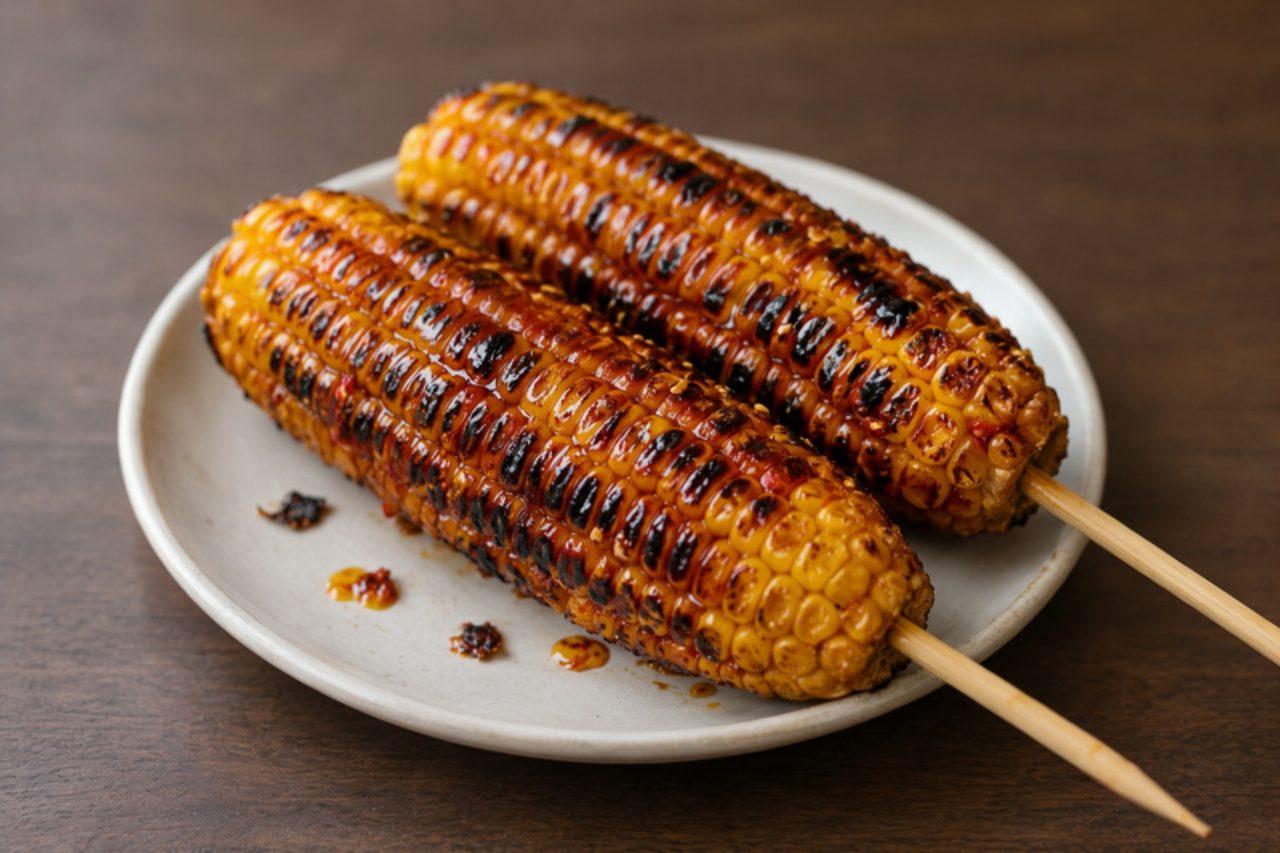
Taiwanese grilled corn
At Raohe and Shilin night markets the grilled-corn stalls are easy to find: look for the queue and the smoky, sweet smell. Cobs are par-cooked, then turned slowly over charcoal while the cook brushes them with a dark glaze of sacha sauce, thick soy paste, garlic and chilli, layer after layer, until the kernels are sticky, slightly charred and deeply savoury. It is eaten hot from a paper sleeve while walking the market. Sacha (shacha) sauce, a Taiwanese barbecue paste, usually contains dried fish and shrimp; vegetarian sacha is sold in Asian shops. Contains soy, wheat and fish. Chef's tip: brush thin coats and turn often; one thick coat burns before the corn chars.
 Taiwanese