
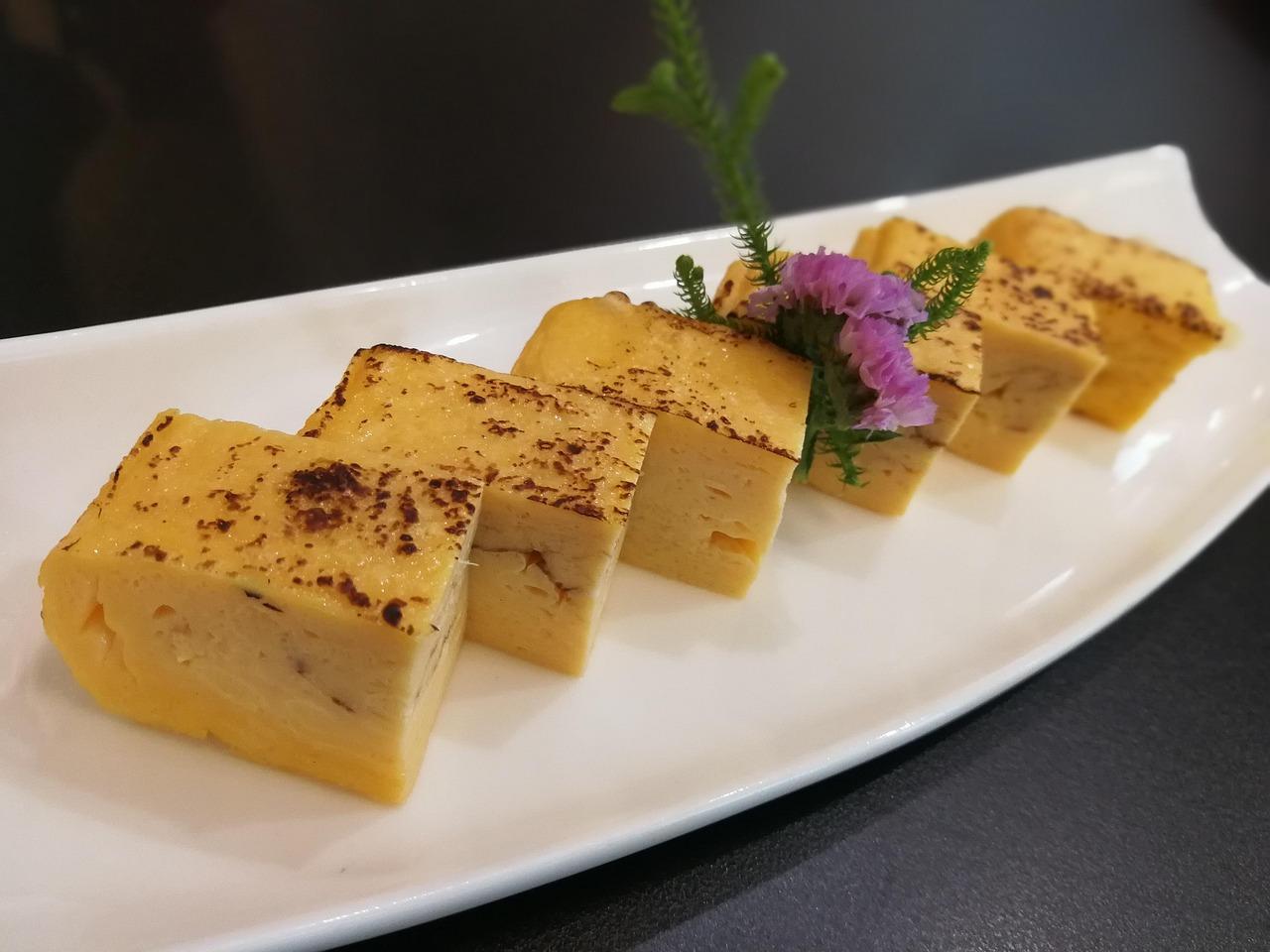
Tamagoyaki
Rolled omelette
卵焼き: sweet, layered rolled omelette cooked in thin sheets

Tamagoyaki (卵焼き) is a rolled omelette made in layers, found in breakfast trays and bento boxes all over Japan. Thin sheets of seasoned egg are cooked one at a time and rolled up around each other, giving soft, springy slices with pretty spiral lines. This is the gently sweet home style; a little soy keeps it savoury. A square tamagoyaki pan helps, but a small round frying pan works too. Chef's tip: keep the heat moderate and the pan well oiled between layers. If the egg browns, the heat is too high; a good tamagoyaki is evenly yellow with just a few golden patches.
- Total time
- 15 min
- Difficulty
- medium
- Serves
- 2
Ingredients
- 4 eggs
- 1 tbsp sugar
- 1 tsp light soy sauce
- 1 tsp mirin
- 2 tbsp water or kombu dashi
- 1 pinch salt
- 1 tbsp vegetable oil
- 2 tbsp grated daikon (optional)to serve
Shop this recipe on Amazon
What you'll need
Fresh ingredients (1)
Links open Amazon in a new tab. As an Amazon Associate, WhatToEat.Today earns from qualifying purchases.
Method
0/6 doneStep 1: Beat 4 eggs gently with chopsticks, cutting through the whites rather than whisking in air. Stir in 1 tbsp sugar, 1 tsp light soy sauce, 1 tsp mirin, 2 tbsp water or kombu dashi and 1 pinch salt until the sugar dissolves. Strain through a sieve for the smoothest result.
Step 2: Heat a tamagoyaki pan or 20 cm non-stick frying pan over a medium-low heat and wipe it with kitchen paper dipped in 1 tbsp vegetable oil.
Step 3: Test the heat with a drop of egg: it should sizzle gently and set in a few seconds, without browning. Pour in a quarter of the egg and tilt so it coats the base. Prick any big bubbles. When it's almost set but still a little wet on top, about 1 minute, roll it from the far side towards you with chopsticks or a spatula.
1 minStep 4: Push the roll back to the far side, oil the empty pan again and pour in another quarter of the egg. Lift the roll so the new egg flows underneath it.
1 minStep 5: When nearly set, roll the omelette back towards you, wrapping the new layer around it. Repeat with the rest of the egg, oiling the pan each time, to build up 4 layers.
4 minStep 6: Tip onto a bamboo mat or clean tea towel, wrap tightly and leave for 2 minutes to firm into shape. Slice into 6–8 pieces and serve warm or cold, with 2 tbsp grated daikon if you like.
Nutrition per serving
- Calories
- 220 kcal
- Protein
- 13 g
- Carbs
- 9 g
- Fat
- 15 g
- Fibre
- 0 g
Nutrition values are estimates.
KrazyBadal
Good to know
- How long does tamagoyaki take?
- About 15 minutes in total: 5 minutes to prepare and 10 minutes to cook.
- How many people does it serve?
- 2 as written. Change the servings above the ingredients and every amount scales to match.
- Is it vegetarian?
- Yes. It has no meat or fish.
- What can I use instead of eggs?
- 1 tbsp ground flaxseed + 3 tbsp water per egg, left for 5 minutes (baking only; vegan).
- What can I use instead of sugar?
- Caster sugar, same amount.
Reviews
No reviews yet. Be the first to cook it.
Rate this recipe
Sign in to rate and review this recipe.
You might also like

Miso soup
Miso soup (味噌汁) is drunk every day in homes all over Japan, at breakfast as well as dinner, beside a bowl of rice. The base is dashi; this vegan version uses kombu and dried shiitake instead of bonito, which gives it a deep, rounded flavour. Silken tofu and wakame seaweed are the classic fillings. It takes ten minutes; just remember not to boil the miso. Chef's tip: add the miso at the very end and never let it boil. Boiling kills the miso's fresh, fermented aroma; Japanese cooks say the soup should only 'smile', with the surface barely trembling.


Yaki onigiriGrilled rice balls
Yaki onigiri (焼きおにぎり) are rice balls grilled until they form a crisp, toasty crust, then brushed with soy sauce glaze. They are eaten all over Japan, at izakaya, at barbecues and from the freezer section, as a snack or with miso soup. The inside stays soft and steamy while the outside crackles. Best eaten hot, straight from the pan. Chef's tip: let the shaped rice balls dry for 10 minutes before they go in the pan. A drier surface forms a better crust and won't stick, and the glaze goes on only at the end so it doesn't burn.

Sabudana khichdiSago with peanuts and potato
Sabudana khichdi is the dish that sees Maharashtra through every vrat (fast), from Navratri to Ekadashi, but it's so good that people eat it any day of the week. Soaked sago pearls are tossed in a pan with crushed roasted peanuts, cubes of potato, cumin and green chilli until each pearl turns glassy and separate, then finished with lemon and coriander. It's soft, chewy, nutty and gently hot. Fasting rules vary from family to family, so check yours; this version uses rock salt and no asafoetida, onion or garlic. Traditionally it's cooked in ghee; use ghee instead of oil if you aren't keeping it vegan. Chef's tip: soak the sago in just enough water to cover by the height of the pearls themselves, no more; too much water is the reason khichdi turns into one sticky lump.
 Indian
