
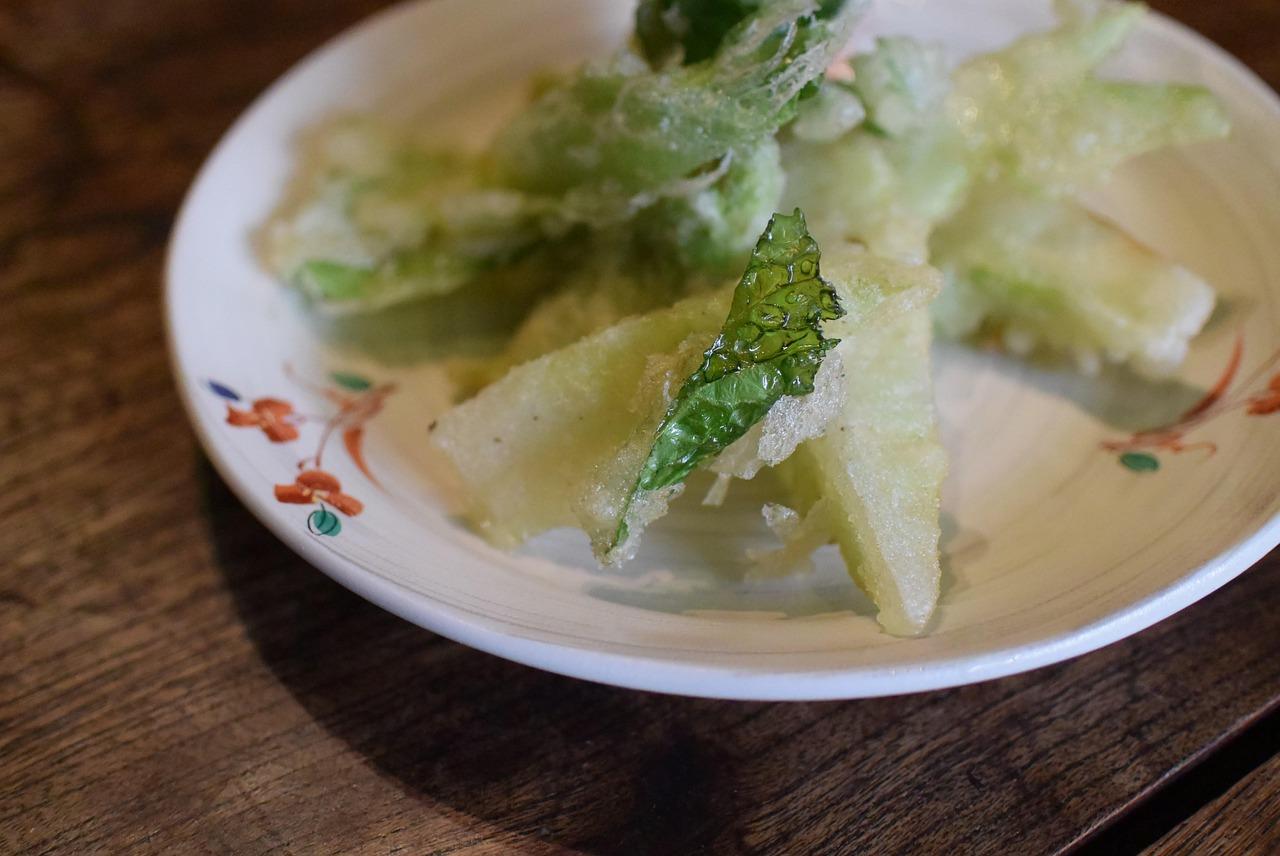
Vegetable tempura
野菜天ぷら: lacy, light-as-air battered vegetables with a kombu-shiitake dipping sauce
 Japanese
Tempura (天ぷら) became a Tokyo street food in the Edo period, when stalls fried it to order by the city's riverbanks. The secret to the thin, lacy coating is an ice-cold, lumpy batter mixed at the last second and vegetables fried in small batches. Sweet potato, aubergine, pepper, shiitake and green beans all work well. Serve straight from the pan with a light dipping sauce and grated daikon. Chef's tip: keep everything cold. Use ice-cold water, mix the batter only seconds before frying, leave it lumpy, and stand the bowl in a larger bowl of ice. Cold batter hitting hot oil is what makes the lacy, crackly shell that Tokyo tempura masters prize.
- Total time
- 35 min
- Difficulty
- medium
- Serves
- 4
Ingredients
For the dipping sauce
- ¾ cup water
- ⅛ oz kombu (dried kelp)
- 3 tbsp soy sauce
- 3 tbsp mirin
- 3 ½ oz daikon radish (optional)finely grated
For the vegetables
- 1 sweet potatocut into 5 mm slices
- 1 auberginecut into fans or 1 cm slices
- 1 red or green peppercut into strips
- 8 fresh shiitake mushroomsstems removed
- 3 ½ oz green beanstrimmed
- 2 tbsp plain flourfor dusting
For the batter
- 1 eggcold
- ¾ cup ice-cold sparkling water
- 4 oz plain flour
- 2 tbsp cornflour
For frying
- vegetable oilfor deep-frying
- 1 pinch flaky sea salt (optional)
Shop this recipe on Amazon
What you'll need
Spices & pantry
Fresh ingredients (6)
Links open Amazon in a new tab. As an Amazon Associate, WhatToEat.Today earns from qualifying purchases.
Method
0/7 doneStep 1: Make the sauce: soak ⅛ oz kombu (dried kelp) in ¾ cup water for 10 minutes, then bring to a simmer in a small pan, remove the kombu and add 3 tbsp soy sauce and 3 tbsp mirin. Simmer for 1 minute and keep warm.
3 minStep 2: Pat all the vegetables completely dry: 1 sweet potato, 1 aubergine, 1 red or green pepper, 8 fresh shiitake mushrooms and 3 ½ oz green beans. Dust them lightly with 2 tbsp plain flour so the batter clings.
Step 3: Heat vegetable oil in a deep pan or wok, no more than half full, to 350°F. A drop of batter should sink halfway, then rise and sizzle.
Step 4: Only when the oil is hot, make the batter: beat 1 egg with ¾ cup ice-cold sparkling water, then tip in 4 oz plain flour and 2 tbsp cornflour all at once. Stir a few times with chopsticks: it should stay lumpy, with dry flour still visible. Over-mixing makes it heavy.
Step 5: Dip the vegetables one at a time in the batter, let the excess drip off and slide into the oil. Fry 5 or 6 pieces at a time for 2–3 minutes (sweet potato 3–4), turning once, until crisp and pale gold. Don't crowd the pan, or the oil cools and the batter turns greasy.
12 minStep 6: Lift onto a rack lined with kitchen paper and sprinkle with 1 pinch flaky sea salt. Skim off any loose bits of batter between batches.
Step 7: Serve straight away with the warm dipping sauce and a mound of 3 ½ oz daikon radish to stir into it.
Nutrition per serving
- Calories
- 360 kcal
- Protein
- 7 g
- Carbs
- 48 g
- Fat
- 16 g
- Fibre
- 6 g
Nutrition values are estimates.
KrazyBadal
Good to know
- How long does vegetable tempura take?
- About 35 minutes in total: 20 minutes to prepare and 15 minutes to cook.
- How many people does it serve?
- 4 as written. Change the servings above the ingredients and every amount scales to match.
- Is it vegetarian?
- Yes. It has no meat or fish.
- What can I use instead of soy sauce?
- Tamari, same amount (gluten free).
- What can I use instead of mirin?
- Rice vinegar with ½ tsp sugar per tbsp.
Reviews
No reviews yet. Be the first to cook it.
Rate this recipe
Sign in to rate and review this recipe.
You might also like

SakarpadaSweet fried dough diamonds
Sakarpada (shakarpara) are little sweet diamonds of a rich dough made with ghee, milk and sugar, fried until golden and crunchy. They are a Diwali favourite with tea, and the cubes go into bhusu too. They keep for weeks in an air-tight tin.
 Indian

Yaki onigiriGrilled rice balls
Yaki onigiri (焼きおにぎり) are rice balls grilled until they form a crisp, toasty crust, then brushed with soy sauce glaze. They are eaten all over Japan, at izakaya, at barbecues and from the freezer section, as a snack or with miso soup. The inside stays soft and steamy while the outside crackles. Best eaten hot, straight from the pan. Chef's tip: let the shaped rice balls dry for 10 minutes before they go in the pan. A drier surface forms a better crust and won't stick, and the glaze goes on only at the end so it doesn't burn.


Miso soup
Miso soup (味噌汁) is drunk every day in homes all over Japan, at breakfast as well as dinner, beside a bowl of rice. The base is dashi; this vegan version uses kombu and dried shiitake instead of bonito, which gives it a deep, rounded flavour. Silken tofu and wakame seaweed are the classic fillings. It takes ten minutes; just remember not to boil the miso. Chef's tip: add the miso at the very end and never let it boil. Boiling kills the miso's fresh, fermented aroma; Japanese cooks say the soup should only 'smile', with the surface barely trembling.