
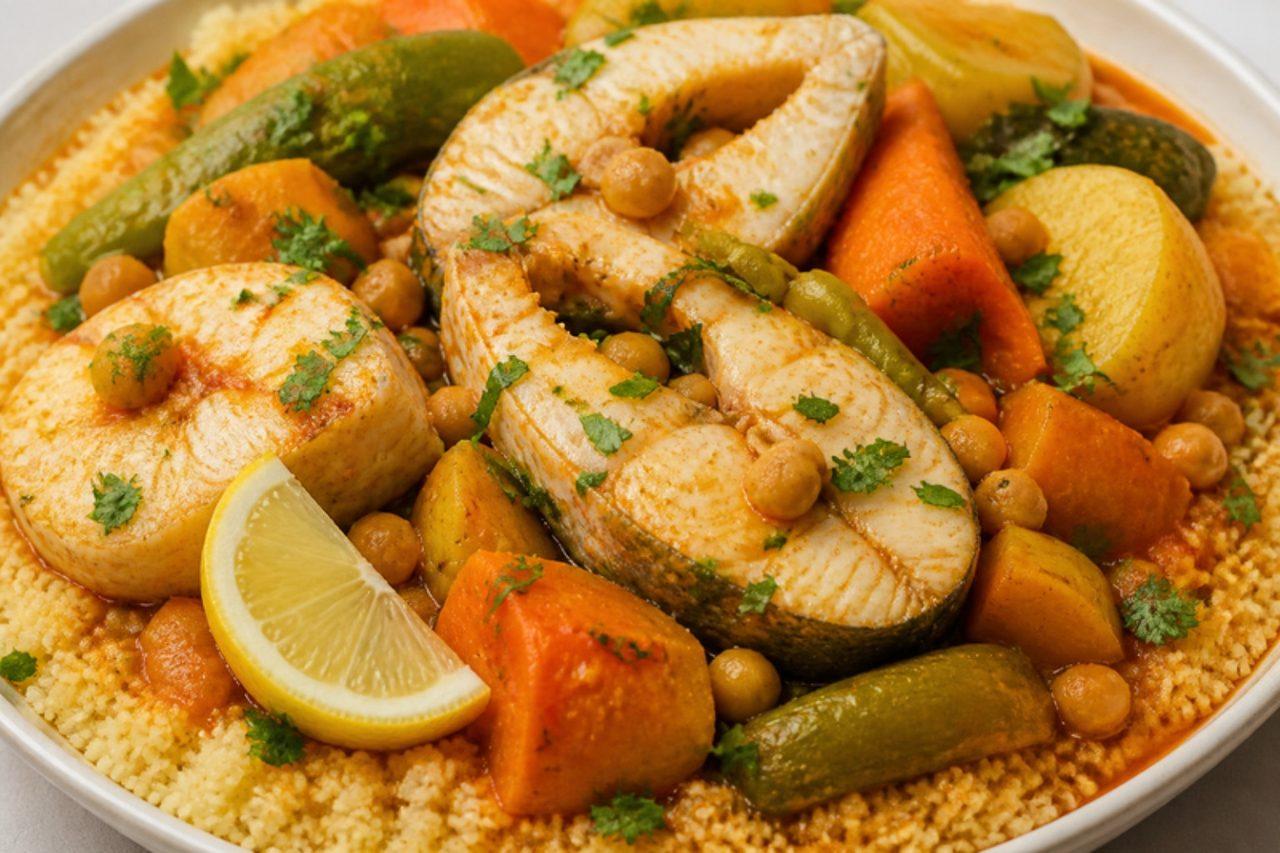
AI-generated image
Tunisian fish couscous
Kosksi bil hout: Sfax-style couscous with fish in a red harissa broth


On Tunisia's coast, especially in Sfax, Mahdia and the fishing towns of Cap Bon, couscous for Friday lunch is made with fish instead of meat: a red, peppery broth of tomato, harissa and caraway in which the vegetables cook first and the fish is poached at the end, while the couscous steams on top. The broth is ladled over the grains at the table until they glisten. The mistake is boiling the fish too long, so it breaks into the broth; poach it gently for the last 10 minutes only. Chef's tip: oil and rub the couscous between your palms before and after the first steaming so every grain stays separate.
- Total time
- 105 min
- Difficulty
- hard
- Serves
- 6
Ingredients
For the broth
- 5 tbsp olive oil
- 1 large onionchopped
- 4 garlic clovescrushed
- 3 tbsp tomato paste
- 1 ½ tbsp harissa
- 1 tsp ground caraway
- 1 tsp ground coriander
- 1 tsp sweet paprika
- ½ tsp ground turmeric
- 2 tsp salt
- 8 ¼ cups water
- 14 oz cooked chickpeas1 tin, drained
Vegetables
- 3 carrotshalved lengthways
- 3 potatoeshalved
- 10 ½ oz pumpkinin large chunks
- 2 courgetteshalved
- 2 long green pepperswhole
Fish and couscous
- 2 ⅝ lb firm white fish steaksgrouper, sea bream or hake, 3 cm thick
- 1 lemonjuiced
- 1 ⅛ lb medium couscous
- 2 tbsp olive oil
Shop this recipe on Amazon
What you'll need
Spices & pantry
Fresh ingredients (8)
Links open Amazon in a new tab. As an Amazon Associate, WhatToEat.Today earns from qualifying purchases.
Method
0/8 doneStep 1: Rub 2 ⅝ lb firm white fish steaks with 1 lemon and a pinch of the ½ tsp salt. Cover and chill while you make the broth.
Step 2: Heat 5 tbsp olive oil in the bottom of a couscoussier or a large pot. Fry 1 large onion for 6 minutes, then add 4 garlic cloves, 3 tbsp tomato paste, 1 ½ tbsp harissa, 1 tsp ground caraway, 1 tsp ground coriander, 1 tsp sweet paprika and ½ tsp ground turmeric and fry for 3 minutes, stirring, until the oil turns deep red.
9 minStep 3: Add 8 ¼ cups water, the rest of 1 ½ tsp salt and 14 oz cooked chickpeas. Bring to the boil. Add 3 carrots and 3 potatoes and simmer for 15 minutes.
20 minStep 4: Meanwhile put 1 ⅛ lb medium couscous in a wide bowl, sprinkle with 150 ml cold water and 2 tbsp olive oil and rub between your palms. Leave for 10 minutes.
10 minStep 6: Tip the couscous back into the bowl, break up lumps with a fork, sprinkle with 100 ml water and a ladle of broth and rub again. Add 10 ½ oz pumpkin, 2 courgettes and 2 long green peppers to the broth and put the couscous back on top for 15 minutes more.
15 minStep 7: Lift off the couscous and keep it covered. Slide the fish into the simmering broth and poach gently for 8–10 minutes, until it is opaque all the way through and flakes easily.
10 minStep 8: Pile the couscous in a large dish, moisten it with 2 ladles of broth, and arrange the vegetables and fish on top. Serve extra broth in a jug. Eat fish leftovers within 1 day.
Nutrition per serving
- Calories
- 560 kcal
- Protein
- 38 g
- Carbs
- 72 g
- Fat
- 13 g
- Fibre
- 7 g
Nutrition values are estimates.
KrazyBadal
Good to know
- How long does tunisian fish couscous take?
- About 105 minutes in total: 35 minutes to prepare and 70 minutes to cook.
- How many people does it serve?
- 6 as written. Change the servings above the ingredients and every amount scales to match.
- Is it very spicy?
- It has some heat. Use less chilli for a milder version, or more if you like it hot.
- What can I use instead of large onion?
- 2 shallots per onion.
- What can I use instead of garlic cloves?
- ½ tsp garlic paste or ⅛ tsp garlic powder per clove.
Reviews
No reviews yet. Be the first to cook it.
Rate this recipe
Sign in to rate and review this recipe.
You might also like

Moreton Bay bugsSlipper lobster with garlic butter
Moreton Bay bugs are the flat, shovel-nosed slipper lobsters caught off the Queensland coast around Brisbane and the Sunshine Coast, and for Queenslanders they are a summer treat, split and grilled at the beach house. The tail meat is sweet and rich, somewhere between lobster and prawn. Buy them raw, frozen or fresh, from a fishmonger and ask them to halve them if you like. A common mistake is overcooking, which makes the meat rubbery; it is ready the moment it turns white. Chef's tip: grill flesh side down first to mark it, then turn and baste in the shell.
 Australian


BsissaRoasted barley flour with olive oil
A tin of bsissa sits in many Tunisian kitchen cupboards, from Tunis flats to farmhouses in the south: a finely ground flour of roasted barley, roasted chickpeas and spices such as coriander, fennel and aniseed. In the morning a few spoonfuls are worked with olive oil and something sweet into a nutty, crumbly paste, or stirred with water into a thick drink, and it keeps you going until lunch. Travellers and pilgrims once carried it for the road. Roasting your own flour takes 15 minutes and makes a jar that lasts weeks. Sugar and dates keep it vegan; some families use honey. Chef's tip: roast the flours separately over a low heat and stir constantly; the moment they smell like toasted biscuits and turn light tan, tip them out of the pan.

All i pebreEel and potato paprika stew
In El Palmar and the other villages around the Albufera lagoon south of Valencia, the restaurants that are famous for paella serve something older first: all i pebre, "garlic and pepper", a brick-red stew of lagoon eel and potatoes thickened with a pounded almond and fried-bread picada. It is rich, garlicky and gently hot, eaten with bread to mop up the sauce. Ask your fishmonger to skin and cut the eel, and handle it with gloves: raw eel blood is irritating, though harmless once cooked. If you can't find eel, monkfish or hake works well. A common mistake is letting the paprika burn; it turns bitter in seconds, so add it off the heat. Chef's tip: break the potatoes with a knife instead of cutting cleanly; the rough edges release starch and thicken the sauce.
 Spanish
