
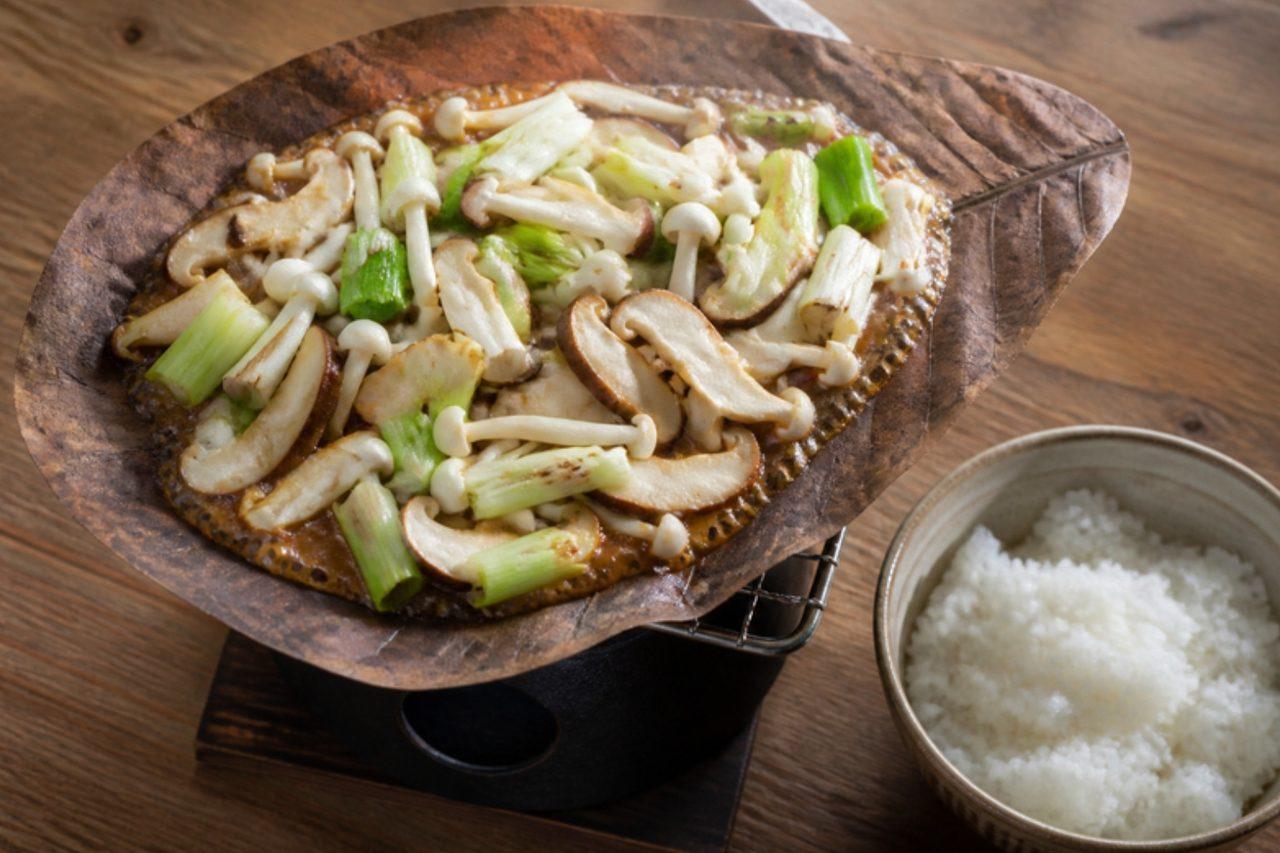
AI-generated image
Hoba miso
Miso grilled on magnolia leaf
朴葉味噌 (hoba miso): sweet miso with leek and mushrooms, grilled on a dried magnolia leaf


In the old mountain town of Takayama, in Gifu's Hida region, inns serve breakfast with a small charcoal brazier on the table and a dried magnolia leaf, hoba, resting on its grill. On it sits a mound of miso mixed with leek and mushrooms. As the leaf warms, the miso bubbles and gives off a smoky, woodsy smell, and you scoop it up with rice. It started as farmhouse winter food, when people toasted frozen pickles on leaves to thaw them. Dried hoba leaves are sold in Japanese shops and online; a sheet of baking paper works too, without the scent. Chef's tip: soak the leaf in water first. A damp leaf scorches slowly and perfumes the miso instead of catching fire.
- Total time
- 23 min
- Difficulty
- easy
- Serves
- 2
Ingredients
For the miso
- 3 tbsp medium or red miso
- 1 tbsp sugar
- 1 tbsp mirinor 1 tbsp water and 1 tsp sugar
- 1 tsp sakeor water
For the topping
- 1 Japanese leek (negi) or spring onionsfinely chopped
- 3 fresh shiitake mushroomsthinly sliced
- 1 ¾ oz shimeji mushroomsseparated
- 2 dried hoba (magnolia) leavesor 2 sheets baking paper
To serve
- 1 ¾ oz Japanese pickles (optional)
Shop this recipe on Amazon
Spices & pantry
Fresh ingredients (3)
Links open Amazon in a new tab. As an Amazon Associate, WhatToEat.Today earns from qualifying purchases.
Method
0/6 doneStep 1: Soak 2 dried hoba (magnolia) leaves in cold water for 10–15 minutes, then wipe dry. It should feel supple, not brittle.
15 minStep 2: Mix 3 tbsp medium or red miso, 1 tbsp sugar, 1 tbsp mirin and 1 tsp sake into a smooth, thick paste.
Step 3: Lay a leaf on a small tabletop grill, a fish grill, or a wire rack set over a gas ring on low heat. Spread half the miso in a circle in the middle and pile half of 1 Japanese leek (negi) or spring onions, 3 fresh shiitake mushrooms and 1 ¾ oz shimeji mushrooms around it. Repeat with the second leaf.
1 minStep 4: Grill over low heat for 6–8 minutes, stirring the miso into the vegetables with chopsticks as it heats. It's ready when the miso bubbles at the edges, smells toasty and the mushrooms have wilted.
7 minStep 5: Common mistake: high heat. The leaf scorches and the miso burns bitter before the mushrooms cook. If the leaf starts to smoke hard, lift it off the heat for a moment.
Step 6: Serve the leaves straight from the grill with bowls of 14 oz cooked Japanese short-grain rice and 1 ¾ oz Japanese pickles, scooping small amounts of miso onto each mouthful.
Nutrition per serving
- Calories
- 330 kcal
- Protein
- 9 g
- Carbs
- 66 g
- Fat
- 2 g
- Fibre
- 4 g
Nutrition values are estimates.
KrazyBadal
Good to know
- How long does hoba miso take?
- About 23 minutes in total: 15 minutes to prepare and 8 minutes to cook.
- How many people does it serve?
- 2 as written. Change the servings above the ingredients and every amount scales to match.
- Is it vegan?
- Yes. It has no meat, fish, dairy or eggs.
- What can I use instead of sugar?
- Caster sugar, same amount.
- What can I use instead of mirin?
- Rice vinegar with ½ tsp sugar per tbsp.
Reviews
No reviews yet. Be the first to cook it.
Rate this recipe
Sign in to rate and review this recipe.
You might also like
Black bean tacos with lime slaw
Proof that a meat-free taco night can be the best one. The beans are mashed with chipotle and cumin so they hold together in the tortilla, and a quick lime slaw adds crunch.
 Mexican


Yaki onigiriGrilled rice balls
Yaki onigiri (焼きおにぎり) are rice balls grilled until they form a crisp, toasty crust, then brushed with soy sauce glaze. They are eaten all over Japan, at izakaya, at barbecues and from the freezer section, as a snack or with miso soup. The inside stays soft and steamy while the outside crackles. Best eaten hot, straight from the pan. Chef's tip: let the shaped rice balls dry for 10 minutes before they go in the pan. A drier surface forms a better crust and won't stick, and the glaze goes on only at the end so it doesn't burn.

Miso soup
Miso soup (味噌汁) is drunk every day in homes all over Japan, at breakfast as well as dinner, beside a bowl of rice. The base is dashi; this vegan version uses kombu and dried shiitake instead of bonito, which gives it a deep, rounded flavour. Silken tofu and wakame seaweed are the classic fillings. It takes ten minutes; just remember not to boil the miso. Chef's tip: add the miso at the very end and never let it boil. Boiling kills the miso's fresh, fermented aroma; Japanese cooks say the soup should only 'smile', with the surface barely trembling.