
AI-generated image
Homemade fresh yuba
Fresh tofu skin
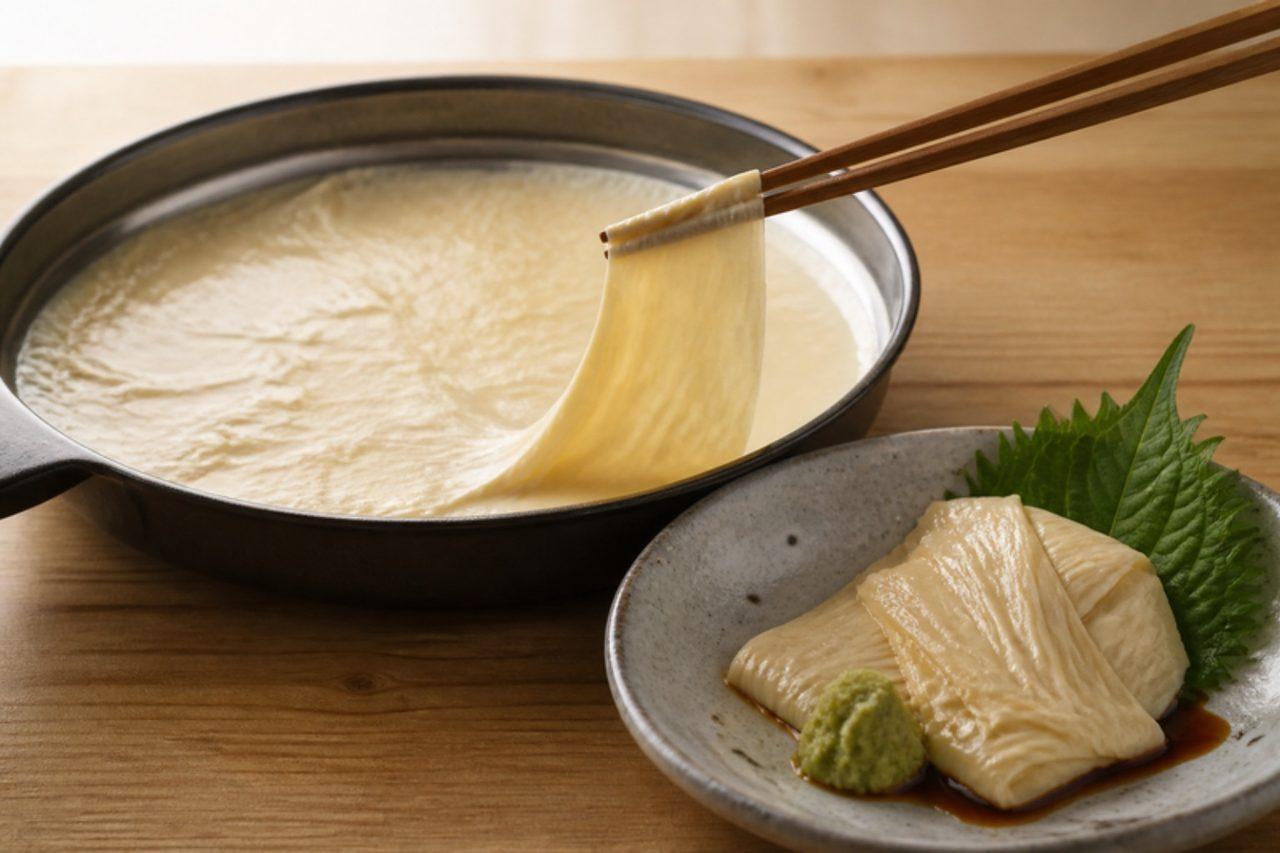
湯葉 (yuba): delicate tofu skins lifted from warm soy milk, eaten fresh with wasabi soy


Yuba is the thin skin that forms on soy milk as it heats, and in Kyoto and the temple town of Nikko it is a delicacy in its own right. Workshops in Kyoto's old streets have made it for centuries for monks' shojin ryori, the Buddhist vegetarian cuisine that relied on it for protein. Fresh yuba is soft, creamy and faintly sweet, and the first sheets of the day, eaten warm with a drop of soy, are prized above all. It needs patience rather than skill: just a wide pan, gentle heat and good soy milk. Serve as a starter with wasabi soy, or roll the sheets and slice them. Chef's tip: use unsweetened soy milk with at least 7% protein (check the label). Thin supermarket drinks won't form a skin.
- Total time
- 45 min
- Difficulty
- medium
- Serves
- 2
Ingredients
- 2 tbsp soy sauce
- 1 tsp wasabi paste
- ⅛ oz fresh ginger (optional)finely grated
- 4 shiso or mitsuba leaves (optional)
Shop this recipe on Amazon
What you'll need
Fresh ingredients (1)
Links open Amazon in a new tab. As an Amazon Associate, WhatToEat.Today earns from qualifying purchases.
Method
0/7 doneStep 1: Pour 4 ¼ cups unsweetened soy milk, at least 7% protein into a wide frying pan or sauté pan, at least 24 cm across, to a depth of about 2 cm. The wider the surface, the bigger the sheets.
Step 2: Set it over low heat and warm to about 176°F: steam rises and the surface trembles, but nothing bubbles. Keep it there. On a gas hob, use a heat diffuser if you have one.
5 minStep 3: After 6–8 minutes a matt, wrinkled skin forms across the top. Run a knife round the edge of the pan to free it.
8 minStep 4: Slide a chopstick or thin skewer under the middle of the skin and lift it straight up so the sheet hangs in two halves. Drape it over a plate or a second chopstick laid across a bowl. A new skin will form in another 6–8 minutes.
25 minStep 5: Common mistake: turning up the heat to speed things up. The milk boils, the skin turns thick and blistered and the bottom scorches. Low and steady gives thin, silky sheets.
Step 6: Keep lifting sheets until the milk becomes thick and creamy and stops forming skins, usually 5–7 sheets. Pour the remaining rich milk into a cup to drink, or use it in a soup.
Step 7: Mix 2 tbsp soy sauce and 1 tsp wasabi paste. Fold the warm yuba onto small plates with 4 shiso or mitsuba leaves and ⅛ oz fresh ginger and eat straight away, dipped in the wasabi soy.
Nutrition per serving
- Calories
- 200 kcal
- Protein
- 18 g
- Carbs
- 10 g
- Fat
- 9 g
- Fibre
- 2 g
Nutrition values are estimates.
KrazyBadal
Good to know
- How long does homemade fresh yuba take?
- About 45 minutes in total: 5 minutes to prepare and 40 minutes to cook.
- How many people does it serve?
- 2 as written. Change the servings above the ingredients and every amount scales to match.
- Is it vegan?
- Yes. It has no meat, fish, dairy or eggs.
- What can I use instead of unsweetened soy milk, at least 7% protein?
- Oat, soy or almond milk, same amount (use unsweetened for savoury dishes).
- What can I use instead of soy sauce?
- Tamari, same amount (gluten free).
Reviews
No reviews yet. Be the first to cook it.
Rate this recipe
Sign in to rate and review this recipe.
You might also like

SakarpadaSweet fried dough diamonds
Sakarpada (shakarpara) are little sweet diamonds of a rich dough made with ghee, milk and sugar, fried until golden and crunchy. They are a Diwali favourite with tea, and the cubes go into bhusu too. They keep for weeks in an air-tight tin.
 Indian

Yaki onigiriGrilled rice balls
Yaki onigiri (焼きおにぎり) are rice balls grilled until they form a crisp, toasty crust, then brushed with soy sauce glaze. They are eaten all over Japan, at izakaya, at barbecues and from the freezer section, as a snack or with miso soup. The inside stays soft and steamy while the outside crackles. Best eaten hot, straight from the pan. Chef's tip: let the shaped rice balls dry for 10 minutes before they go in the pan. A drier surface forms a better crust and won't stick, and the glaze goes on only at the end so it doesn't burn.


Miso soup
Miso soup (味噌汁) is drunk every day in homes all over Japan, at breakfast as well as dinner, beside a bowl of rice. The base is dashi; this vegan version uses kombu and dried shiitake instead of bonito, which gives it a deep, rounded flavour. Silken tofu and wakame seaweed are the classic fillings. It takes ten minutes; just remember not to boil the miso. Chef's tip: add the miso at the very end and never let it boil. Boiling kills the miso's fresh, fermented aroma; Japanese cooks say the soup should only 'smile', with the surface barely trembling.