
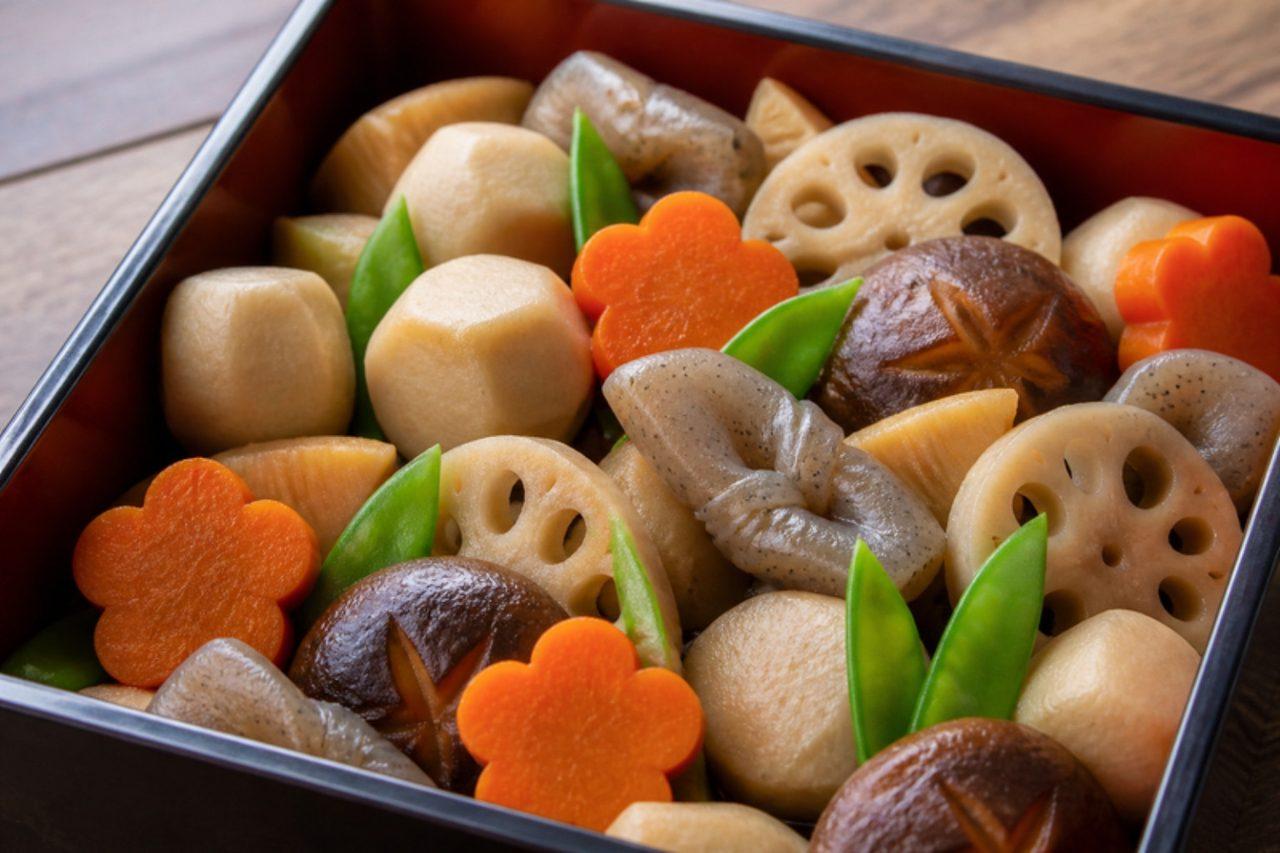
AI-generated image
Nishime (simmered root vegetables)
Taro, lotus root, carrot, konnyaku and shiitake simmered one by one in kombu-shiitake dashi


Nishime is the quiet backbone of the Shōgatsu osechi box all over Japan: root vegetables that grow deep and hold together, cooked so the family stays rooted and united through the year. Unlike chikuzenni, nothing is fried first and there is no chicken here; each vegetable is simmered on its own, very gently, until the seasoned dashi has soaked right in and almost vanished from the pan, so the colours stay clean and the flavours distinct. This version is vegan, with a dashi of kombu and dried shiitake, and the sweetness comes from sugar and mirin, a sweet rice wine (for no alcohol, use 1 tbsp water plus 1 tsp sugar for every tbsp of mirin). Serve it at room temperature in the osechi box, beside rice and pickles, or with zōni. Chef's tip: cook the pale vegetables before the dark ones, so the shiitake never stains the taro.
- Total time
- 75 min
- Difficulty
- medium
- Serves
- 6
Ingredients
For the kombu-shiitake dashi
- ⅓ oz kombu (dried kelp)a 10 cm square, wiped with a damp cloth
- 6 dried shiitake mushroomsmedium caps
- 3 ¾ cups cold water
For the vegetables
- 14 oz small taro (satoimo)about 8, peeled and halved if large
- 7 oz lotus rootpeeled, sliced 1 cm thick, kept in water with a dash of vinegar
- 1 tsp rice vinegarfor the lotus soaking water
- 1 carrotlarge, cut into 1.5 cm rounds (flower-cut if you like)
- 9 oz konnyaku block1 block
- 1 tsp salt
- 8 snow peas (optional)strings removed
For the seasoning
- 3 tbsp sugar
- 3 tbsp mirinor 3 tbsp water + 1 tbsp sugar for no alcohol
- 3 tbsp light soy sauce (usukuchi)
Shop this recipe on Amazon
What you'll need
Spices & pantry
Links open Amazon in a new tab. As an Amazon Associate, WhatToEat.Today earns from qualifying purchases.
Method
0/10 doneStep 1: Soak ⅓ oz kombu (dried kelp) and 6 dried shiitake mushrooms in 3 ¾ cups cold water for at least 30 minutes (or overnight in the fridge), until the mushrooms are soft right through to the stem.
30 minStep 2: Squeeze the shiitake back over the bowl, cut off the woody stems and score a star on each cap. Lift out the kombu, cut it into strips and tie each strip into a knot; keep all the soaking liquid as your dashi.
5 minStep 3: Tear 9 oz konnyaku block into bite-sized pieces with a spoon (rough edges hold the sauce), or slice and twist it into rope knots. Rub with ½ tsp salt, then boil for 3 minutes and drain to remove its smell.
6 minStep 4: Rub 14 oz small taro (satoimo) with ½ tsp salt, rinse off the slime, then parboil in plain water over medium heat for 5 minutes and rinse again. Drain 7 oz lotus root from its water with 1 tsp rice vinegar.
8 minStep 5: Stir 3 tbsp sugar, 3 tbsp mirin and 3 tbsp light soy sauce (usukuchi) into the dashi. Pour about a third into a small pan, add the taro and bring to a bare simmer over low heat.
3 minStep 6: Cover with a drop lid (otoshibuta) or a circle of baking paper and simmer the taro very gently for 15 minutes, until a skewer slides in easily. Common mistake: letting it bubble hard; taro crumbles and the liquid turns cloudy, so keep only a few lazy bubbles.
15 minStep 7: Lift out the taro. Add the lotus root and 1 carrot to the same liquid with another third of the dashi and simmer, covered with the drop lid, for 12 minutes, until the carrot is tender but still bright orange and the lotus is crisp-tender.
12 minStep 8: Lift those out too. Add the konnyaku, kombu knots, shiitake and the rest of the dashi and simmer uncovered over medium-low heat for 12–15 minutes, until the liquid has reduced to a few spoonfuls of glossy glaze and the shiitake are dark and shiny.
14 minStep 9: Return all the vegetables to the pan, spoon the glaze over and leave to cool in it; they keep absorbing flavour as they cool. Meanwhile blanch 8 snow peas for 1 minute in salted water until bright green and drain.
5 minStep 10: Arrange the vegetables in separate groups in a lacquered box or on a platter, scatter with the snow peas and serve at room temperature. It keeps 3 days in the fridge. For the classic non-vegan version, simmer everything in bonito (katsuobushi) dashi instead of the kombu-shiitake dashi.
2 min
Nutrition per serving
- Calories
- 120 kcal
- Protein
- 3 g
- Carbs
- 26 g
- Fat
- 1 g
- Fibre
- 6 g
Nutrition values are estimates.
KrazyBadal
Good to know
- How long does nishime (simmered root vegetables) take?
- About 75 minutes in total: 25 minutes to prepare and 50 minutes to cook.
- How many people does it serve?
- 6 as written. Change the servings above the ingredients and every amount scales to match.
- Is it vegan?
- Yes. It has no meat, fish, dairy or eggs.
- Can I make it ahead?
- Yes. It keeps well, so you can cook it earlier in the day or the day before and reheat it.
- What can I use instead of dried shiitake mushrooms?
- Aubergine, diced, same weight.
- What can I use instead of rice vinegar?
- Cider vinegar with a pinch of sugar, same amount.
Reviews
No reviews yet. Be the first to cook it.
Rate this recipe
Sign in to rate and review this recipe.
You might also like

Black bean tacos with lime slaw
Proof that a meat-free taco night can be the best one. The beans are mashed with chipotle and cumin so they hold together in the tortilla, and a quick lime slaw adds crunch.
 Mexican


Yaki onigiriGrilled rice balls
Yaki onigiri (焼きおにぎり) are rice balls grilled until they form a crisp, toasty crust, then brushed with soy sauce glaze. They are eaten all over Japan, at izakaya, at barbecues and from the freezer section, as a snack or with miso soup. The inside stays soft and steamy while the outside crackles. Best eaten hot, straight from the pan. Chef's tip: let the shaped rice balls dry for 10 minutes before they go in the pan. A drier surface forms a better crust and won't stick, and the glaze goes on only at the end so it doesn't burn.

Miso soup
Miso soup (味噌汁) is drunk every day in homes all over Japan, at breakfast as well as dinner, beside a bowl of rice. The base is dashi; this vegan version uses kombu and dried shiitake instead of bonito, which gives it a deep, rounded flavour. Silken tofu and wakame seaweed are the classic fillings. It takes ten minutes; just remember not to boil the miso. Chef's tip: add the miso at the very end and never let it boil. Boiling kills the miso's fresh, fermented aroma; Japanese cooks say the soup should only 'smile', with the surface barely trembling.