
AI-generated image
Negiyaki
Spring onion pancake
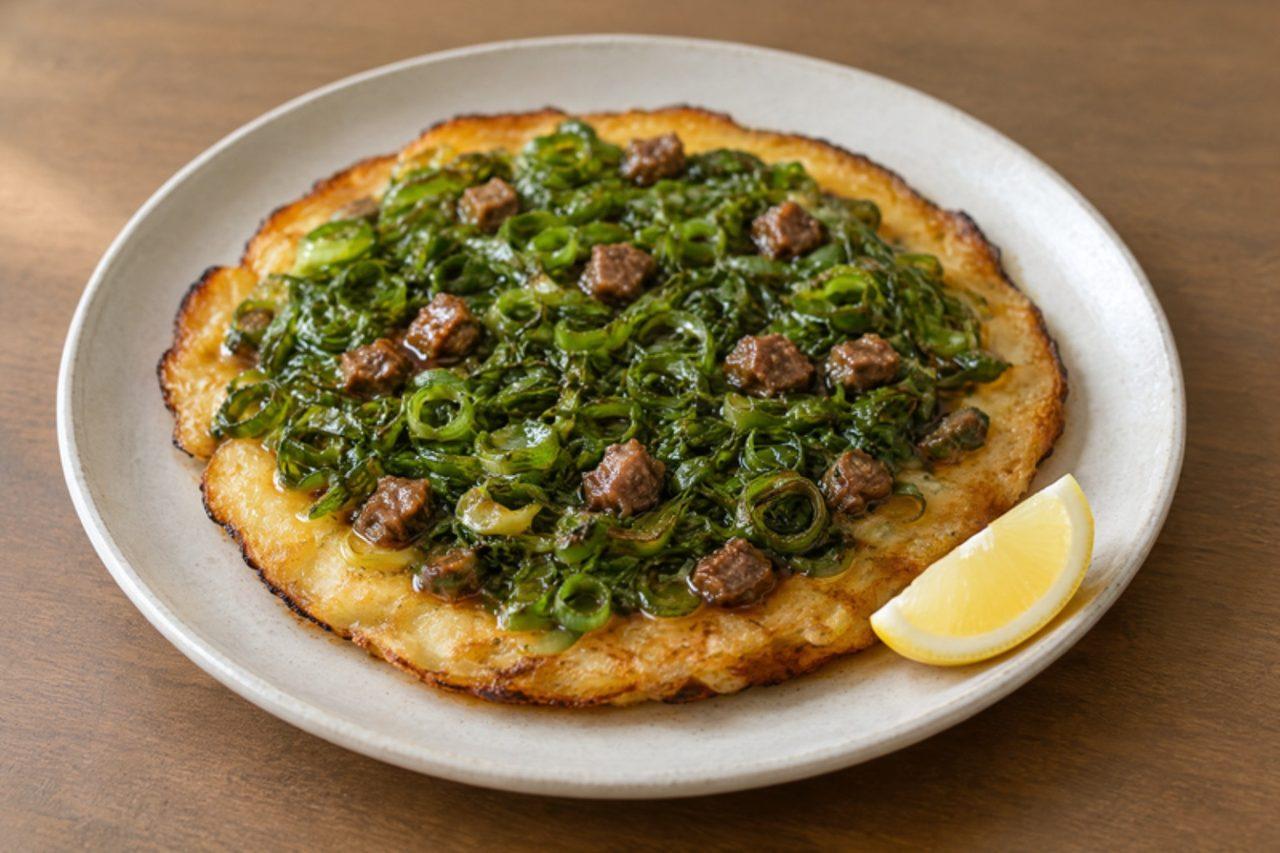
ねぎ焼き: Osaka's thin spring-onion pancake with beef tendon and konnyaku, finished with soy sauce and lemon
 Japanese
Negiyaki began in the late 1960s at a small teppan counter in Jūsō, the station district just north of the Yodo River, as a cheap staff meal of spring onion folded into thin batter. Office workers still eat it there and around Umeda in the evening, cut into wedges and scraped straight off the hot plate. There is no cabbage and no thick brown sauce: just a pile of green onion held together by a light batter, chewy cubes of slow-cooked beef tendon and konnyaku, a brush of soy sauce and a squeeze of lemon. Chef's tip: dry the sliced onion well on kitchen paper; wet onion stops the batter from clinging.
- Total time
- 30 min
- Difficulty
- medium
- Serves
- 2
Ingredients
For the batter
- 3 ½ oz plain flour
- ¾ cup dashicold, kombu and bonito
- 1 egg
For the filling
- 5 ½ oz spring onionsgreen parts, sliced very thinly
- 4 oz cooked beef tendon (gyū-suji)ready-cooked from an Asian butcher, chopped small; or 100 g thinly sliced raw beef
- 2 ⅞ oz konnyakucut into small cubes
- 2 tbsp tenkasu (tempura crumbs) (optional)
To cook and finish
- 2 tbsp vegetable oil
- 2 eggs
- 2 tbsp soy sauce
- 1 lemoncut into wedges
Shop this recipe on Amazon
Spices & pantry
Fresh ingredients (5)
Links open Amazon in a new tab. As an Amazon Associate, WhatToEat.Today earns from qualifying purchases.
Method
0/8 doneStep 1: Whisk 3 ½ oz plain flour with ¾ cup dashi and 1 egg until smooth and runny like single cream. Rest it in the fridge for 10 minutes while you prepare the filling.
10 minStep 2: Boil 2 ⅞ oz konnyaku in a small pan of water for 2 minutes to take away its smell, then drain and pat dry.
2 minStep 3: Heat a large frying pan or griddle over a medium heat and add 1 tbsp vegetable oil. Pour in a quarter of the batter and spread it into a thin 20 cm round.
1 minStep 4: Pile half of 5 ½ oz spring onions over the batter, then scatter over half of 4 oz cooked beef tendon (gyū-suji), half of the konnyaku and a little 2 tbsp tenkasu (tempura crumbs) if using. If you are using raw sliced beef, lay it directly on the batter so it cooks through. Drizzle another quarter of the batter over the top to bind it.
2 minStep 5: Cook for 4 minutes, until the underside is golden and set, then flip with two wide spatulas and press lightly. Common mistake: piling the onion more than 2 cm high; the middle stays raw and the pancake falls apart when you turn it.
5 minStep 6: Crack one of 1 eggs onto the hot plate beside the pancake, break the yolk and spread it to the size of the pancake. Flip the pancake onto the egg and cook for 2–3 minutes, until the egg is fully set and the onion has wilted and turned sweet. Any raw beef should show no pink.
3 minStep 7: Slide onto a board, brush with half of 2 tbsp soy sauce and squeeze over 1 lemon. Make the second pancake with the remaining 1 tbsp vegetable oil, batter and filling, and serve cut into wedges.
8 minStep 8: Vegetarian version: use kombu-only dashi, leave out the beef tendon and add extra konnyaku or diced fried tofu instead.
Nutrition per serving
- Calories
- 430 kcal
- Protein
- 22 g
- Carbs
- 48 g
- Fat
- 16 g
- Fibre
- 4 g
Nutrition values are estimates.
KrazyBadal
Good to know
- How long does negiyaki take?
- About 30 minutes in total: 15 minutes to prepare and 15 minutes to cook.
- How many people does it serve?
- 2 as written. Change the servings above the ingredients and every amount scales to match.
- What can I use instead of plain flour?
- Self-raising flour, same amount (then leave out the baking powder).
- What can I use instead of egg?
- 1 tbsp ground flaxseed + 3 tbsp water per egg, left for 5 minutes (baking only; vegan).
Reviews
No reviews yet. Be the first to cook it.
Rate this recipe
Sign in to rate and review this recipe.
You might also like

SakarpadaSweet fried dough diamonds
Sakarpada (shakarpara) are little sweet diamonds of a rich dough made with ghee, milk and sugar, fried until golden and crunchy. They are a Diwali favourite with tea, and the cubes go into bhusu too. They keep for weeks in an air-tight tin.
 Indian

Yaki onigiriGrilled rice balls
Yaki onigiri (焼きおにぎり) are rice balls grilled until they form a crisp, toasty crust, then brushed with soy sauce glaze. They are eaten all over Japan, at izakaya, at barbecues and from the freezer section, as a snack or with miso soup. The inside stays soft and steamy while the outside crackles. Best eaten hot, straight from the pan. Chef's tip: let the shaped rice balls dry for 10 minutes before they go in the pan. A drier surface forms a better crust and won't stick, and the glaze goes on only at the end so it doesn't burn.


Miso soup
Miso soup (味噌汁) is drunk every day in homes all over Japan, at breakfast as well as dinner, beside a bowl of rice. The base is dashi; this vegan version uses kombu and dried shiitake instead of bonito, which gives it a deep, rounded flavour. Silken tofu and wakame seaweed are the classic fillings. It takes ten minutes; just remember not to boil the miso. Chef's tip: add the miso at the very end and never let it boil. Boiling kills the miso's fresh, fermented aroma; Japanese cooks say the soup should only 'smile', with the surface barely trembling.