
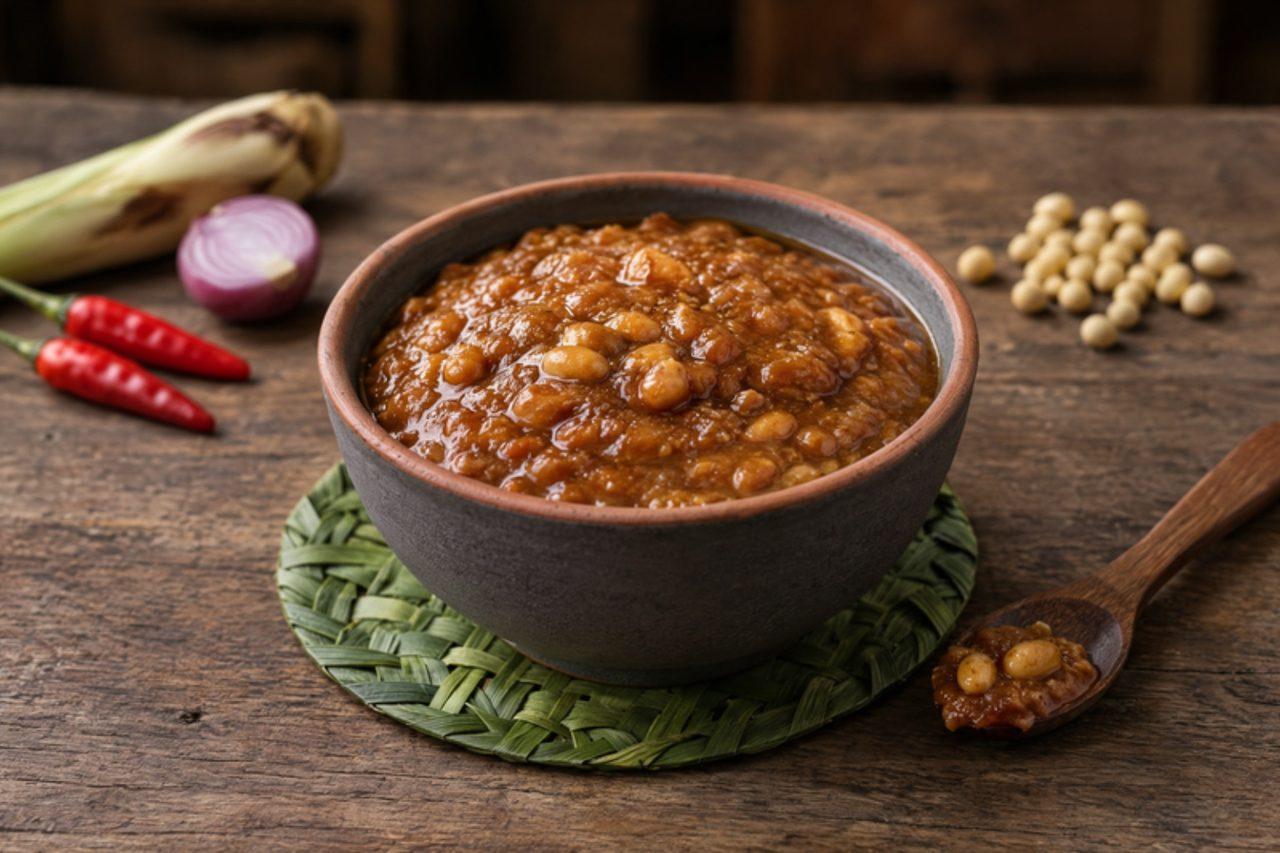
AI-generated image
Tauco
Tauco: soybeans grown with koji, ripened in salt brine and cooked down with palm sugar, the Cianjur way



Cianjur, in the hills of West Java, has made tauco since the late 1800s, when Chinese Peranakan families brought the technique, and the town's sweet, thick version is still sold in squat jars to every traveller on the Puncak road. Sundanese and Peranakan cooks fry it with garlic and chilli for tumis tauco with tofu, long beans or kangkung, and add a spoonful to fish stews. The beans are first grown with a mould culture, then ripened in strong salt brine in the sun for weeks, and finally simmered with palm sugar. The result is salty-sweet and deeply savoury, like a soft, chunky miso with caramel notes, half-whole beans in a glossy brown sauce. Common mistake: fermenting the moulded beans in a sealed tub; they sweat, turn slimy and smell of ammonia. They need air and 28–32 °C. Readiness cues: after the mould stage, the beans are knitted with white fluff turning pale yellow-green; after brining, they are brown and smell like soy sauce; after cooking, the sauce is thick and glossy. Chef's tip: a pandan leaf and a slice of galangal in the final simmer give the Cianjur fragrance.
- Total time
- 170 min
- Difficulty
- hard
- Serves
- 24
Ingredients
For the moulded beans
- 1 ⅛ lb dried yellow soybeans
- 2 ⅛ oz rice flour
- oz koji spores (Aspergillus oryzae, for miso or soy sauce)from fermentation suppliers; or 1 tsp tempeh starter
For the brine
- 1 litre water, boiled and cooled
- 7 oz coarse salta brine of about 17% salt
To finish
- 7 oz palm sugar (gula aren)grated; or dark muscovado
- 1 pandan leaf (optional)tied in a knot
- ¾ in galangal (optional)sliced
Shop this recipe on Amazon
Links open Amazon in a new tab. As an Amazon Associate, WhatToEat.Today earns from qualifying purchases.
Method
0/12 doneStep 1: Soak 1 ⅛ lb dried yellow soybeans in plenty of cold water for 12 hours, until plump.
Step 2: Rub the beans between your hands in the water to slip off the skins, then swirl and pour off the floating skins; repeat until most are gone.
20 minStep 3: Boil the beans in fresh water for about 60 minutes, until soft enough to crush between finger and thumb but still holding their shape.
60 minStep 4: Drain well and spread on a clean tray. Pat with a clean cloth and leave until just warm (about 95°F) and only slightly moist on the surface.
15 minStep 5: Dry-roast 2 ⅛ oz rice flour in a pan over a low heat for 5–8 minutes, stirring, until ivory and toasty-smelling. Cool, then mix with oz koji spores (Aspergillus oryzae, for miso or soy sauce) and dust over the beans, tossing until each is coated.
8 minStep 6: Spread the beans 2–3 cm deep on a tray lined with a clean cloth or banana leaves, cover with a cloth (not plastic) and keep at 28–90°F, for example in an oven with only the light on, for 2–3 days. After about 24 hours they warm up by themselves; break them up and spread them thinner so they do not overheat.
Step 7: Check twice a day. Normal: a white fluffy mycelium that knits the beans together, later turning pale yellow-green as the koji forms spores, and a sweet, chestnut-like smell. Discard the batch if you see black, pink, red or orange patches, wet slime, or it smells strongly of ammonia or rot.
Step 8: Dry the moulded beans in the sun or in a 113°F oven for 3–4 hours, until the surface feels dry. Do not wash off the spores.
Step 9: Sterilise a 2-litre glass or ceramic jar and lid: wash in hot soapy water, rinse, then dry in a 250°F oven for 10 minutes (or in strong sun for a few hours). Cool completely; the jar, bowls, spoons and your hands must be bone dry.
Step 10: Dissolve 7 oz coarse salt in 1 litre water, boiled and cooled. Add the beans, stir with a clean dry spoon and cover with a cloth and loose lid. Leave in a warm, sunny spot for 3–4 weeks, stirring every day. Normal: the brine turns brown, a few bubbles rise and it smells like soy sauce; a flat white film can be skimmed. Fuzzy coloured mould or a putrid smell mean discard.
Step 11: Tip the beans and brine into a wide pan with 7 oz palm sugar (gula aren), plus 1 pandan leaf and ¾ in galangal if using. Simmer over a low heat, stirring often, for 30–40 minutes, until the sauce is thick, glossy and some beans have broken down.
35 minStep 12: Remove the pandan and galangal and cool. Spoon into clean sterilised jars and keep in the fridge for up to 6 months, always with a clean dry spoon. Discard if mould, fizzing or an off smell appears.
Nutrition per serving
- Calories
- 85 kcal
- Protein
- 6 g
- Carbs
- 11 g
- Fat
- 3 g
- Fibre
- 2 g
Nutrition values are estimates.
KrazyBadal
Good to know
- How long does tauco take?
- About 170 minutes in total: 60 minutes to prepare and 110 minutes to cook.
- How many people does it serve?
- 24 as written. Change the servings above the ingredients and every amount scales to match.
- Is it vegan?
- Yes. It has no meat, fish, dairy or eggs.
- Is it gluten free?
- Yes, as written. Check the labels on stock, sauces and spice mixes, which sometimes contain gluten.
- Can I make it ahead?
- Yes. It keeps well, so you can cook it earlier in the day or the day before and reheat it.
- What can I use instead of palm sugar (gula aren)?
- Caster sugar, same amount.
Reviews
No reviews yet. Be the first to cook it.
Rate this recipe
Sign in to rate and review this recipe.
You might also like

Sayur lodeh
Sayur lodeh is everyday cooking in Central Java, made in big pots in Solo and Semarang kitchens and ladled over rice, with lontong rice cakes at Lebaran, or alongside opor and sambal goreng on festive tables. It's soupy rather than thick: a fragrant broth of coconut milk, galangal, lemongrass and lime leaf that carries chunks of aubergine, long beans, chayote and sweetcorn, plus tempeh and tofu to make it a meal. The flavour is mellow and slightly sweet, so the heat comes from sambal on the side. Chef's tip: keep the pot at a gentle simmer once the coconut milk goes in and stir now and then — a rolling boil splits the coconut milk into oily curds.



Vegetable brown stock
A hearty stock that's simmered for 2 hours, then blended and strained, so the potato gives it body. Its deeper flavour suits thick soups, gravies and stews. Freeze it in portions so it's ready when you need it.

Soto Banjar
Along the rivers of Banjarmasin in South Kalimantan, breakfast often means soto Banjar eaten at a wooden riverside warung, sometimes after a dawn trip to the floating market. Unlike the turmeric sotos of Java, this broth is pale and clear, perfumed with the sweet spices that traders brought up the river centuries ago: cinnamon, cloves, star anise, cardamom and nutmeg. Shredded chicken, glass noodles, carrot and a boiled egg go into the bowl with rice cakes, and lime and a little chilli sharpen it at the table. Chef's tip: toast the whole spices in the pan for a minute before the paste goes in; it brings out their sweetness without the dusty edge of ground spice.